Review
. 2016 Nov:108:91-110.
doi: 10.1016/j.biomaterials.2016.08.054. Epub 2016 Sep 2.

Tissue engineering-based therapeutic strategies for vocal fold repair and regeneration

Affiliations
Review

Tissue engineering-based therapeutic strategies for vocal fold repair and regeneration

Linqing Li et al. Biomaterials. 2016 Nov.

Abstract

Vocal folds are soft laryngeal connective tissues with distinct layered structures and complex multicomponent matrix compositions that endow phonatory and respiratory functions. This delicate tissue is easily damaged by various environmental factors and pathological conditions, altering vocal biomechanics and causing debilitating vocal disorders that detrimentally affect the daily lives of suffering individuals. Modern techniques and advanced knowledge of regenerative medicine have led to a deeper understanding of the microstructure, microphysiology, and micropathophysiology of vocal fold tissues. State-of-the-art materials ranging from extracecullar-matrix (ECM)-derived biomaterials to synthetic polymer scaffolds have been proposed for the prevention and treatment of voice disorders including vocal fold scarring and fibrosis. This review intends to provide a thorough overview of current achievements in the field of vocal fold tissue engineering, including the fabrication of injectable biomaterials to mimic in vitro cell microenvironments, novel designs of bioreactors that capture in vivo tissue biomechanics, and establishment of various animal models to characterize the in vivo biocompatibility of these materials. The combination of polymeric scaffolds, cell transplantation, biomechanical stimulation, and delivery of antifibrotic growth factors will lead to successful restoration of functional vocal folds and improved vocal recovery in animal models, facilitating the application of these materials and related methodologies in clinical practice.

Keywords: Animal model; Bioreactor; Collagen; Elastin; Growth factor; Human mesenchymal stem cells; Hyaluronic acid; Lamina propria; Regenerative medicine; Resilin; Tissue engineering; VF fibroblasts; Vocal folds.


Figures

Figure 1
Figure 1. Vocal fold structure
(A) Schematic of the micro-structure of the vocal fold;[27] (B) Coronal histological images of the mid-membranous normal rat vocal fold stained with hematoxylin and eosin (H&E). Superficial to deep, the layers of the vocal fold include the stratified squamous epithelium (E), the lamina propria (LP) and thyroarytenoid muscle (M); (C) Coronal histological image of the mid-membranous scarred rat vocal fold three days following a scarification injury; the specimen demonstrates the early inflammatory response associated with injury. There is some evidence of granulation, but significant fibrosis has not yet occurred. The epithelium is thick and irregular and the basal cells are dis-organized. The lamina propria is more cellular than found in normal tissue, and contains increased fibroblasts (F) and inflammatory cells including neutrophils (N) and macrophages (M).The extracellular matrix (ECM) also appears to be altered as compared to normal tissues. A few small, thin walled vessels are present which represents angiogenesis (A). [10] Reprinted with permission from Graupp, M.; Bachna-Rotter, S.; Gerstenberger, C.; et al. Eur. Arch. Otorhinolaryngol. 2015, 1. Copyright (2015) Springer and Bartlett, R. S.; Thibeault, S. L.; Prestwich, G. D., Biomed. Mater. 2012, 7, 24103. Copyright (2012) IOP Publishing.
Figure 1
Figure 1. Vocal fold structure
(A) Schematic of the micro-structure of the vocal fold;[27] (B) Coronal histological images of the mid-membranous normal rat vocal fold stained with hematoxylin and eosin (H&E). Superficial to deep, the layers of the vocal fold include the stratified squamous epithelium (E), the lamina propria (LP) and thyroarytenoid muscle (M); (C) Coronal histological image of the mid-membranous scarred rat vocal fold three days following a scarification injury; the specimen demonstrates the early inflammatory response associated with injury. There is some evidence of granulation, but significant fibrosis has not yet occurred. The epithelium is thick and irregular and the basal cells are dis-organized. The lamina propria is more cellular than found in normal tissue, and contains increased fibroblasts (F) and inflammatory cells including neutrophils (N) and macrophages (M).The extracellular matrix (ECM) also appears to be altered as compared to normal tissues. A few small, thin walled vessels are present which represents angiogenesis (A). [10] Reprinted with permission from Graupp, M.; Bachna-Rotter, S.; Gerstenberger, C.; et al. Eur. Arch. Otorhinolaryngol. 2015, 1. Copyright (2015) Springer and Bartlett, R. S.; Thibeault, S. L.; Prestwich, G. D., Biomed. Mater. 2012, 7, 24103. Copyright (2012) IOP Publishing.
Figure 2
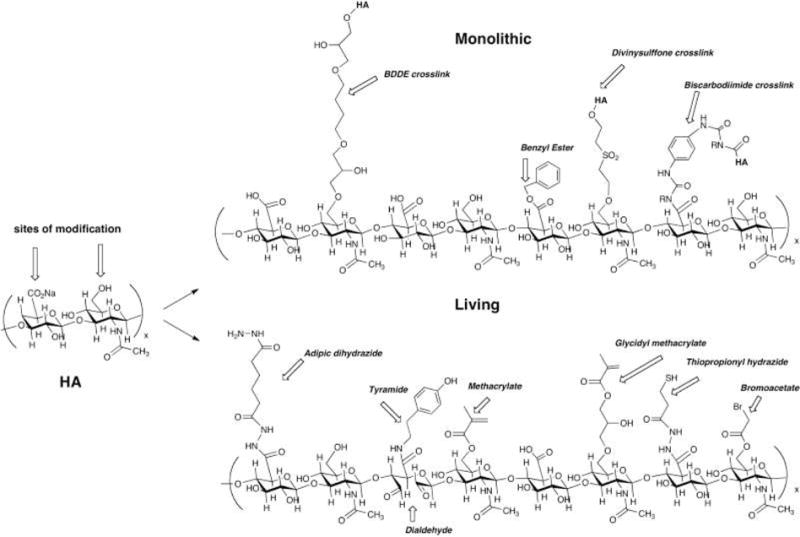
Figure 2
Sample chemical structures of monolithic (top) and living (bottom) chemical modifications of hyaluronic acid. A hypothetical composite structure illustrates selected primary modifications: adipic dihydrazide for use in further crosslinking via acrylamide or hydrazone linkages; butane-1,4-diol diglycidyl ether, a prototypical monolithic crosslinker for HA; tyramide for peroxidase crosslinking; dialdehyde obtained by periodate oxidation; methacrylate on primary 6-hydroxyl group; benzyl ester; glycidyl methacrylate; thiopropionyl hydrazide from DTPH modification; bromoacetate; an unmodified disaccharide unit for comparison.[66] Reprinted with permission from Burdick, J. A. and Prestwich, G. D. Adv. Mater. (2011) 23, H41.Copyright (2011) Wiley.
Figure 3
Figure 3
A thioether crosslinked semi-synthetic ECM formed by crosslinking thiol-modified carboxymethyl HA (CMHA-S) with thiol-modified gelatin using the bifunctional crosslinker, PEGDA.[66] Reprinted with permission from Burdick, J. A. and Prestwich, G. D. Adv. Mater. (2011) 23, H41. Copyright (2011) Wiley.
Figure 4
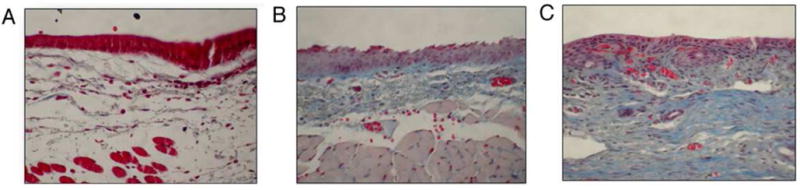
Figure 4. Representative coronal sections 40× of the vocal fold treated with a trichrome stain
Statistical significance established by a blinded pathologist qualitatively categorizing the fibrosis level for each section. (A) Carbylan-SX treated vocal folds showing mild fibrosis. Visual inspection indicates a significant decrease in fibrosis between the Carbylan-SX treatment group and saline-treated controls (p=0.0158); (B) HA-DTPH−PEGDA treated vocal folds showing moderate fibrosis. No statistical difference between fibrosis levels observed in saline-treated controls (p=0.1645); (C) Saline treated controls showing moderate fibrosis.[65] Reprinted with permission from Gaston, J. and Thibeault, S. L. Biomatter (2013) 3, e23799. Copyright (2013) Taylor & Francis Group.
Figure 5
Figure 5. Morphologic appearance and fibroblast marker (hPH) distribution of immortalized hVFFs in various culture environments
After 72 h of in vitro culture, fluorescent images of hVFFs on polystyrene (A), on a thin layer of Carbylan-GSX (2-D condition) or in Carbylan-GSX (3-D condition) were captured by an inverted confocal microscope equipped with dual excitation lasers for green and blue fluorescence.[85] Reprint with permission from Chen, X. and Thibeault, S. L. Acta Biomater. 2010, 6, 2940. Copyright (2010) Elsevier.
Figure 6
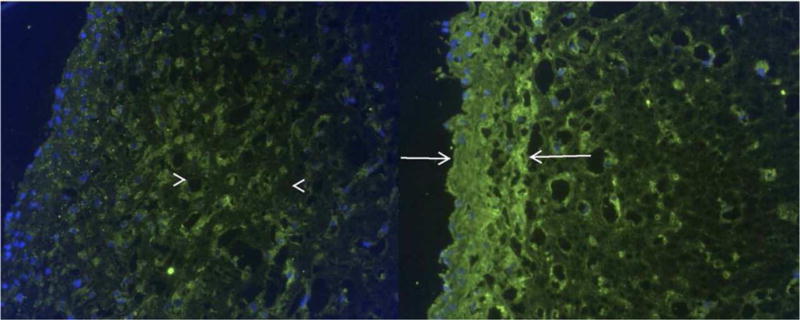
Figure 6. Immunohistochemical labeling for type I collagen in fibrin-ASC tissue constructs
Bilayered construct on the left shows green collagen labeling in the middle segment (arrowheads). Homogeneous construct on the right shows intense labeling near the surface (arrows). In both, nuclei are labeled blue. (Original magnification: 20×)[97] Reprint with permission from Long, J. L.; Neubauer, J.; Zhang, Z.; et al. Otolaryngol.- Head Neck Surg. 2010, 142, 438. Copyright (2010) SAGE Publishing.
Figure 7
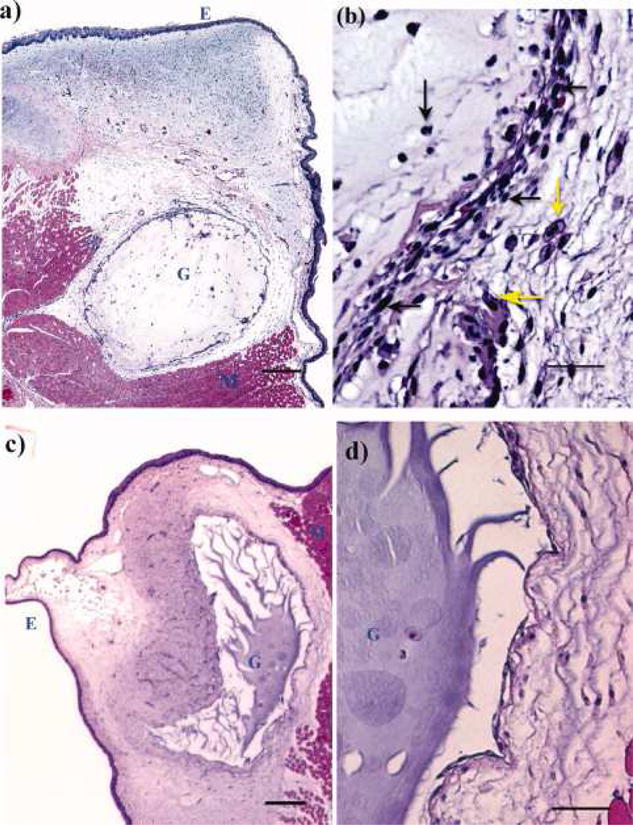
Figure 7. H&E stained tissue slides of HA-Dextran crosslinked hydrogel implanted in the ferret vocal fold at week 3
Regions of epithelium, injected gel and muscle tissue are indicated by letters E, G, and M, respectively. (a) HA-dex0.75 in the host tissue (scale bar: 200μm); (b), the interface of the host tissue and HA-dex0.75 gel (scale bar: 50μm); (c), HA-dex1 in the host tissue (scale bar: 200μm); (d) the interface of the host tissue and HA-dex1 gel (scale bar: 50μm). Cell types were visually identified in b and pointed by arrows (yellow horizontal arrow: macrophage; yellow vertical arrow: foam cell; black vertical arrow: neutrophil; black horizontal arrows: fibroblasts).[113] Reprint with permission from Luo, Y.; Kobler, J. B.; Heaton, J. T.; et al. J. Biomed. Mater. Res. B. Appl. Biomater. 2010, 93, 386. Copyright (2010) Wiley.
Figure 8
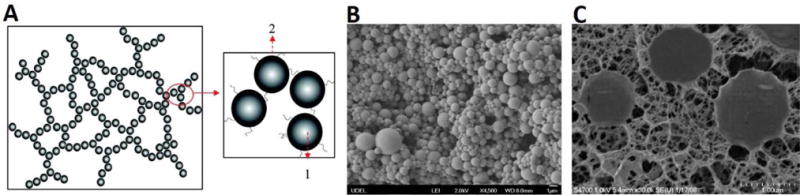
Figure 8. Schematic representation of doubly cross-linked networks (DXNs)
(A) HA-based doubly crosslinked networks with (1) intra-particle cross-linking between DVS and HA and (2) inter-particle cross-linking between oxHGPs and HAADH; (B) Scanning electron micrograph of HA HGPs; (C) CryoSEM images of doubly cross-linked networks.[122] Reprint with permission from Jha, A. K.; Hule, R. A.; Jiao, T.; et al. Macromolecules 2009, 42, 537. Copyright (2009) American Chemical Society.
Figure 9
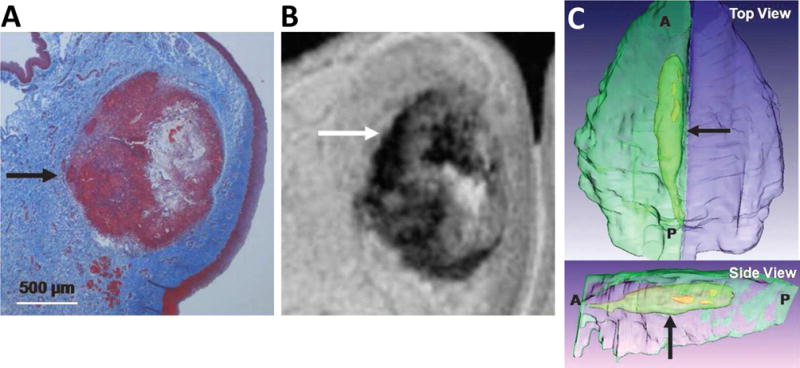
Figure 9
Representative example of histology–magnetic resonance imaging matching (A: histology and B: MRI) that was used for 3-dimensional reconstruction of vocal fold with Amira software (C). Arrows show location of residual PEG30 and cellular infiltrate. A: anterior; P: posterior.[132] Reprint with permission from Karajanagi, S. S.; Lopez-Guerra, G.; Park, H.; et al. Ann. Otol. Rhinol. Laryngol. 2011, 120, 175. Copyright (2011) SAGE Publications.
Figure 10
Figure 10
Schematic of approaches for independently tailoring mechanical and biological properties of RLPs with three-repeats of stress-strain cyclic tensile testing mechanical properties at 20wt% with different material compositions and 2D hMSCs attachment biological responses with a 20wt% RLP-RGD hydrogel.[194] Reprint with permission from Li, L.; Mahara, A.; Tong, Z.; et al. Adv. Health. Mater. 2016, 5, 266. Copyright (2016) Wiley.
Figure 11
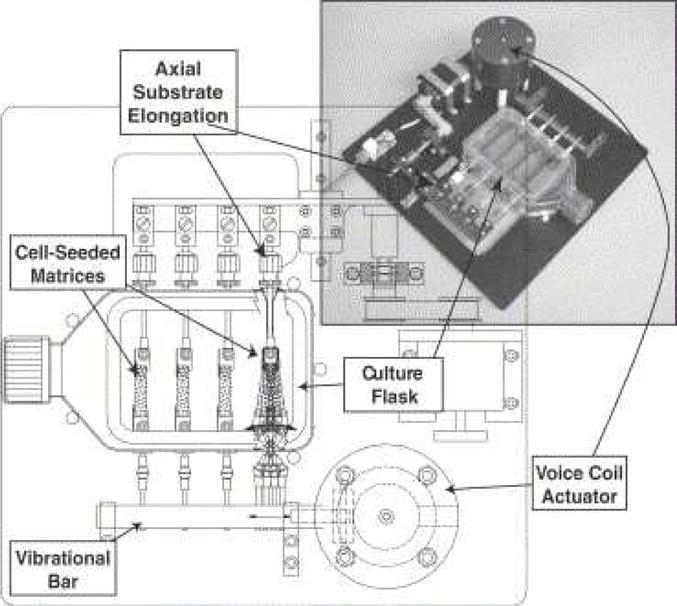
Figure 11
Schematic diagram and photograph of the Hitchcock bioreactor (named after designer), showing T-flask, substrate, and voice coil actuator.[203] Reprint with permission from Titze, I. R.; Hitchcock, R. W.; Broadhead, K.; et al. J Biomech. 2004, 37, 1521. Copyright (2004) Elsevier.
Figure 12
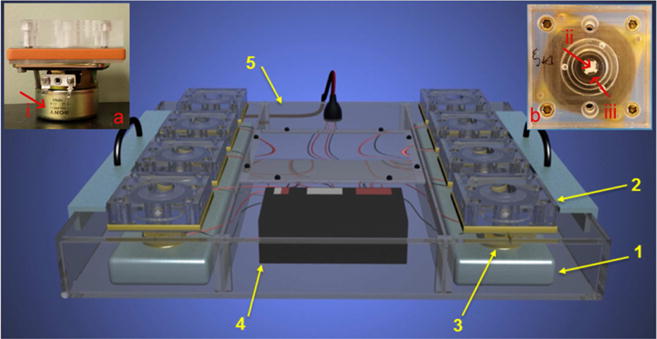
Figure 12. A custom-designed vocal fold bioreactor
(1): stationary metal bar; (2): vibration module; (3): speaker; (4): speaker selector; (5): acrylic anti-humidity chamber. Inserts: a side (a) and a top (b) view of an individual vibration module, (i): speaker; (ii): PCL mat (white); (iii): silicone elastomer (transparent) that serves the bottom of the chamber.[206] Reprint with permission from Tong, Z.; Zerdoum, A. B.; Duncan, R. L.; et al. Tissue Eng. Part A. 2014, 20, 1922. Copyright (2014) Mary Ann Liebert, Inc.

References

    1. Jiang J, Lin E, Hanson DG. Vocal fold physiology. Otolaryngol Clin North Am. 2000;33:699–718. - PubMed
    1. Gray SD, Alipour F, Titze IR, Hammond TH. Biomechanical and histologic observations of vocal fold fibrous proteins. Ann Otol Rhinol Laryngol. 2000;109:77–85. - PubMed
    1. Sato K, Hirano M, Nakashima T. Fine Structure of the Human Newborn and Infant Vocal Fold Mucosae. Ann Otol Rhinol Laryngol. 2001;110:417–424. - PubMed
    1. Gray SD. Cellular physiology of the vocal folds. Otolaryngol Clin North Am. 2000;33:679–698. - PubMed
    1. Benninger MS, Alessi D, Archer S, Bastian R, Ford C, Koufman J, et al. Vocal fold scarring: Current concepts and management. Otolaryngol Neck Surg. 1996;115:474–482. - PubMed

Publication types