. 2016 Nov:498:218-225.
doi: 10.1016/j.virol.2016.08.030. Epub 2016 Sep 15.

Polymorphisms in the S1 spike glycoprotein of Arkansas-type infectious bronchitis virus (IBV) show differential binding to host tissues and altered antigenicity

Affiliations

Polymorphisms in the S1 spike glycoprotein of Arkansas-type infectious bronchitis virus (IBV) show differential binding to host tissues and altered antigenicity

Christina Leyson et al. Virology. 2016 Nov.

Abstract

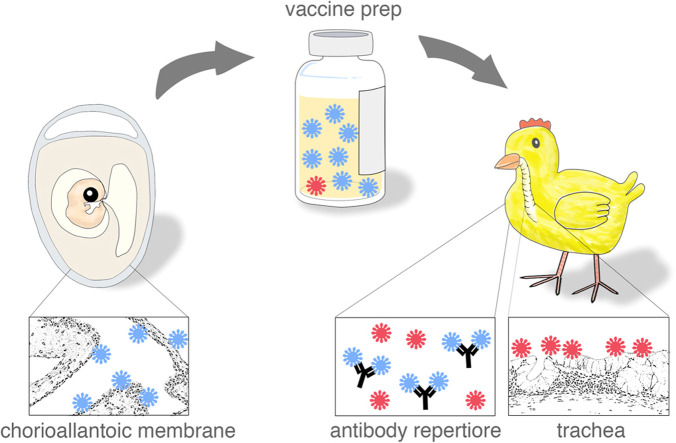
Sequencing avian infectious bronchitis virus spike genes re-isolated from vaccinated chicks revealed that many sequence changes are found on the S1 spike gene. In the ArkDPI strain, Y43H and ∆344 are the two most common changes observed. This study aims to examine the roles of Y43H and ∆344 in selection in vivo. Using recombinant ArkDPI S1 proteins, we conducted binding assays on chicken tracheas and embryonic chorioallantoic membrane (CAM). Protein histochemistry showed that the Y43H change allows for enhanced binding to trachea, whereas the ArkDPI S1 spike with H43 alone was able to bind CAM. Using Western blot under denaturing conditions, ArkDPI serotype-specific sera did not bind to S1 proteins with ∆344, suggesting that ∆344 alters antigenicity of S1. These findings are important because they propose that specific changes in S1 enhances virus fitness by more effective binding to host tissues (Y43H) and by evading a vaccine-induced antibody response (∆344).

Keywords: Arkansas-type vaccine; Coronavirus spike; Infectious bronchitis virus; S1 spike; Spike glycoprotein.


Figures

fx1
Graphical abstract
Fig. 1.
Fig. 1
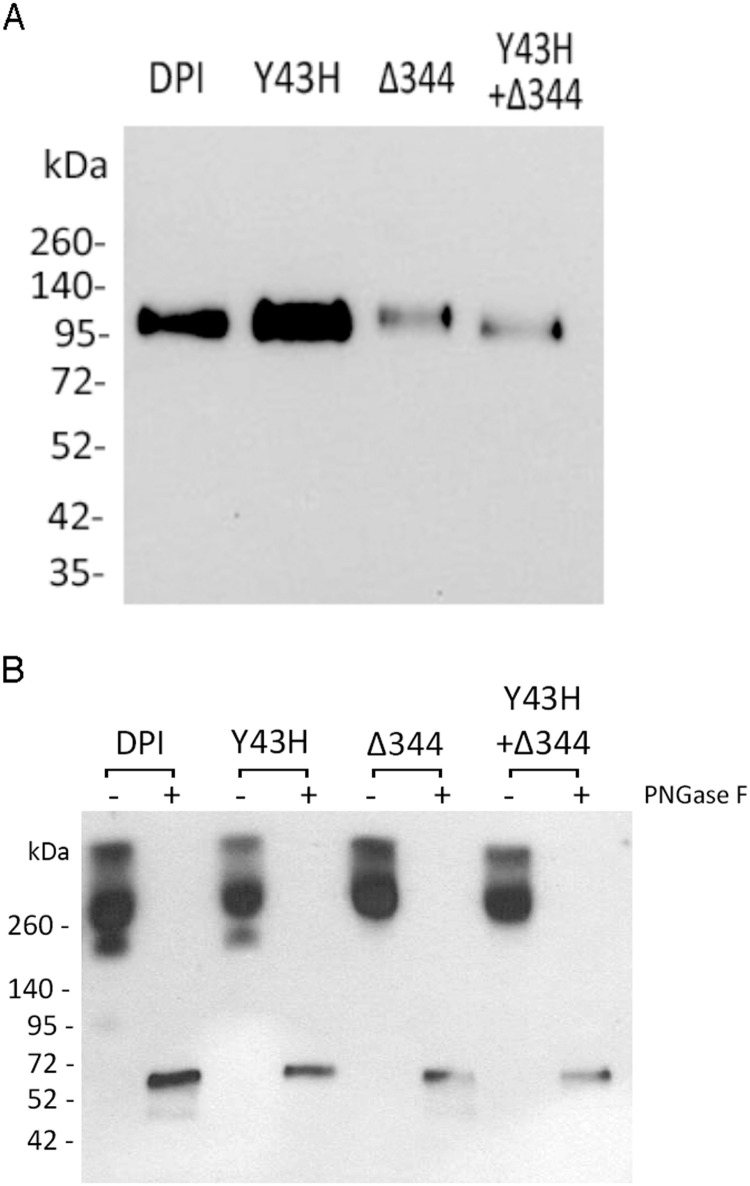
S1 fusion proteins were successfully expressed and purified from HEK 293 cells (A) S1 spike protein monomers migrated to a band about 100 kDa, as expected. (B) PNGase digestion was performed to remove N-glycosylation from the recombinant proteins. As expected, unglycosylated S1 fusion proteins migrated to a band 60 kDa in size. Also shown in (B) are fully glycosylated trimeric S1 spike proteins that are about 260 kDa in size.
Fig. 2.
Fig. 2
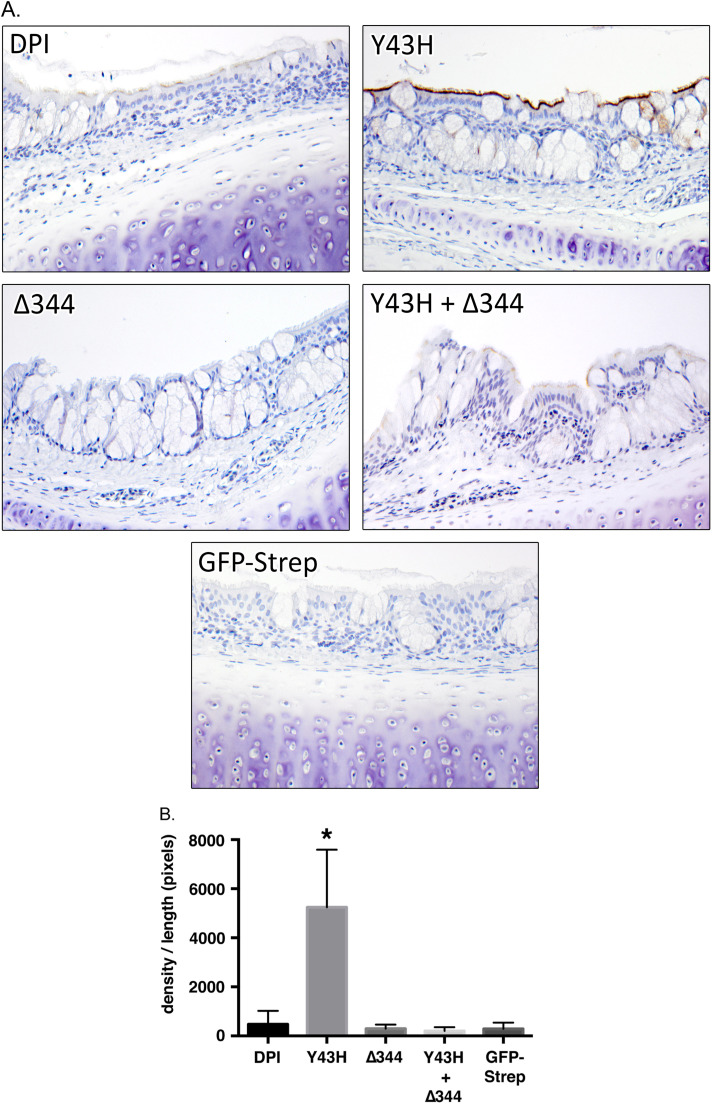
The amino acid position 43 is critical for spike binding onto tracheal tissue. Binding of recombinant S1 spike proteins on tissue sections of mature tracheal tissue was examined using protein histochemistry (A). Four S1 spike proteins were used for the binding experiments namely, the primary ArkDPI S1 spike (DPI), the ArkDPI spike with the Y43H change (Y43H), the ArkDPI spike with a deletion at position 344 (∆344), and finally, the ArkDPI spike with both Y43H and ∆344 changes. StrepTactin-tagged GFP protein (GFP-Strep) was used as a negative control. To detect binding, we pre-complexed the S1 spike proteins with horseradish peroxidase-conjugated StrepTactin and developed a brown signal using DAB as a substrate. Quantification of the signals was performed by densitometry using the ImageJ software (B). Highest binding to ciliated epithelium of the trachea was observed for Y43H spike. Statistical analysis was done in GraphPad Prism software.*Indicates p <0.05 when compared to other groups.
Fig. 3.
Fig. 3
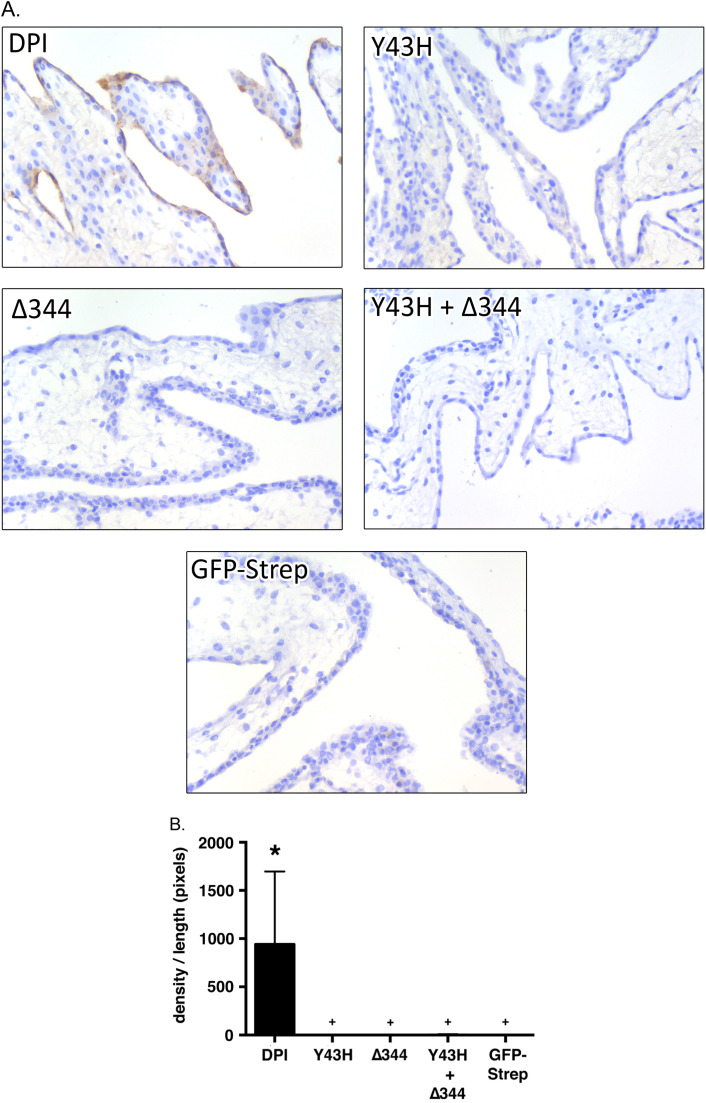
The primary ArkDPI spike exhibits highest binding to embryonic tissue. Protein histochemistry on embryonic tissue chorioallantoic membrane (CAM) was performed using purified recombinant S1 spike proteins (A). As with the protein histochemistry with tracheal tissues, the four S1 proteins were used: the primary ArkDPI S1 spike (DPI), the ArkDPI spike with the Y43H change (Y43H), the ArkDPI spike with a deletion at position 344 (∆344), and the ArkDPI spike with both Y43H and ∆344 changes. As a negative control, StrepTactin-tagged GFP protein (GFP-Strep) was also used in protein histochemistry. S1 spike proteins were pre-complexed with horseradish peroxidase-conjugated StrepTactin prior to addition onto CAM tissue sections. Binding signal was developed using DAB as a substrate, thereby producing a brown color. Quantification of the brown signal was performed by densitometry using the ImageJ software (B). Substantial binding to CAM was only observed for the primary ArkDPI vaccine spike protein. Densitometry was performed using the ImageJ software. Statistical analysis was done in GraphPad Prism software.*Indicates p <0.05 when compared to other groups.+Indicates very low level of signal detected.
Fig. 4.
Fig. 4
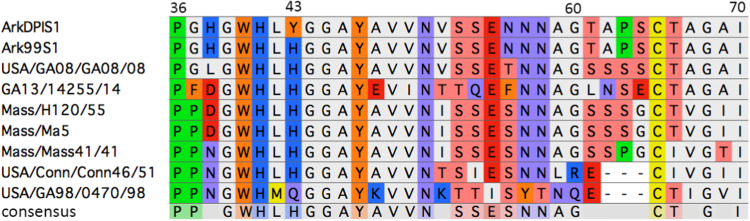
Multiple sequence alignment of the partial S1 spike protein. The sequence above shows amino acid positions 35–70. Previous studies have shown there are four amino acid positions (38, 43, 63, and 69) that are important for binding of the spike on tracheal tissue (Becker et al., 1967, Promkuntod et al., 2014). Multiple sequence alignment was performed using ClustalW and eBioX software.
Fig. 5.
Fig. 5
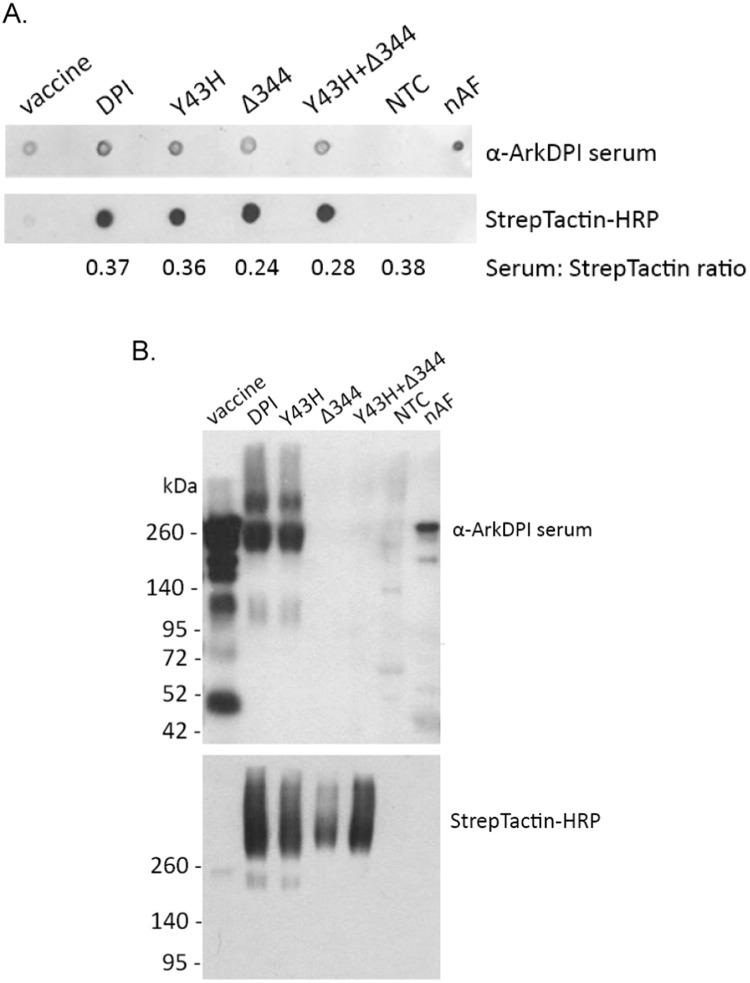
Immunoblot analysis of recombinant S1 proteins. ArkDPI serotype-specific antiserum was used to examine antigenicity of recombinant S1 spike proteins. (A) Dot blot was performed under native conditions. An equal amount of protein (350 ng) was spotted onto a nitrocellulose membrane strip and subsequently probed with ArkDPI serotype-specific sera and StrepTactin, as a control. No differences were observed in the amount of antibody binding between recombinant spike proteins. (B) Conventional Western blot under denaturing conditions. We observed that denatured S1 spike proteins with ∆344 singly or in combination with Y43H were unable to bind to ArkDPI-serotype specific antisera. Densitometry analysis was done using ImageJ software. NTC = non-transfected control, nAF = normal, non-infected allantoic fluid.

References

    1. Ammayappan A., Upadhyay C., Gelb J., Jr, Vakharia V.N. Identification of sequence changes responsible for the attenuation of avian infectious bronchitis virus strain Arkansas DPI. Arch. Virol. 2009;154:495–499. - PMC - PubMed
    1. Becker W.B., McIntosh K., Dees J.H., Chanock R.M. Morphogenesis of avian infectious bronchitis virus and a related human virus (strain 229E) J. Virol. 1967;1:1019–1027. - PMC - PubMed
    1. Bosch B.J., van der Zee R., de Haan C.A., Rottier P.J. The coronavirus spike protein is a class I virus fusion protein: structural and functional characterization of the fusion core complex. J. Virol. 2003;77:8801–8811. - PMC - PubMed
    1. Casais R., Dove B., Cavanagh D., Britton P. Recombinant avian infectious bronchitis virus expressing a heterologous spike gene demonstrates that the spike protein is a determinant of cell tropism. J. Virol. 2003;77:9084–9089. - PMC - PubMed
    1. Cavanagh D. Coronavirus avian infectious bronchitis virus. Vet. Res. 2007;38:281–297. - PubMed

Publication types

MeSH terms

Substances