


Connectivity rescues genetic diversity after a demographic bottleneck in a butterfly population network
- PMID: 27621433
- PMCID: PMC5047165
- DOI: 10.1073/pnas.1600865113
Connectivity rescues genetic diversity after a demographic bottleneck in a butterfly population network
Abstract
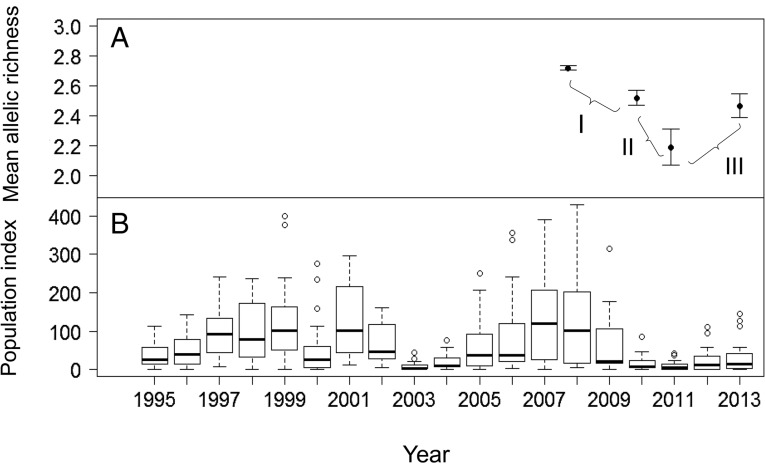
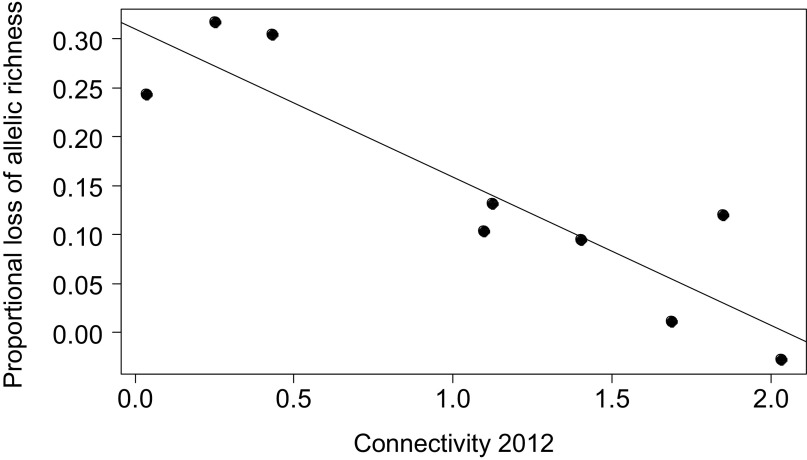
Demographic bottlenecks that occur when populations fluctuate in size erode genetic diversity, but that diversity can be recovered through immigration. Connectivity among populations and habitat patches in the landscape enhances immigration and should in turn facilitate recovery of genetic diversity after a sudden reduction in population size. For the conservation of genetic diversity, it may therefore be particularly important to maintain connectivity in the face of factors that increase demographic instability, such as climate change. However, a direct link between connectivity and recovery of genetic diversity after a demographic bottleneck has not been clearly demonstrated in an empirical system. Here, we show that connectivity of habitat patches in the landscape contributes to the maintenance of genetic diversity after a demographic bottleneck. We were able to monitor genetic diversity in a network of populations of the alpine butterfly, Parnassius smintheus, before, during, and after a severe reduction in population size that lasted two generations. We found that allelic diversity in the network declined after the demographic bottleneck but that less allelic diversity was lost from populations occupying habitat patches with higher connectivity. Furthermore, the effect of connectivity on allelic diversity was important during the demographic recovery phase. Our results demonstrate directly the ability of connectivity to mediate the rescue of genetic diversity in a natural system.
Keywords: alpine butterfly; connectivity; demographic bottleneck; genetic diversity; recovery.
Conflict of interest statement
The authors declare no conflict of interest.
Figures

References
-
- Saccheri I, et al. Inbreeding and extinction in a butterfly metapopulation. Nature. 1998;392(6675):491–494.
-
- Bouzat JL, et al. Genetic evaluation of a demographic bottleneck in the greater prairie chicken. Conserv Biol. 1998;12(4):836–843.
-
- Lacy RC. Loss of genetic diversity from managed populations: Interacting effects of drift, mutation, immigration, selection, and population subdivision. Conserv Biol. 1987;1(2):143–158.
-
- Ehrich D, Jorde E. High genetic variability despite high amplitude population cycles in lemmings. J Mammal. 2005;86(2):380–385.
Publication types
MeSH terms
LinkOut - more resources
Full Text Sources
Other Literature Sources
