. 2016 Sep 27;113(39):10986-91.
doi: 10.1073/pnas.1612441113. Epub 2016 Sep 12.

Stac3 has a direct role in skeletal muscle-type excitation-contraction coupling that is disrupted by a myopathy-causing mutation

Affiliations

Stac3 has a direct role in skeletal muscle-type excitation-contraction coupling that is disrupted by a myopathy-causing mutation

Alexander Polster et al. Proc Natl Acad Sci U S A. .

Abstract

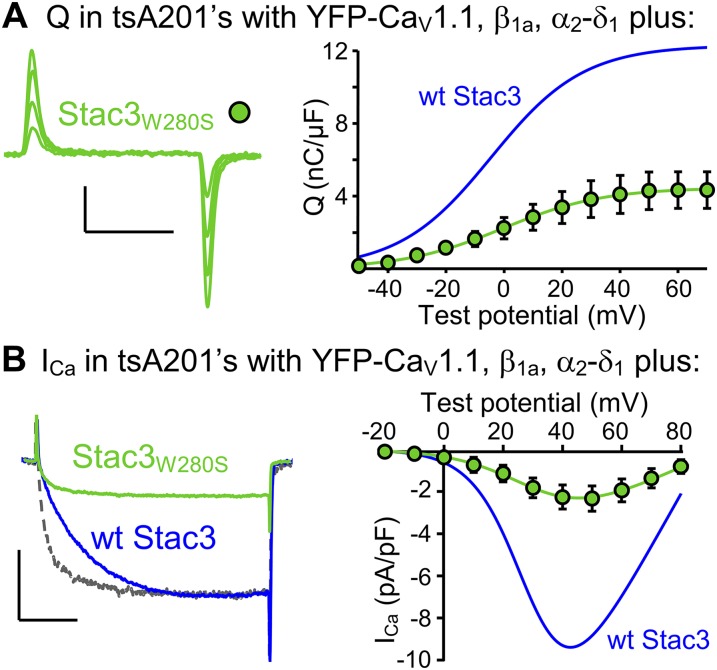
In skeletal muscle, conformational coupling between CaV1.1 in the plasma membrane and type 1 ryanodine receptor (RyR1) in the sarcoplasmic reticulum (SR) is thought to underlie both excitation-contraction (EC) coupling Ca(2+) release from the SR and retrograde coupling by which RyR1 increases the magnitude of the Ca(2+) current via CaV1.1. Recent work has shown that EC coupling fails in muscle from mice and fish null for the protein Stac3 (SH3 and cysteine-rich domain 3) but did not establish the functional role of Stac3 in the CaV1.1-RyR1 interaction. We investigated this using both tsA201 cells and Stac3 KO myotubes. While confirming in tsA201 cells that Stac3 could support surface expression of CaV1.1 (coexpressed with its auxiliary β1a and α2-δ1 subunits) and the generation of large Ca(2+) currents, we found that without Stac3 the auxiliary γ1 subunit also supported membrane expression of CaV1.1/β1a/α2-δ1, but that this combination generated only tiny Ca(2+) currents. In Stac3 KO myotubes, there was reduced, but still substantial CaV1.1 in the plasma membrane. However, the CaV1.1 remaining in Stac3 KO myotubes did not generate appreciable Ca(2+) currents or EC coupling Ca(2+) release. Expression of WT Stac3 in Stac3 KO myotubes fully restored Ca(2+) currents and EC coupling Ca(2+) release, whereas expression of Stac3W280S (containing the Native American myopathy mutation) partially restored Ca(2+) currents but only marginally restored EC coupling. We conclude that membrane trafficking of CaV1.1 is facilitated by, but does not require, Stac3, and that Stac3 is directly involved in conformational coupling between CaV1.1 and RyR1.

Keywords: L-type Ca2+ channels; Stac3 protein; excitation–contraction coupling.


Conflict of interest statement

The authors declare no conflict of interest.

Figures
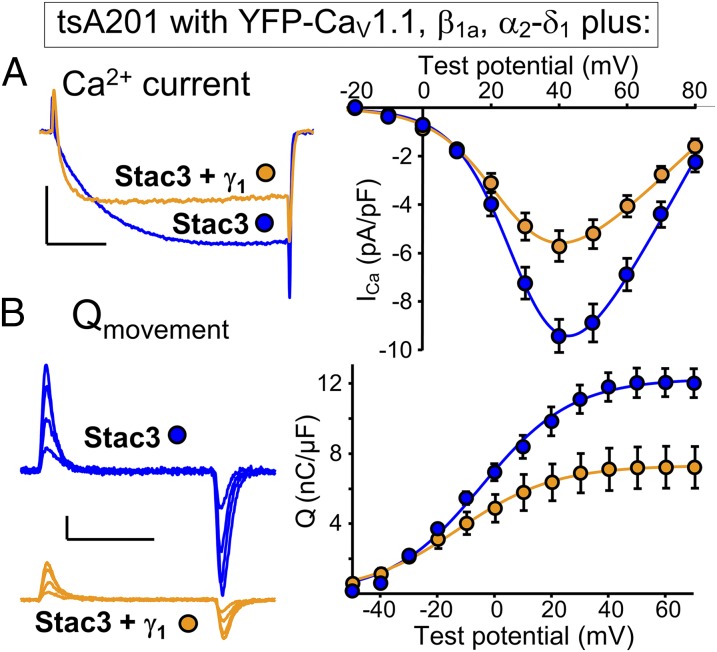
Fig. 1.
Fig. 1.
The γ1 subunit alters the kinetics of Ca2+ current via CaV1.1 in tsA201 cells. (A) Representative peak calcium currents (Left) and peak I-V relationships (Right) in tsA201 cells transfected with YFP-CaV1.1, β1a, and α21 together with Stac3 alone, or with both Stac3 and γ1. Test potentials: +40 mV; calibrations: 5 pA/pF (vertical), 50 ms (horizontal). (B) Representative charge movements (Left, Vtest of −20, 0, +20, and +40 mV) and average Q-V relationships (Right) in tsA201 cells transfected with YFP-CaV1.1, β1a, and α21 together with Stac3 alone, or with both Stac3 and γ1. Calibrations: 2 pA/pF (vertical), 10 ms (horizontal).
Fig. 2.
Fig. 2.
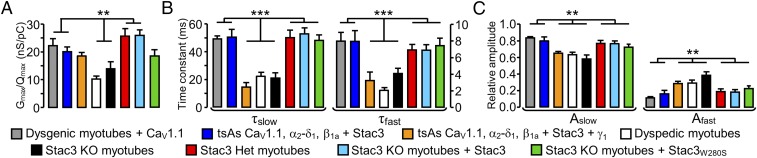
(A) Gmax/Qmax for the indicated combinations of cell type and construct. Values of Gmax and Qmax (and thus Gmax/Qmax) were obtained only from cells in which both peak I-V and Q-V relationships were measured. ** indicates a statistically significant difference (P < 0.05) between the center two combinations and the indicated combinations flanking them to the left and right. The Gmax/Qmax ratios were not corrected for any background charge (unrelated to CaV1.1), which was small in dysgenic myotubes in the current experiments (0.83 ± 0.16 nC/μF, n = 7, measured at +40 mV). (B and C) Time constants and relative amplitudes, respectively, derived from a double-exponential function (Eq. 3) fitted to Ca2+ currents at +40 mV. There was a statistically significant difference (***P < 0.001; **P < 0.05) between the center three combinations and the indicated combinations flanking them to the left and right. Numbers of cells (from left to right): 9 [dysgenic (CaV1.1-null) myotubes expressing YFP-CaV1.1], 10 (tsA201 cells expressing YFP-CaV1.1, α21, β1a + Stac3), 9 (tsA201 cells expressing YFP-CaV1.1, α21, β1a + Stac3 + γ1), 7 [dyspedic (RyR1-null) myotubes], 7 (Stac3 KO myotubes), 9 (Stac3 heterozygous myotubes), 10 (Stac3 KO myotubes expressing WT Stac3), and 6 (Stac3 KO myotubes expressing Stac3W280S).
Fig. 3.
Fig. 3.
The γ1 subunit supports membrane expression of CaV1.1 in tsA201 cells. (A) Representative peak calcium current (test potential: +30 mV) and peak I-V relationships in tsA201 cells transfected with YFP-CaV1.1, β1a, and α21 and γ1. Calibrations: 1 pA/pF (vertical), 50 ms (horizontal). (B) Representative charge movements (Vtest of −20, 0, +20, and +40 mV) and average Q-V relationships in tsA201 cells transfected with YFP-CaV1.1, β1a, α21 and γ1. Calibrations: 2 pA/pF (vertical), 10 ms (horizontal). For comparison, the smooth curves fitted to the peak I-V and Q-V data for tsA201 cells transfected with YFP-CaV1.1, β1a, α21 and WT Stac3 (Fig. 1 A and B) are replotted in blue.
Fig. S1.
Fig. S1.
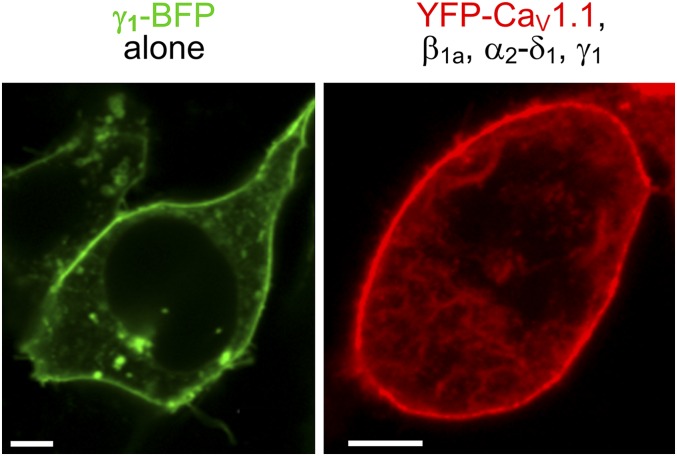
Subcellular distribution in tsA201 cells of transiently expressed γ1-BFP alone (Left) or YFP-CaV1.1 coexpressed with β1a, α21, and γ1 (Right). (Scale bars: 5 μm.)
Fig. 4.
Fig. 4.
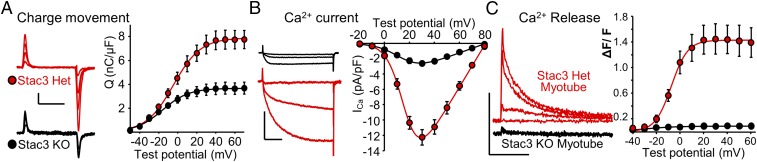
The absence of Stac3 in myotubes partially reduces CaV1.1 membrane expression, significantly alters L-type Ca2+ current, and abolishes EC coupling Ca2+ release. (A) Representative charge movements (Vtest of −20, 0, +20, and +40 mV, Left) and average Q-V relationships (Right) in myotubes homo- or heterozygous for a null mutation of Stac3. Calibrations: 1 pA/pF (vertical), 10 ms (horizontal). (B) Representative Ca2+ currents (Vtest of −10, +10 and +30 mV, Left), and average peak I-V relationships (Right) in myotubes homo- or heterozygous for Stac3 KO. Calibrations: 5 pA/pF (vertical), 50 ms (horizontal). (C) Representative whole-cell, voltage-clamp measurements of Ca2+ transients with Fluo-3 (200 ms depolarizations from −80 mV to −40, −20, 0, and +20 mV, Left) and average peak change in fluorescence normalized by baseline (ΔF/F) as a function of test potential (Right) for heterozygous or homozygous Stac3 KO myotubes. Calibrations: 1 ΔF/F (vertical), 5 s (horizontal).
Fig. 5.
Fig. 5.
CaV1.1 immunostaining in myotubes heterozygous (Left) or homozygous (Right) for Stac3 KO. (Scale bars: 5 μm.)
Fig. 6.
Fig. 6.
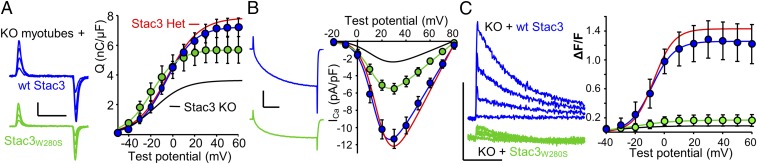
In myotubes, the NAM mutation of Stac3 has modest effects on membrane expression of CaV1.1 and L-type current properties but causes a very large reduction in EC coupling Ca2+ release. (A) Representative charge movements (Vtest of −20, 0, +20, and +40 mV, Left) and average Q-V relationships (Right) in Stac3 KO myotubes expressing WT Stac3 or Stac3W280S. Calibrations: 2 pA/pF (vertical), 10 ms (horizontal). (B) Representative ionic peak currents at +30 mV (Left), and average peak I-V relationships (Right) for Stac3 KO myotubes expressing WT Stac3 or Stac3W280S. Calibrations: 5 pA/pF (vertical), 50 ms (horizontal). (C) Representative whole-cell, voltage-clamp measurements of Ca2+ transients with Fluo-3 (200-ms depolarizations from −80 mV to −40, −20, 0, and +20 mV, Left) and average peak change in fluorescence normalized by baseline (ΔF/F) as a function of test potential (Right) for Stac3 KO myotubes expressing WT Stac3 or Stac3W280S. Calibrations: 1 ΔF/F (vertical), 5 s (horizontal). The smooth curves for data from myotubes heterozygous (red) and homozygous (black) for Stac3 KO are replotted from Fig. 4 AC.
Fig. S2.
Fig. S2.
In tsA201 cells, the NAM mutation introduced into mouse Stac3 (Stac3W280S) depresses membrane expression of CaV1.1 and accelerates L-type current activation kinetics. (A) Representative charge movements (Vtest of −20, 0, +20, and +40 mV, Left) and average Q-V relationship (Right) for YFP-CaV1.1 coexpressed in tsA201 cells with β1a, α21, and Stac3W280S. Calibrations: 2 pA/pF (vertical), 10 ms (horizontal). (B) Representative peak currents at +40 mV (Left) and average peak I-V relationships (Right) in tsA201 cells expressing YFP-CaV1.1, β1a, and α21 together with Stac3W280S (green) or with WT Stac3 (blue). The gray trace (Left) represents a vertically scaled (3.75×) version of the peak current for Stac3W280S. Calibrations: 5 pA/pF (vertical), 50 ms (horizontal). For comparison, the smooth curves fitted to the peak I-V and Q-V data for YFP-CaV1.1, β1a, α21 and WT Stac3 expressed in tsA201 cells (Fig. 1B) are replotted in blue.

References

    1. Tanabe T, Beam KG, Powell JA, Numa S. Restoration of excitation-contraction coupling and slow calcium current in dysgenic muscle by dihydropyridine receptor complementary DNA. Nature. 1988;336(6195):134–139. - PubMed
    1. Takeshima H, et al. Excitation-contraction uncoupling and muscular degeneration in mice lacking functional skeletal muscle ryanodine-receptor gene. Nature. 1994;369(6481):556–559. - PubMed
    1. Arikkath J, Campbell KP. Auxiliary subunits: Essential components of the voltage-gated calcium channel complex. Curr Opin Neurobiol. 2003;13(3):298–307. - PubMed
    1. Freise D, et al. Absence of the γ subunit of the skeletal muscle dihydropyridine receptor increases L-type Ca2+ currents and alters channel inactivation properties. J Biol Chem. 2000;275(19):14476–14481. - PubMed
    1. Ursu D, et al. Excitation-contraction coupling in skeletal muscle of a mouse lacking the dihydropyridine receptor subunit γ1. J Physiol. 2001;533(Pt 2):367–377. - PMC - PubMed

Publication types

MeSH terms