


Screening for genital chlamydia infection
- PMID: 27623210
- PMCID: PMC6457643
- DOI: 10.1002/14651858.CD010866.pub2
Screening for genital chlamydia infection
Abstract
Background: Genital infections caused by Chlamydia trachomatis are the most prevalent bacterial sexually transmitted infection worldwide. Screening of sexually active young adults to detect and treat asymptomatic infections might reduce chlamydia transmission and prevent reproductive tract morbidity, particularly pelvic inflammatory disease (PID) in women, which can cause tubal infertility and ectopic pregnancy.
Objectives: To assess the effects and safety of chlamydia screening versus standard care on chlamydia transmission and infection complications in pregnant and non-pregnant women and in men.
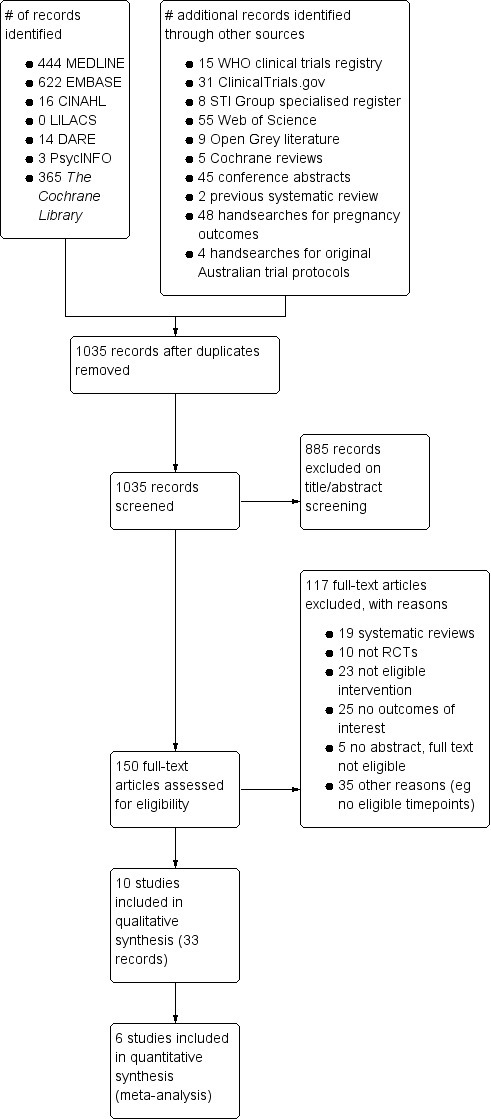
Search methods: We searched the Cochrane Sexually Transmitted Infections Group Specialised Register, the Cochrane Central Register of Controlled Trials (CENTRAL), MEDLINE, EMBASE, LILACS, CINAHL, DARE, PsycINFO and Web of Science electronic databases up to 14 February 2016, together with World Health Organization International Clinical Trials Registry (ICTRP) and ClinicalTrials.gov. We also handsearched conference proceedings, contacted trial authors and reviewed the reference lists of retrieved studies.
Selection criteria: Randomised controlled trials (RCTs) in adult women (non-pregnant and pregnant) and men comparing a chlamydia screening intervention with usual care and reporting on a primary outcome (C. trachomatis prevalence, PID in women, epididymitis in men or incidence of preterm delivery). We included non-randomised controlled clinical trials if there were no RCTs for a primary outcome.
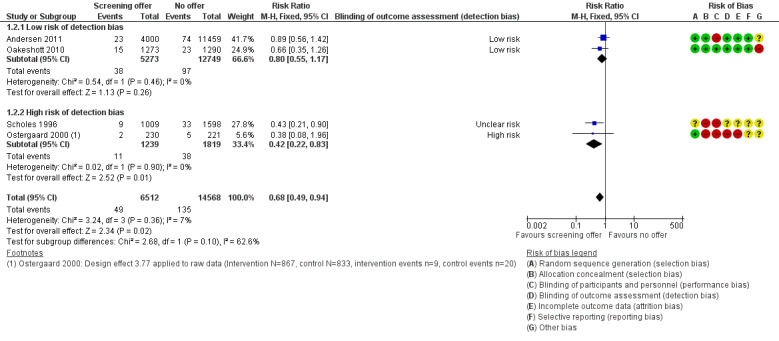
Data collection and analysis: Two review authors independently assessed trials for inclusion, extracted data and assessed the risk of bias. We resolved disagreements by consensus or adjudication by a third reviewer. We described results in forest plots and conducted meta-analysis where appropriate using a fixed-effect model to estimate risk ratios (RR with 95% confidence intervals, CI) in intervention vs control groups. We conducted a pre-specified sensitivity analysis of the primary outcome, PID incidence, according to the risks of selection and detection bias.
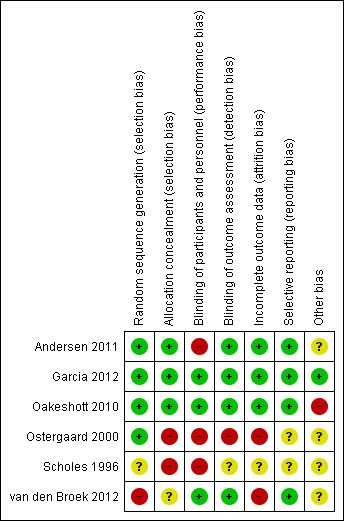
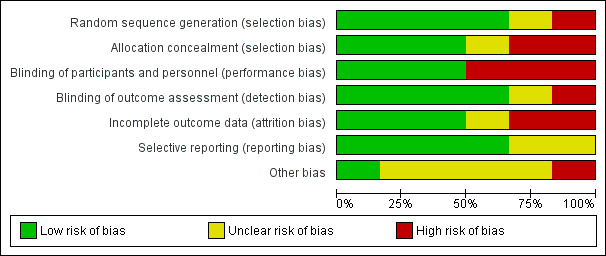
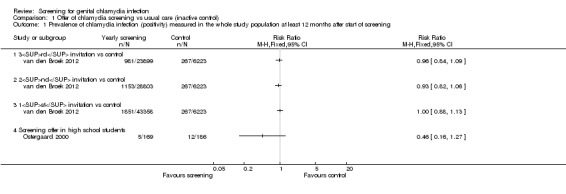
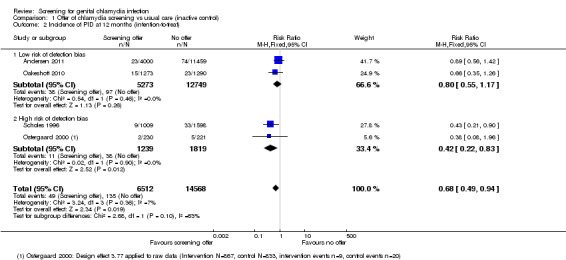
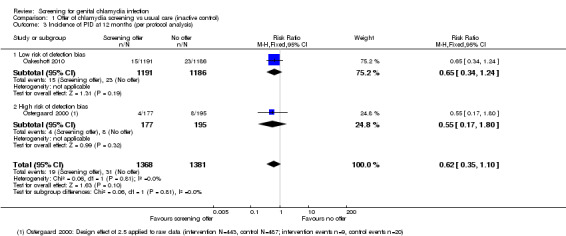
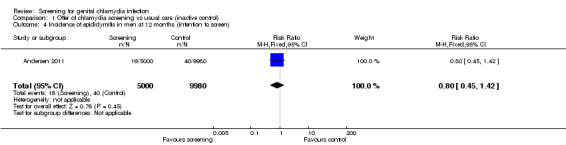
Main results: We included six trials involving 359,078 adult women and men. One trial was at low risk of bias in all six specific domains assessed. Two trials examined the effect of multiple rounds of chlamydia screening on C. trachomatis transmission. A cluster-controlled trial in women and men in the general population in the Netherlands found no change in chlamydia test positivity after three yearly invitations (intervention 4.1% vs control 4.3%, RR 0.96, 95% CI 0.84 to 1.09, 1 trial, 317,304 participants at first screening invitation, low quality evidence). Uptake of the intervention was low (maximum 16%). A cluster-randomised trial in female sex workers in Peru found a reduction in chlamydia prevalence after four years (adjusted RR 0.72, 95% CI 0.54 to 0.98, 1 trial, 4465 participants, low quality evidence).Four RCTs examined the effect of chlamydia screening on PID in women 12 months after a single screening offer. In analysis of four trials according to the intention-to-treat principle, the risk of PID was lower in women in intervention than control groups, with little evidence of between-trial heterogeneity (RR 0.68, 95% CI 0.49 to 0.94, I2 7%, 4 trials, 21,686 participants, moderate quality evidence). In a sensitivity analysis, the estimated effect of chlamydia screening in two RCTs at low risk of detection bias (RR 0.80, 95% CI 0.55 to 1.17) was compatible with no effect and was lower than in two RCTs at high or unclear risk of detection bias (RR 0.42, 95% CI 0.22 to 0.83).The risk of epididymitis in men invited for screening, 12 months after a single screening offer, was 20% lower risk for epididymitis than in those not invited; the confidence interval was wide and compatible with no effect (RR 0.80, 95% CI 0.45 to 1.42, 1 trial, 14,980 participants, very low quality evidence).We found no RCTs of the effects of chlamydia screening in pregnancy and no trials that measured the harms of chlamydia screening.
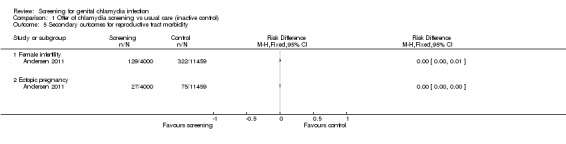
Authors' conclusions: Evidence about the effects of screening on C. trachomatis transmission is of low quality because of directness and risk of bias. There is moderate quality evidence that detection and treatment of chlamydia infection can reduce the risk of PID in women at individual level. There is an absence of RCT evidence about the effects of chlamydia screening in pregnancy.Future RCTs of chlamydia screening interventions should determine the effects of chlamydia screening in pregnancy, of repeated rounds of screening on the incidence of chlamydia-associated PID and chlamydia reinfection in general and high risk populations.
Conflict of interest statement
Berit Andersen is coauthor of two completed trials that are included in the review.
Jan van Bergen, Hannelore Götz and Nicola Low are coauthors on a completed trial that is included in the review .
Authors of included studies will not be involved in assessing and extracting data of their own studies.
Figures
Update of
References
References to studies included in this review
Andersen 2011 {published data only}
-
- Andersen B, Olesen F, Moller JK, Ostergaard L. Population‐based strategies for outreach screening of urogenital Chlamydia trachomatis infections: A randomized, controlled trial. Journal of Infectious Diseases 2002;185(2):252‐8. - PubMed
-
- Andersen B, Valkengoed I, Sokolowski I, Moller JK, Ostergaard L, Olesen F. Impact of intensified testing for urogenital Chlamydia trachomatis infections: A randomised study with 9‐year follow‐up. Sexually Transmitted Infections 2011;87(2):156‐61. - PubMed
-
- NCT00827970. Randomized population‐based study on Chlamydia trachomatis screening. http://clinicaltrials.gov/show/NCT00827970 (accessed 9 June 2016).
Garcia 2012 {published data only}
-
- Peru PREVEN Study. Urban community randomized trial for STD prevention: trial summary and protocol summary of revisions. http://www.proyectopreven.org/portal/index.php/about‐the‐project/preven‐... (accessed 9 June 2016).
Oakeshott 2010 {published data only}
-
- NCT00115388. Community‐based trial of screening for Chlamydia trachomatis to prevent pelvic inflammatory disease. http://ClinicalTrials.gov/show/NCT00115388 (accessed 9 June 2016). - PMC - PubMed
-
- Oakeshott P, Kerry S, Atherton H, Aghaizu A, Hay S, Taylor‐Robinson D, Simms I, Williams E, Hay P. Community‐based trial of screening for Chlamydia trachomatis to prevent pelvic inflammatory disease: the POPI (Prevention Of Pelvic Infection) trial. [Abstract P4.77]. ISSTDR/BASHH meeting. 2009 28 June‐1 July; London, UK.
Ostergaard 2000 {published data only}
-
- Ostergaard L, Andersen B, Moller JK, Olesen F. Home sampling versus conventional swab sampling for screening of Chlamydia trachomatis in women: a cluster‐randomized 1‐year follow‐up study. Clinical Infectious Diseases 2000;31(4):951‐7. - PubMed
Scholes 1996 {published data only}
-
- Scholes D, Stergachis A, Heidrich FE, Andrilla H, Holmes KK, Stamm WE. Prevention of pelvic inflammatory disease by screening for cervical chlamydial infection. New England Journal of Medicine 1996;334(21):1362‐6. - PubMed
van den Broek 2012 {published data only}
-
- Op de Coul EL, Weenen TC, Bergen JEAM, Brouwers EEHG, Feijter EM, Fennema JSA, Gotz HM, Hoebe CJPA, Koekenbier RH, Ravensteijn SM, Broek IVF. Process evaluation of the chlamydia screening implementation Netherlands: results from the first operational phase. [Abstract P4.68]. ISSTDR/BASHH meeting. 2009 28 June‐1 July; London, UK.
-
- Bergen JEAM, Fennema JSA, Broek IVF, Brouwers EEHG, Feijter EM, Hoebe CJPA, Koekenbier RH, Op de Coul ELM, Ravensteijn SM, Gotz HM. Development and implementation of a systematic selective internet‐based chlamydia screening program, the Netherlands 2008‐2010: rationale and design. [Abstract P4.42]. ISSTDR/BASHH meeting. 2009 28 June‐1 July; London, UK.
-
- Broek IVF, Hoebe CJPA, Bergen JEAM, Brouwers EEHG, Feijter EM, Fennema JSA, et al. Evaluation design of a systematic, selective, internet‐based, chlamydia screening implementation in the Netherlands,2008‐2010: implications of first results for the analysis. BMC Infectious Diseases 2010;10:89. - PMC - PubMed
-
- Broek IVF, Hoebe CJPA, Bergen JEAM, Brouwers EEHG, Feijter EM, Fennema JSA, Gotz HM, Koekenbier RH, Ravensteijn SM, Op de Coul EL. First phase of the stepwise chlamydia screening implementation in the Netherlands: participation rates and implications for measures of effect. [Abstract P4.67]. ISSTDR/BASHH meeting. 2009 28 June‐1 July; London, UK.
References to studies excluded from this review
ACTRN12608000499381 {published data only}
-
- ACTRN12608000499381. Chlamydia prevalence and testing program targetting women aged 16 to 24 years in general practice. http://www.anzctr.org.au/ACTRN12608000499381.aspx (accessed 9 June 2016).
Andrews 2006 {published data only}
-
- Andrews WW, Klebanoff MA, Thom EA, Hauth JC, Carey JC, Meis PJ, et al. Midpregnancy genitourinary tract infection with Chlamydia trachomatis: association with subsequent preterm delivery in women with bacterial vaginosis and Trichomonas vaginalis. American Journal of Obstetric Gynecology 2006;194(2):493‐500. - PubMed
Bailey 2013 {published data only}
-
- *Bailey J, McCarthy O, Carswell K, et al. The Sexunzipped website for sexual wellbeing for young people: early results of a pilot online RCT. Journal of Sexual Medicine 2011;8(Suppl 3):126.
Banhidy 2011 {published data only}
-
- Banhidy F, Duda SI, Czeizel AE. Preconceptional screening of sexually transmitted infections/diseases. Central European Journal of Medicine 2011;6(1):49‐57.
Bowden 2008 {published data only}
-
- Bowden FJ, Currie MJ, Toyne H, McGuiness C, Lim LL, Butler JR, et al. Screening for Chlamydia trachomatis at the time of routine Pap smear in general practice: a cluster randomised controlled trial. Medical Journal of Australia 2008;188(2):76‐80. - PubMed
Brown 2010 {published data only}
-
- Brown L, Patel S, Ives NJ, McDermott C, Ross JD. Is non‐invasive testing for sexually transmitted infections an efficient and acceptable alternative for patients? A randomised controlled trial. Sexually Transmitted Infections 2010;86(7):525‐31. - PubMed
Cabeza 2015 {published data only}
Chandeying 1998 {published data only}
Cohen 1999 {published data only}
-
- Cohen DA, Nsuami M, Martin DH, Farley TA. Repeated school‐based screening for sexually transmitted diseases: a feasible strategy for reaching adolescents. Pediatrics 1999;104(6):1281‐5. - PubMed
Cook 2007 {published data only}
-
- NCT00177437. Home screening for chlamydia surveillance. http://clinicaltrials.gov/show/NCT00177437 (accessed 9 June 2016).
De Barbeyrac 2013 {published data only}
-
- Barbeyrac B, Rahib D, Diego S, Roy C, Bébéar C, Lydie N. Internet testing for Chlamydia trachomatis in France in 2012 [P3.025]. Sexually Transmitted Infections 2013;89(Suppl 1):A155‐A156.
Downing 2013 {published data only}
-
- Downing SG, Cashman C, McNamee H, Penney D, Russell DB, Hellard ME. Increasing chlamydia test of re‐infection rates using SMS reminders and incentives. Sexually Transmitted Infections 2013;89(1):16‐9. - PubMed
Gotz 2013 {published data only}
Graseck 2010 {published data only}
-
- *Graseck A, Secura G, Allsworth J, Madden T, Peipert J. Randomized trial of home vs. clinic‐based screening for sexually transmitted infections in long‐acting reversible Contraceptive users. Contraception 2010;82(2):187.
-
- NCT01184157. Randomized trial of home versus clinic‐based screening for sexually transmitted infections in long‐acting reversible contraceptive users. http://clinicaltrials.gov/show/NCT01184157. clintrials, (accessed 9 June 2016).
Guy 2013 {published data only}
-
- ACTRN12613000808741. A randomised trial to evaluate whether point‐of‐care testing for chlamydia and gonorrhoea in remote Aboriginal communities can reduce repeat positivity at three months after treatment, among people with chlamydia or gonorrhoea infection. http://www.anzctr.org.au/ACTRN12613000808741.aspx (accessed 9 June 2016).
-
- Natoli L. The First Cluster Randomised Trial of a Molecular Chlamydia and Gonorrhoea Point‐Of‐Care Assay. Abstract P5.036. Sexually Transmitted Infections. 2013; Vol. 89, issue Suppl 1:A345.
Hodgins 2002 {published data only}
ISRCTN16261241 {published data only}
-
- ISRCTN16261241. Screening for Chlamydia trachomatis (CT) with routine Pap smears in general practice: a randomized controlled trial. http://www.isrctn.com/ISRCTN16261241 (accessed 9 June 2016).
ISRCTN38526137 {published data only}
-
- ISRCTN38526137. A randomised controlled study of mouth swab testing versus same‐day blood tests for human immunodeficiency virus (HIV) infection in young people attending a young person's community drug service. http://isrctn.org/ISRCTN38526137 (accessed 9 June 2016).
Jones 2007 {published data only}
Kekki 2001 {published data only}
-
- Kekki M, Kurki T, Pelkonen J, Kurkinen‐Raty M, Cacciatore B, Paavonen J. Vaginal clindamycin in preventing preterm birth and peripartal infections in asymptomatic women with bacterial vaginosis: a randomized, controlled trial. Obstetric Gynecology 2001;97(5 Pt 1):643‐8. - PubMed
Kersaudy‐Rahib 2013 {published data only}
-
- Kersaudy‐Rahib D, Barbeyrac B, Diego S, Roy C, Bebear C, Lydie N. Home screening compared with clinic‐based screening for Chlamydiae trachomatis in France: a randomised controlled trial. Lancet 2013;382:S53.
Kiss 2004 {published data only}
Klovstad 2013 {published data only}
-
- NCT00283127. Home sampling versus conventional sampling for screening of urogenital Chlamydia trachomatis in young men and women ‐ a randomized controlled trial. http://clinicaltrials.gov/show/NCT00283127 (accessed 9 June 2016).
Lawton 2010 {published data only}
-
- Lawton BA, Rose SB, Elley CR, Bromhead C, MacDonald EJ, Baker MG. Increasing the uptake of opportunistic chlamydia screening: a pilot study in general practice. Journal of Primary Health Care 2010;2(3):199‐207. - PubMed
Martin 1997 {published data only}
McGregor 1990 {published data only}
-
- McGregor JA, French JI, Richter R, Vuchetich M, Bachus V, Seo K, et al. Cervicovaginal microflora and pregnancy outcome: results of a double‐blind, placebo‐controlled trial of erythromycin treatment. American Journal of Obstetrics & Gynecology 1990;163(5 Pt 1):1580‐91. - PubMed
McGregor 1995 {published data only}
-
- French JI, McGregor JA, Parker R. Readily treatable reproductive tract infections and preterm birth among black women. American Journal of Obstetrics & Gynecology 2006;194(6):1717‐26. - PubMed
-
- McGregor JA, French JI, Parker R, Draper D, Patterson E, Jones W, et al. Prevention of premature birth by screening and treatment for common genital tract infections: results of a prospective controlled evaluation. American Journal of Obstetrics & Gynecology 1995;173(1):157‐67. - PubMed
McKee 2011 {published data only}
-
- McKee DM, Rubin S, Alderman E, Fletcher J, Campos G. A pilot intervention to improve sexually transmitted infection testing for urban adolescents. Journal of Adolescent Health 2011;48(2):S65.
Meyer 1991 {published data only}
NCT00829517 {published data only}
-
- NCT00829517. Computer‐assisted provision of reproductive health care. http://clinicaltrials.gov/show/NCT00829517 (accessed 9 June 2016).
NCT01654991 {published data only}
-
- NCT01654991. A randomized trial of home versus clinic‐based STD testing among men. http://clinicaltrials.gov/show/NCT01654991 (accessed 9 June 2016).
Niza 2014 {published data only}
Scholes 2006 {published data only}
-
- Scholes D, Grothaus L, McClure J, Reid R, Fishman P, Sisk C, et al. A randomized trial of strategies to increase chlamydia screening in young women. Preventive Medicine 2006;43(4):343‐50. - PubMed
Scholes 2007 {published data only}
-
- Scholes D, Heidrich FE, Yarbro P, Lindenbaum JE, Marrazzo JM. Population‐based outreach for chlamydia screening in men: results from a randomized trial. Sexually Transmitted Diseases 2007;34(11):837‐9. - PubMed
Senok 2005 {published data only}
-
- Senok A, Wilson P, Reid M, Scoular A, Craig N, McConnachie A, et al. Can we evaluate population screening strategies in UK general practice? A pilot randomised controlled trial comparing postal and opportunistic screening for genital chlamydial infection. Journal of Epidemiology and Community Health. 2005;59(3):198‐204. - PMC - PubMed
Shafer 2002 {published data only}
-
- Shafer MA, Tebb KP, Pantell RH, Wibbelsman CJ, Neuhaus JM, Tipton AC, et al. Effect of a clinical practice improvement intervention on chlamydial screening among adolescent girls. JAMA: the journal of the American Medical Association 2002;288(22):2846‐52. - PubMed
-
- Tebb K, A Shafer M. A clinical practice intervention to increase chlamydial screening: sustaining the gain and translating into practice 4 years later. Sexually Transmitted Infections 2011;87(Suppl 1):A321‐A322.
Smith 2014 {published data only}
-
- ACTRN12611000968976. Randomised controlled trial (RCT) of self‐collection samples to increase chlamydia re‐testing following a chlamydia diagnosis amongst clients attending two urban sexual health clinics. http://www.anzctr.org.au/ACTRN12611000968976.aspx (accessed 9 June 2016).
-
- Smith KS, Hocking J, Wand H. Home‐based sample collection increases chlamydia retesting and detects additional repeat positive tests: a randomised controlled trial in three risk groups. [Abstract O22.7]. Sexually Transmitted Infections 2013;89(Suppl 1):A1–A428.
Stevens‐Simon 2002 {published data only}
-
- Stevens‐Simon C, Rudnick M, Beach RK, Weinberg A. Screening positive urine pregnancy tests for sexually transmitted diseases expedites the treatment of infected adolescent gravidas. Journal of Maternal‐Fetal and Neonatal Medicine 2002;11(6):391‐5. - PubMed
Tebb 2005 {published data only}
Tebb 2009 {published data only}
-
- Tebb KP, Wibbelsman C, Neuhaus JM, Shafer MA. Screening for asymptomatic chlamydia infections among sexually active adolescent girls during pediatric urgent care. Archives of Pediatrics and Adolescent Medicine 2009;163(6):559‐64. - PubMed
Walker 2010 {published data only}
-
- ACTRN12605000411640. A computer alert to increase chlamydia testing of high risk women in general practice: a cluster randomised controlled trial. http://www.anzctr.org.au/ACTRN12605000411640.aspx (accessed 9June 2016).
-
- Walker J, Fairley CK, Walker SM, Gurrin LC, Gunn JM, Pirotta MV, et al. Computer reminders for chlamydia screening in general practice: a randomized controlled trial. Sexually Transmitted Diseases 2010;37(7):445‐50. - PubMed
-
- Walker J, Walker S, Fairley CK, Gunn J, Pirotta M, Gurrin L, et al. Computer reminders for chlamydia screening in general practice: a randomised controlled trial. Sexual Health 2009;6(4):363. - PubMed
-
- Walker, J. Computer reminders for chlamydia screening in general practice: a randomised controlled trial. [Abstract OS2.1.05]. ISSTDR/BASHH Meeting. 2009 28 June‐1 July; London, UK. - PubMed
Xu 2011 {published data only}
-
- Xu F, Stoner B, Taylor S, Mena L, Tian L, Papp J, et al. Rescreening for chlamydial infection using home‐based, self‐obtained vaginal swabs: a randomised controlled trial in family planning clinic clients. Sexually Transmitted Infections 2011;87(Suppl 1):A75‐A76.
References to ongoing studies
Hocking 2010 {published data only}
-
- ACTRN12610000297022. Australian Chlamydia Control Effectiveness Pilot: a trial to determine whether annual chlamydia testing in general practice can lead to a reduction in chlamydia prevalence.. http://www.anzctr.org.au/ACTRN12610000297022.aspx (accessed 9 June 2016).
-
- Hocking J. The Australian Chlamydia Control Effectiveness Pilot (ACCEPt): early results from a randomised trial of annual chlamydia screening in general practice. [Abstract P5.017]. Sexually Transmitted Infections. 2013; Vol. 89, issue Suppl 1:A339‐A340.
-
- Hocking J, Poznanski S, Vaisey A, Walker J, Wood A, Lewis D, et al. A multifaceted intervention to increase chlamydia testing in Australian general practice. Sexually Transmitted Infections 2011;87(Suppl 1):A199.
-
- Hocking J, Spark S, Guy R, Temple‐Smith M, Fairley C, Kaldor J, et al. The Australian Chlamydia Control Effectiveness Pilot (ACCEPT): first results from a randomised trial of annual chlamydia screening in general practice. Sexually Transmitted Infections 2012;88(Suppl 1):A3‐4.
-
- Hocking J, Temple‐Smith M, Poznanski S, Guy R, Low N, Donovan B, et al. Australian chlamydia control effectiveness pilot: preliminary results from a trial of chlamydia testing in general practice. Sexually Transmitted Infections 2011;87(Suppl 1):A202.
Kaldor 2010 {published data only}
-
- ACTRN12610000358044. Sexually transmitted infections (STI) in remote communities: ImproVed & Enhanced primary health care. http://www.anzctr.org.au/ACTRN12610000358044.aspx (accessed 9 June 2016).
-
- Garton L. High levels of re‐testing after chlamydia and gonorrhoea infection in remote Aboriginal communities 2009‐2011: findings from the STRIVE trial [Paper Ref 608]. IUSTI Meeting. 2012 15‐17 October; Melbourne, Australia.
-
- Silver B. Chlamydia trachomatis, Neisseria gonorrhoea and Trichomonas vaginalis incidence in remote Australain Aboriginal communities: findings from the STRIVE trial. [Paper Ref 596]. IUSTI Meeting. 2012 15‐17 October; Melbourne, Australia.
-
- Ward J. Addressing endemic rates of STI in remote Aboriginal communities in Australia using quality improvement as a key strategy: the STRIVE Study. [Abstract P6.007]. Sexually Transmitted Infections. 2013; Vol. 89, issue Suppl 1:A371‐A372.
Lehtinen 2015 {published data only}
-
- Lehtinen M, Rana M, Korhonen S, Öhman H, Eriksson T, Apter D, et al. Characteristics of a randomized Chlamydia screening trial. Proceedings of the Thirteenth International Symposium on Human Chlamydial Infections. 2014 22‐27 june; Asilomar, CA:409‐412.
-
- Lehtinen, M, Apter, D, Baussano, I, et al. Characteristics of a cluster‐randomized phase IV human papillomavirus vaccination effectiveness trial. Vaccine 2015;33(10):1284‐90. - PubMed
NCT01195220 {published data only}
-
- NCT01195220. Project AWARE: using the emergency department (ED) to prevent sexually transmitted infections (STIs) in youth. http://clinicaltrials.gov/show/NCT01195220 (accessed 9 June 2016).
Additional references
Althaus 2010
-
- Althaus CL, Heijne JCM, Roellin A, Low N. Transmission dynamics of Chlamydia trachomatis affect the impact of screening programmes. Epidemics 2010;2(3):123‐31. - PubMed
Althaus 2012
Batteiger 2010a
Batteiger 2010b
Bender 2011
-
- Bender N, Herrmann B, Andersen B, Hocking JS, Bergen J, Morgan J, et al. Chlamydia infection, pelvic inflammatory disease, ectopic pregnancy and infertility: cross‐national study. Sexually Transmitted Infections 2011;87(7):601‐8. - PubMed
Brunham 2005
-
- Brunham RC, Rey‐Ladino J. Immunology of Chlamydia infection: implications for a Chlamydia trachomatis vaccine. Nature Reviews Immunology 2005;5(2):149‐61. - PubMed
Campbell 2005
-
- Campbell MK, Fayers PM, Grimshaw JM. Determinants of the intracluster correlation coefficient in cluster randomized trials: the case of implementation research. Clinical Trials 2005;2(2):99‐107. - PubMed
Campbell 2006
CDC 2015
-
- Centers for Disease Control and Prevention. Sexually Transmitted Disease Surveillance 2014. Atlanta: U.S. Department of Health and Human Services, 2015.
Datta 2012
-
- Datta SD, Torrone E, Kruszon‐Moran D, Berman S, Johnson R, Satterwhite CL, et al. Chlamydia trachomatis trends in the United States among persons 14 to 39 years of age, 1999–2008. Sexually Transmitted Diseases 2012;39(2):92‐6. - PubMed
DoHA 2016
-
- Australian Government Department of Health and Ageing. National Notifiable Diseases Surveillance System. http://www9.health.gov.au/cda/Source/CDA‐index.cfm (accessed 9 June 2016).
ECDC 2014
-
- European Centre for Disease Prevention and Control. Chlamydia Control in Europe: Literature Review. Technical report. Stockholm: ECDC, 2014.
ECDC 2015
-
- European Centre for Disease Prevention and Control. Annual epidemiological report. Sexually transmitted infections, including HIV and blood‐borne viruses 2014. www.ecdc.europa.eu (accessed 9 June 2016).
Egger 1997
Epidata [Computer program]
-
- Lauritsen JM. EpiData Data Entry, Data Management and basic Statistical Analysis System.. Version Version 3.1. Odense, Denmark: EpiData Association, 2005.
Fleming 1999
Geisler 2013
Glassman 2015
Gottlieb 2010
-
- Gottlieb SL, Berman SM, Low N. Screening and treatment to prevent sequelae in women with Chlamydia trachomatis genital infection: how much do we know?. Journal of Infectious Diseases 2010;201(Suppl 2):S156‐S167. - PubMed
Gottlieb 2011
-
- Gottlieb SL, Stoner BP, Zaidi AA, Buckel C, Tran M, Leichliter JS, et al. A prospective study of the psychosocial impact of a positive Chlamydia trachomatis laboratory test. Sexually Transmitted Diseases 2011;38(11):1004‐11. - PubMed
Gottlieb 2013
-
- Gottlieb SL, Xu F, Brunham RC. Screening and treating Chlamydia trachomatis genital infection to prevent pelvic inflammatory disease: interpretation of findings from randomized controlled trials. Sexually Transmitted Diseases 2013;40(2):97‐102. - PubMed
Gotz 2005
Hager 1983
-
- Hager D, Eschenbach D. Criteria for diagnosis and grading of salpingitis. Obstetrics and Gynecology 1983;61(1):113‐4. - PubMed
Harbord 2005
Herzog 2012
Herzog 2013
-
- Herzog SA, Heijne JCM, Scott P, Althaus CL, Low N. Direct and indirect effects of screening for Chlamydia trachomatis on the prevention of pelvic inflammatory disease: a mathematical modelling study. Epidemiology 2013;24(6):854‐62. - PubMed
Higgins 2002
-
- Higgins JP, Thompson SG. Quantifying heterogeneity in a meta‐analysis. Statistics in Medicine 2002;21(11):1539‐58. - PubMed
Higgins 2011a
-
- Higgins JPT, Green S (editors). Cochrane Handbook for Systematic Reviews of Interventions. Version 5.1.0 [updated March 2011]. The Cochrane Collaboration, 2011. Available from www.cochrane‐handbook.org. Chichester, UK: John Wiley & Sons.
Higgins 2011b
-
- Higgins JPT, Altman DG, Sterne JAC (editors). Chapter 8: Assessing risk of bias in included studies. In: Higgins JPT, Green S (editors). Cochrane Handbook for Systematic Reviews of Interventions. Version 5.1.0 [updated March 2011]. The Cochrane Collaboration, 2011. Available from www.cochrane‐handbook.org. Chichester, UK: John Wiley & Sons.
Hillis 1997
-
- Hillis SD, Owens LM, Marchbanks PA, Amsterdam LF, MacKenzie WR. Recurrent chlamydial infections increase the risks of hospitalization for ectopic pregnancy and pelvic inflammatory disease. American Journal of Obestetrics & Gynecology 1997;176(1 Pt 1):103‐7. - PubMed
Hocking 2012
-
- Hocking JS, Spark S, Guy R, Temple‐Smith M, Fairley CK, Kaldor J, et al. The Australian chlamydia control effectiveness pilot (ACCEPt): first results from a randomised controlled trial of annual chlamydia screening in general practice. Oral presentation O8. Abstracts of the 4th joint BASHH‐ASTDA meeting; 2012 June 27‐29; Brighton (UK). Sexually Transmitted Infections 2012;88(Suppl 1):A3‐A4.
Kavanagh 2013
-
- Kavanagh K, Wallace LA, Robertson C, Wilson P, Scoular A. Estimation of the risk of tubal factor infertility associated with genital chlamydial infection in women: a statistical modelling study. International Journal of Epidemiology 2013;42(2):493‐503. - PubMed
Kohlhoff 2008
-
- Kohlhoff SA, Hammerschlag MR. Chapter 83. Gonococcal and chlamydial infections in infants and children. In: Holmes KK, Sparling PF, Stamm WE, Piot P, Wasserheit JN, Corey L, et al. editor(s). Sexually Transmitted Diseases. Vol. 4, New York: McGraw‐Hill, 2008:1613‐27.
Land 2010
-
- Land JA, Bergen JE, Morre SA, Postma MJ. Epidemiology of Chlamydia trachomatis infection in women and the cost‐effectiveness of screening. Human Reproduction Update 2010;16(2):189‐204. - PubMed
Low 2009
-
- Low N, Bender N, Nartey L, Shang A, Stephenson JM. Effectiveness of chlamydia screening: systematic review. International Journal of Epidemiology 2009;38(2):435‐48. - PubMed
Low 2012
Low 2013
-
- Low N, Geisler WM, Stephenson JM, Hook EW 3rd, Aral SO, Fenton KA, et al. Chlamydia control: a comparative review from the USA and UK. The New Public Health and STD/HIV Prevention. New York: Springer, 2013. [DOI: 10.1007/978-1-4614-4526-5_20] - DOI
Manhart 2013
Meyers 2007
-
- Meyers DS, Halvorson H, Luckhaupt S. Screening for chlamydial infection: an evidence update for the U.S. Preventive Services Task Force. Annals of Internal Medicine 2007;147(2):134‐41. - PubMed
Mills 2006
-
- Mills N, Daker‐White G, Graham A, Campbell R. Population screening for Chlamydia trachomatis infection in the UK: a qualitative study of the experiences of those screened. Family Practice 2006;23(5):550‐7. - PubMed
NCSP 2014
-
- Public Health England. National chlamydia screening programme standards (seventh edition). Available from https://www.gov.uk/government/uploads/system/uploads/attachment_data/fil.... London, (accesed 9 June 2016).
Newman 2015
-
- Newman L, Rowley J, Vander Hoorn S, Wijesooriya NS, Unemo M, Low N, et al. Global estimates of the prevalence and incidence of four curable sexually transmitted infections in 2012 based on systematic review and global reporting. PLOS ONE 2015;10(12):e0143304. [doi:10.1371/journal.pone.0143304] - PMC - PubMed
NICE 2012
-
- UK National Institute of Health and Care Excellence. Appendix D: Methodology checklist: cohort studies. In: Process and Methods Guides. The Guidelines Manual ‐ Appendices B‐1. National Institute of Health and Care Excellence, 2012: 21‐4. Available from http://publications.nice.org.uk/pmg6.
O'Farrell 2013
-
- O'Farrell N, Weiss HA. Effect of chlamydia diagnosis on heterosexual relationships. International Journal of STD & AIDS 2013;24(9):722‐6. - PubMed
Paavonen 2008
-
- Paavonen J, Westrom L, Eschenbach D. Holmes KK, Sparling PF, Stamm WE, et al. Chapter 56: Pelvic inflammatory disease. Sexually Transmitted Diseases. 4th Edition. New York: McGraw Hill Medical, 2008:1017‐50.
Peterman 2009
-
- Peterman TA, Gottlieb SL, Berman SM. Chlamydia trachomatis screening: what are we trying to do? [Commentary]. International Journal of Epidemiology 2009;38(2):449‐51. - PubMed
Price 2012
-
- Price MJ, Ades AE, Welton NJ, Macleod J, Turner K, Simms I, et al. How much tubal factor infertility is caused by Chlamydia? Estimates based on serological evidence corrected for sensitivity and specificity. Sexually Transmitted Diseases 2012;39(8):608‐13. - PubMed
RACGP 2012
-
- Royal Australian College of General Practitioners. Guidelines for Preventive Activities in General Practice 8th Edition. The Royal Australian College of General Practitioners (RACGP). Available from http://www.racgp.org.au/your‐practice/guidelines/redbook/. Melbourne, (accessed 9 June 2016).
Raffle 2007
-
- Raffle A, Gray M. Screening: Evidence and practice. Screening: Evidence and Practice. Oxford: Oxford University Press, 2007.
Redmond 2015
Reeves 2011
-
- Reeves BC, Deeks JJ, Higgins JPT, Wells GA. Chapter 13: Including non‐randomized studies. In: Higgins JPT, Green S (editors), Cochrane Handbook for Systematic Reviews of Interventions Version 5.1.0 [updated March 2011]. The Cochrane Collaboration, 2011. Available from www.cochrane‐handbook.org. Chichester: John Wiley & Sons Ltd.
Regan 2008
-
- Regan DG, Wilson DP, Hocking JS. Coverage is the key for effective screening of Chlamydia trachomatis in Australia. Journal of Infectious Diseases 2008;198(3):349‐58. - PubMed
RevMan [Computer program]
-
- The Nordic Cochrane Centre, The Cochrane Collaboration. Review Manager (RevMan). Version 5.3. Copenhagen: The Nordic Cochrane Centre, The Cochrane Collaboration, 2014.
Riley 2011
-
- Riley RD, Higgins JP, Deeks JJ. Interpretation of random effects meta‐analyses. BMJ 2011;342:d549. - PubMed
Rours 2011
Scott LaMontagne 2007
-
- Scott LaMontagne D, Baster K, Emmett L, Nichols T, Randall S, McLean L, et al. Incidence and reinfection rates of genital chlamydial infection among women aged 16 ‐ 24 years attending general practice, family planning and genitourinary medicine clinics in England: a prospective cohort study by the Chlamydia Recall Study Advisory Group. Sexually Transmitted Infections 2007;83(4):292‐303. - PMC - PubMed
Smith 2007
-
- Smith KJ, Cook RL, Roberts MS. Time from sexually transmitted infection acquisition to pelvic inflammatory disease development: influence on the cost‐effectiveness of different screening intervals. Value in Health 2007;10(5):358‐66. - PubMed
Stamm 2008
-
- Stamm WE, Holmes KK, Sparling PF, Stamm WE, Piot P, Wasserheit JN, et al. Chlamydia trachomatis infections of the adult. Sexually Transmitted Diseases. 4th Edition. New York: McGraw Hill Medical, 2008:575‐93.
Stergachis 1993
-
- Stergachis A, Scholes D, Heidrich FE, Sherer DM, Holmes KK, Stamm WE. Selective screening for Chlamydia trachomatis infection in a primary care population of women. American Journal of Epidemiology 1993;138(3):143‐53. - PubMed
UKNSC 2013
-
- UK National Screening Committee. UK Screening Portal. Screening Information. What is a screening?. https://www.gov.uk/guidance/nhs‐population‐screening‐explained (accessed 9 June 2016).
Ukoumunne 1999
-
- Ukoumunne OC, Gulliford MC, Chinn S, Sterne JAC, Burney PG. Methods for evaluating area‐wide and organisation‐based interventions in health and health care: a systematic review. Health Technology Assessment 1999;3(5):iii‐92. - PubMed
USPSTF 2014
-
- U.S. Preventive Services Task Force. Final Recommendation Statement. Gonorrhea and Chlamydia: Screening, September 2014. Available from http://www.uspreventiveservicestaskforce.org/Page/Document/Recommendatio... 2014; Vol. (accessed 9 June 2016).
Publication types
LinkOut - more resources
Full Text Sources
Other Literature Sources
