


Ankle brachial index for the diagnosis of lower limb peripheral arterial disease
- PMID: 27623758
- PMCID: PMC6457627
- DOI: 10.1002/14651858.CD010680.pub2
Ankle brachial index for the diagnosis of lower limb peripheral arterial disease
Abstract
Background: Peripheral arterial disease (PAD) of the lower limb is common, with prevalence of both symptomatic and asymptomatic disease estimated at 13% in the over 50 age group. Symptomatic PAD affects about 5% of individuals in Western populations between the ages of 55 and 74 years. The most common initial symptom of PAD is muscle pain on exercise that is relieved by rest and is attributed to reduced lower limb blood flow due to atherosclerotic disease (intermittent claudication). The ankle brachial index (ABI) is widely used by a variety of healthcare professionals, including specialist nurses, physicians, surgeons and podiatrists working in primary and secondary care settings, to assess signs and symptoms of PAD. As the ABI test is non-invasive and inexpensive and is in widespread clinical use, a systematic review of its diagnostic accuracy in people presenting with leg pain suggestive of PAD is highly relevant to routine clinical practice.
Objectives: To estimate the diagnostic accuracy of the ankle brachial index (ABI) - also known as the ankle brachial pressure index (ABPI) - for the diagnosis of peripheral arterial disease in people who experience leg pain on walking that is alleviated by rest.
Search methods: We carried out searches of the following databases in August 2013: MEDLINE (Ovid SP),Embase (Ovid SP), the Cumulative Index to Nursing and Allied Health Literature (CINAHL) (EBSCO), Latin American and Caribbean Health Sciences (LILACS) (Bireme), Database of Abstracts of Reviews of Effects and the Health Technology Assessment Database in The Cochrane Library, the Institute for Scientific Information (ISI) Conference Proceedings Citation Index - Science, the British Library Zetoc Conference search and Medion.
Selection criteria: We included cross-sectional studies of ABI in which duplex ultrasonography or angiography was used as the reference standard. We also included cross-sectional or diagnostic test accuracy (DTA) cohort studies consisting of both prospective and retrospective studies.Participants were adults presenting with leg pain on walking that was relieved by rest, who were tested in primary care settings or secondary care settings (hospital outpatients only) and who did not have signs or symptoms of critical limb ischaemia (rest pain, ischaemic ulcers or gangrene).The index test was ABI, also called the ankle brachial pressure index (ABPI) or the Ankle Arm Index (AAI), which was performed with a hand-held doppler or oscillometry device to detect ankle vessels. We included data collected via sphygmomanometers (both manual and aneroid) and digital equipment.
Data collection and analysis: Two review authors independently replicated data extraction by using a standard form, which included an assessment of study quality, and resolved disagreements by discussion. Two review authors extracted participant-level data when available to populate 2×2 contingency tables (true positives, true negatives, false positives and false negatives).After a pilot phase involving two review authors working independently, we used the methodological quality assessment tool the Quality Assessment of Diagnostic Accuracy Studies-2 (QUADAS-2), which incorporated our review question - along with a flow diagram to aid reviewers' understanding of the conduct of the study when necessary and an assessment of risk of bias and applicability judgements.
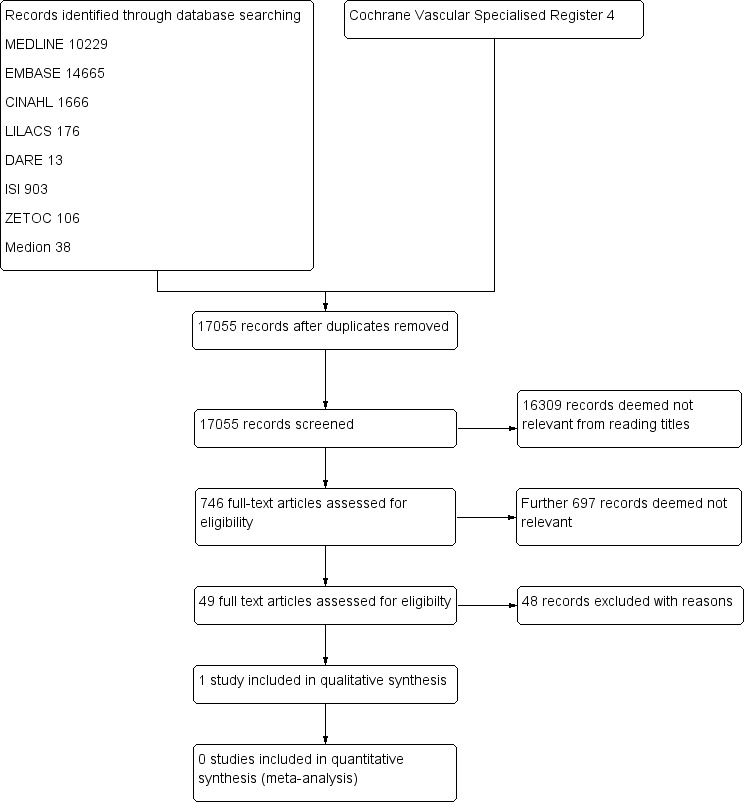
Main results: We screened 17,055 records identified through searches of databases. We obtained 746 full-text articles and assessed them for relevance. We scrutinised 49 studies to establish their eligibility for inclusion in the review and excluded 48, primarily because participants were not patients presenting solely with exertional leg pain, investigators used no reference standard or investigators used neither angiography nor duplex ultrasonography as the reference standard. We excluded most studies for more than one reason.Only one study met the eligibility criteria and provided limb-level accuracy data from just 85 participants (158 legs). This prospective study compared the manual doppler method of obtaining an ABI (performed by untrained personnel) with the automated oscillometric method. Limb-level data, as reported by the study, indicated that the accuracy of the ABI in detecting significant arterial disease on angiography is superior when stenosis is present in the femoropopliteal vessels, with sensitivity of 97% (95% confidence interval (CI) 93% to 99%) and specificity of 89% (95% CI 67% to 95%) for oscillometric ABI, and sensitivity of 95% (95% CI 89% to 97%) and specificity of 56% (95% CI 33% to 70%) for doppler ABI. The ABI threshold was not reported. Investigators attributed the lower specificity for doppler to the fact that a tibial or dorsalis pedis pulse could not be detected by doppler in 12 of 27 legs with normal vessels or non-significant lesions. The superiority of the oscillometric (automated) method for obtaining an ABI reading over the manual method with a doppler probe used by inexperienced operators may be a clinically important finding.
Authors' conclusions: Evidence about the accuracy of the ankle brachial index for the diagnosis of PAD in people with leg pain on exercise that is alleviated by rest is sparse. The single study included in our review provided only limb-level data from a few participants. Well-designed cross-sectional studies are required to evaluate the accuracy of ABI in patients presenting with early symptoms of peripheral arterial disease in all healthcare settings. Another systematic review of existing studies assessing the use of ABI in alternative patient groups, including asymptomatic, high-risk patients, is required.
Conflict of interest statement
FC: none known. KW: none known. AA: none known. FMC: none known.
This review forms part of a National Institute of Health Research (NIHR) Cochrane programme grant (10/4001/14) and is being conducted independently of our funders, the NIHR. The NIHR has had no input on the conduct or results of the review.
Figures
Update of
References
References to studies included in this review
Vega 2011 {published data only}
-
- Vega J, Romani S, Garciperez J, Vicente L, Pacheco N, Zamorano J, et al. Peripheral arterial disease: efficacy of the oscillometric method. Revista Espanola De Cardiologia 2011;64(7):619‐21. - PubMed
References to studies excluded from this review
Akhtar 2009 {published data only}
-
- Akhtar B, Siddique S, Khan RA, Zulfiqar S. Detection of atherosclerosis by ankle brachial index: evaluation of palpatory method versus ultrasound Doppler technique. Journal of Ayub Medical College, Abbottabad 2009;21(1):11‐6. - PubMed
Alnaeb 2007 {published data only}
-
- Alnaeb ME, Crabtree VP, Boutin A, Mikhailidis DP, Seifalian AM, Hamilton G. Prospective assessment of lower‐extremity peripheral arterial disease in diabetic patients using a novel automated optical device. Angiology 2007;58(5):579. - PubMed
Alnaeb 2008 {published data only}
-
- Alnaeb ME, Boutin A, Crabtree VP, Mikhailidis DP, Seifalian AM, Hamilton G. Assessment of lower extremity peripheral arterial disease using a novel automated optical device. Vascular and Endovascular Surgery 2008;41(6):522‐7. - PubMed
Armstrong 2010 {published data only}
Baxter 1993 {published data only}
-
- Baxter GM, Polak JF. Lower limb colour flow imaging: a comparison with ankle:brachial measurements and angiography. Clinical Radiology 1993;47:91‐5. - PubMed
Beckman 2005 {published data only}
-
- Beckman JA, Higgins CO, Gerhard‐Herman M. Automated oscillometric determination of the ankle‐brachial index provides accuracy necessary for office practice. Hypertension 2005;47:35‐8. - PubMed
Benchimol 2009 {published data only}
-
- Benchimol D, Pillois X, Benchimol A, Houitte A, Sagardiluz P, Tortelier L, et al. Accuracy of ankle‐brachial index using an automatic blood pressure device to detect peripheral artery disease in preventive medicine. Archives of Cardiovascular Diseases 2009;102:519‐24. - PubMed
Beutner 2012 {published data only}
-
- Beutner F, Teren A, Gielen S, Schuler G, Wirkner K, Tiller D, et al. Automated photoplethysmography‐based determination of ankle‐brachial: a validation study against doppler sonography. Clinical Research in Cardiology 2012;101:875‐83. - PubMed
Bogomolov 2012 {published data only}
-
- Bogomolov MS, Sedov VM, Slobodianiuk VV. Reliability of doppler examination and measurement of ABI for diagnostic peripheral arterial disease. Khirurglia 2012;9:78‐81. - PubMed
Cacoub 2005 {published data only}
-
- Cacoub P, Luizy F, Saadoun D, Michon‐Pasturel M, Hello C, Frances Y, et al. Screening for peripheral arterial disease by the ankle‐brachial pressure index (ABPI) using Stethoflux™ in comparison to continuous wave doppler. Circulation. 2005; Vol. 112, issue 17:U863‐U864.
Carmo 2009 {published data only}
-
- Carmo GAL, Mandil A, Nascimento BR, Arantes BD, Brittencourt JC, Falqueto EB, et al. Can we measure the ankle‐brachial index using only a stethoscope? A pilot study. Family Practice 2009;26:22‐6. - PubMed
Clairotte 2009 {published data only}
Cortez‐Cooper 2003 {published data only}
-
- Cortez‐Cooper MY, Supak JA, Tanaka H. A new screening device for automatic measurements of arterial stiffness and ankle brachial index. American Journal of Hypertension 2003;16(81):138A. - PubMed
Eason 2005 {published data only}
-
- Eason SL, Petersen NJ, Suarez‐Almazor M, Davis B, Collins TC. Diabetes mellitus, smoking, and the risk for asymptomatic peripheral arterial disease: whom should we screen?. Journal of the American Board of Family Practice / American Board of Family Practice 2005;18:355‐61. - PubMed
Ena 2011 {published data only}
-
- Ena J, Lozano T, Verdú G, Argente CR, González VL. Accuracy of ankle‐brachial index obtained by automated blood pressure measuring devices in patients with diabetes mellitus. Diabetes Research and Clinical Practice 2011;92:329‐36. - PubMed
Espeland 2008 {published data only}
Feigelson 1994 {published data only}
-
- Feigelson HS, Criqui MH, Fronek A, Langer RD, Molgaard CA. Screening for peripheral arterial disease: the sensitivity, specificity, and predictive value of noninvasive tests in a defined population. American Journal of Epidemiology 1994;140(6):526‐34. - PubMed
Fronek 1999 {published data only}
-
- Fronek A, Oglevie S, Curran B, Fronek K. Combination of pressure and velocity parameters in the non‐invasive diagnosis of aorto‐iliac disease. Vascular Medicine (London, England) 1999;4:77‐81. - PubMed
Guo 2008 {published data only}
-
- Guo X, Pang W, Zhao M, Luo Y, Sun Y, Hu D. Sensitivity and specificity of ankle‐brachial index for detecting angiographic stenosis of peripheral arteries. Ciculation Journal 2008;72:605‐10. - PubMed
Heidrich 1998 {published data only}
-
- Heidrich H, Blank B. Does the measurement of the digital arterial pressure using the doppler ultrasonic technique without testing for vasospasm to detect digital arterial occlusions make good sense?. Vasa‐Journal of Vascular Diseases 1998;27(3):158‐62. - PubMed
Hoyer 2012 {published data only}
-
- Hoyer C, Sanderman J, Petersen LJ. Randomised diagnostic accuracy study of a fully automated portable device for diagnosing peripheral arterial disease by measuring the toe‐brachial index. European Journal of Vascular and Endovascular Surgery 2013;45(1):57‐64. - PubMed
Hriljac 2004 {published data only}
-
- Hriljac I, Olin JW, Teodorescu V, Gustavson SM, Halpern JL. Measurement of resting ankle brachial index may not accurately identify disease in patients with signs or symptoms of peripheral arterial disease. Journal of the American College of Cardiology 2004;43(5s2):A459 (Abstract No. 1046‐165).
Johansson 2002 {published data only}
-
- Johansson KE, Marklund BR, Fowelin JH. Evaluation of a new screening method for detecting peripheral arterial disease in a primary health care population of patients with diabetes mellitus. Diabetic Medicine 2002;19:307‐10. - PubMed
Klein 2003 {published data only}
-
- Klein S, Hage JJ, Horst CMAM, Lagerweij M. Ankle‐arm index versus angiography for the preassessment of the fibula free flap. Plastic Reconstruction Surgery 2003;111(2):735‐43. - PubMed
Kollias 2011 {published data only}
-
- Kollias A, Xilomenos A, Protogerou A, Dimakakos E, Stergiou GS. Automated determination of the ankle‐brachial index using an oscillometeric blood pressure monitor: validation vs. doppler measurement and cardiovascular risk factor profile. Hypertension Research 2011;34:825‐30. - PubMed
Korno 2009 {published data only}
-
- Korno M, Eldrup N, Sillesen H. Comparison of ankle‐brachial index measured by an automated oscillometric apparatus with that by standard doppler technique in vascular patients. European Journal of Vascular Surgery 2009;38:610‐5. - PubMed
Kurtoglu 2009 {published data only}
-
- Kurtoglu M, Dolay K, Karamustafaoglu B, Yanar H, Kuzkaya M. The role of the ankle brachial pressure index in the diagnosis of peripheral arterial injury. Turkish Journal of Trauma and Emergency Surgery 2009;15(5):448‐52. - PubMed
Lijmer 1996 {published data only}
-
- Lijmer JG, Hunink MGM, Dungen JJAM, Loonstra J, Smit AJ. ROC analysis of non invasive tests for peripheral Arterial Disease. Ultrasound in Medicine and Biology 1996;22(4):391‐8. - PubMed
MacDougall 2008 {published data only}
Manzano 2006 {published data only}
-
- Manzano L, Vargus JA, Cepeda‐Rodrigo JM, Bianchi‐Llaves JL, Cabreu‐Roue M, Grilo‐Reina A, et al. Diagnostic value of atypical claudication for peripheral arterial disease diagnosed by a low ankle‐brachial index: MERITO study. European Heart Journal 2006;27(Suppl 1):671.
McLafferty 1997 {published data only}
-
- McLafferty RB, Moneta GL, Taylor LM Jr, Porter JM. Ability of ankle‐brachial index to detect lower‐extremity atherosclerotic disease progression. Archives of Surgery 1997;132(8):836‐40. - PubMed
Mehlsen 2008 {published data only}
-
- Mehlsen J, Wiinberg N, Bruce C. Oscillometric blood pressure measurement: a simple method in screening for peripheral arterial disease. Clinical Physiology and Functional Imaging 2008;28:426‐9. - PubMed
Nam 2010 {published data only}
-
- Nam SC, Seung HH, Sang HL, You SH, Je HW, Jae IB, et al. Factors affecting the validity of ankle‐brachial index in the diagnosis of peripheral arteria: obstructive disease. Angiology 2010;61(4):392‐6. - PubMed
Nexoe 2012 {published data only}
-
- Nexoe J, Damsbo B, Lund JO, Munck A. Measurement of blood pressure, ankle blood pressure and calculation of ankle brachial index in general practice. Family Practice 2012;29:345. - PubMed
Niazi 2006 {published data only}
-
- Niazi K, Khan TH, Easley KA. Diagnostic utility of the two methods of ankle brachial index in the detection of peripheral arterial disease of lower extremities. Catheterization and Cardiovascular Interventions 2006;68:788‐92. - PubMed
Oksala 2010 {published data only}
-
- Oksala NKJ, Viljamaa J, Saimanen E, Venermo M, on behalf of the ATTAC Study Group. Modified ankle‐brachial index detects more patients at risk in a Finnish primary health care. European Journal of Vascular Surgery 2010;39:227‐33. - PubMed
Paez 2010 {published data only}
-
- Páez EAN, Oróstegui AM, Hernández GHJ, Valencia ALI, Reyes SCI, Tapias VLF, et al. Validation of oscillometric measurement of ankle‐brachial index compared with arterial lower echo‐doppler for arterial disease [Validacion del indice tobillo brazo oscilometrico comparado con eco‐doppler arterial de miembros inferiores para enfermadad]. Revista Columbiana de Cardiologia 2010;17(4):157‐66.
Parmeswarin 2005 {published data only}
-
- Parameswaran GL, Brand K, Dolan J. Pulse oximetry as a potential screening tool for lower extremity arterial disease in asymptomatic patients with diabetes mellitus. Archives of Internal Medicine 2005;165:442‐6. - PubMed
Potier 2008 {published data only}
-
- Potier L, Clairotte C, Roussel R, Escoubet B. Automated oscillometric ankle‐brachial index measurement by nurses as a sensitive screening test for peripheral arterial disease (PAD): a doppler ultrasound validation. Diabetes 68th Scientific Sessions. 2008:Abstract number 2210‐PO.
Premalatha 2002 {published data only}
-
- Premalatha G, Ravkumar R, Sanjay R, Deepa R, Mohan V. Comparison of colour duplex ultrasound and ankle brachial pressure index measurements in peripheral vascular disease in type 2 diabetic patients with foot infections. Journal of the Association of Physicians in India 2002;50:1240‐4. - PubMed
Premanath 2010 {published data only}
Ramos 2011 {published data only}
-
- Ramos R, Baena‐Diez JM, Quesada M, Solanas P, Subirana I, Sala J, et al. Derivation and validation of REASON: a risk score identifying candidates to screen for peripheral arterial disease using ankle brachial Index. Atherosclerosis 2010;214:474‐9. - PubMed
Schroder 2006 {published data only}
-
- Schroder F, Diehm N, Kareem S, Ames M, Pira A, Zwettler U, et al. A modified calculation of ankle‐brachial pressure index is far more sensitive in the detection of peripheral arterial disease. Journal of Vascular Surgery 2006;44:531‐6. - PubMed
Stoffers 1996 {published data only}
-
- Stoffers HEJH, Kester ADM, Kaiser V, Rinkens PELM, Kitslaar EHM, Knottnerus JA. The diagnostic value of the measurement of the ankle brachial systolic pressure index in primary health care. Journal of Clinical Epidemiology 1996;49(12):1401‐5. - PubMed
Vinyoles 2007 {published data only}
-
- Vinyoles E, Pujol E, Casermeiro J, Prado C, Jabalera S, Salido V. Ankle‐brachial index to detect peripheral arterial disease: concordance and validation study between Doppler and an oscillometric device [Indice tobillo‐brazo en la deteccion de arteriopatia periferica: estudio de validez y concordiancia entre Doppler t metodo oscilometrico]. Medicina Clinica 2007;128(3):92‐4. - PubMed
Williams 2005 {published data only}
-
- Williams DT, Harding KG, Price P. An evaluation of the efficacy of methods used in screening for lower limb arterial disease in diabetes. Diabetes Care 2005;28:2206‐10. - PubMed
Wohlfahrt 2011 {published data only}
-
- Wohlfahrt P, Ingrischova M, Karjcoviechova A, Palous D, Dolejsova M, Seidlerova J, et al. A novel oscillometric device for peripheral arterial disease screening in everyday practice. International Angiography 2010;30:256‐61. - PubMed
Zhang 2010 {published data only}
-
- Zhang H, Li XY, Si XY, Lu XS, Liu ZY. Manifestations of lower extremity atherosclerosis in diabetic patients with high ankle‐brachial index. Chinese Medical Journal 2010;123(7):890‐4. - PubMed
Additional references
Aboyans 2012
-
- Aboyans V, Criqui MH, Abraham P, Allison MA, Creager MA, Dieham C, et al. Measurement and interpretation of the ankle‐brachial index: a scientific statement from the American Heart Association. Circulation 2012;126(24):2890‐909. - PubMed
Ankle Brachial Index Collaboration 2008
Bhasin 2007
Cassar 2003
-
- Cassar K, Bachoo P, Brittenden J. The effect of peripheral percutaneous transluminal angioplasty on quality of life in patients with intermittent claudication. European Journal of Vascular and Endovascular Surgery 2003;26(2):130‐6. - PubMed
Chang 2011
Dachun 2013
-
- Dachun X, Zou LZ, Xing Y, Hou L, Wei Y, Zhang J, et al. Diagnostic value of ankle‐brachial index in peripheral arterial disease: a meta analysis. Canadian Journal of Cardiology 2013;29:492‐8. - PubMed
de Backer 2012
Deeks 2005
-
- Deeks JJ, Macaskill P, Irwig L. The performance of tests of publication bias and other sample size effects in systematic reviews of diagnostic test accuracy was assessed. Journal of Clinical Epidemiology 2005;58(9):882‐93. - PubMed
Fokkenrood 2013
Fontaine 1954
-
- Fontaine R, Kim M, Kieny R. Surgical treatment of peripheral circulation disorders [Die Chirurgische Behandlung Der Peripheren Durch‐blutungsstörungen]. Helvetica Chirurgica Acta 1954;21(5‐6):499‐533. - PubMed
Harbord 2007
-
- Harbord RM, Deeks JJ, Egger M, Whiting P, Sterne JA. A unification of models for meta‐analysis of diagnostic accuracy studies. Biostatistics 2007;8(2):239‐51. - PubMed
Heald 2006
-
- Heald CL, Fowkes FG, Murray GD, Price JF, on behalf of the Ankle Brachial Index Collaboration. Risk of mortality and cardiovascular disease associated with the ankle‐brachial index: systematic review. Atherosclerosis 2006;189(1):61‐9. - PubMed
Hirsch 2001
-
- Hirsch AT, Criqui MH, Treat‐Jacobson D, Regensteiner JG, Creager MA, Olin JW, et al. Peripheral arterial disease detection awareness and treatment in primary care. JAMA 2001;286(11):1317‐24. - PubMed
Hooi 2007
-
- Hooi JD, Kester ADM, Stoffers HEJH, Rinkens PELM, Knottnerus JA, Ree JW. Asymptomatic peripheral arterial occlusive disease predicted cardiovascular morbidity and mortality in a 7 year follow‐up study. Journal of Clinical Epidemiology 2004;57(3):294‐300. - PubMed
Khan 2007
-
- Khan S, Flather M, Mister R, Delahunty N, Fowkes G, Bradbury A, et al. Characteristics and treatments of patients with peripheral arterial disease referred to UK vascular clinics: results of a prospective registry. European Journal of Vascular and Endovascular Surgery 2007;33(4):442‐50. - PubMed
Lane 2014
MacLeod‐Roberts 1995
-
- MacLeod‐Roberts J. Vascular assessment. In: Merriman LM, Tollafield DR editor(s). Assessment of the Lower Limb. 1st Edition. Edinburgh: Churchill Livingstone, 1995:79‐112.
McDermott 2000
-
- McDermott MM, Criqui MH, Liu K, Guralnik JM, Greenland P, Martin GJ, et al. Lower ankle/brachial index, as calculated by averaging the dorsalis pedis and posterior tibial arterial pressures, and association with leg functioning in peripheral arterial disease. Journal of Vascular Surgery 2000;32(6):1164‐71. - PubMed
NICE 2012
-
- NHS National Institute for Health and Clinical Excellence. Lower limb peripheral arterial disease: diagnosis and management, August 2012. guidance.nice.org.uk/cg147 (accessed 7 September 2012).
Rutherford 1997
-
- Rutherford RB, Baker JD, Ernst C, Johnston KW, Porter JM, Ahn S, et al. Recommended standards for reports dealing with lower extremity ischemia: revised version. Journal of Vascular Surgery 1997;26(3):517‐38. - PubMed
SIGN 2007
-
- Scottish InterCollegiate Guidelines Network (SIGN). Diagnosis and management of peripheral arterial disease. A national clinical guideline, 2007. www.sign.ac.uk (accessed 7 September 2012).
Twine 2009
Whiting 2011
-
- Whiting PF, Rutjes AW, Westwood ME, Mallett S, Deeks JJ, Reitsma JB, et al. QUADAS‐2 Group. QUADAS‐2: a revised tool for the quality assessment of diagnostic accuracy studies. Annals of Internal Medicine 2011;155(8):529‐36. - PubMed
Publication types
Grants and funding
LinkOut - more resources
Full Text Sources
Other Literature Sources
Miscellaneous
