


Comment
doi: 10.4161/23328940.2014.982048.
eCollection 2014 Oct-Dec.
Correctly identifying responses is critical for understanding homeostatic and allostatic regulation
Affiliations
- PMID: 27624452
- PMCID: PMC5008704
- DOI: 10.4161/23328940.2014.982048
Item in Clipboard
Comment
Correctly identifying responses is critical for understanding homeostatic and allostatic regulation
Temperature (Austin).
.
Abstract
Homeostasis stabilizes critical biological variables within appropriate limits via corrective regulatory effector responses that adequately counter disturbing effects. Identifying individual effects and responses, and distinguishing their individual influences on a regulated state, is challenging. Studying effector responses can reveal regulatory phenomena that depart from homeostasis into the realm of allostasis.
Keywords: addiction; allostasis; homeostasis; nitrous oxide; obesity; regulation; sign reversal; thermoregulation.
Figures
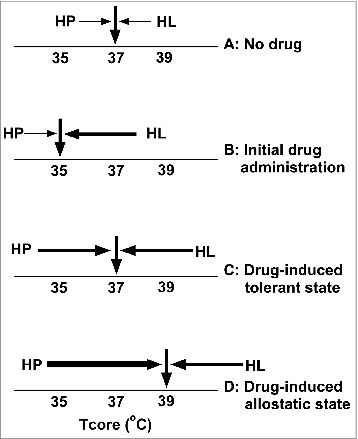
Simple thermoregulatory heuristic distilled from our research findings illustrating the importance of identifying actual regulatory responses for studying regulatory adaptation. (A) Prior to administration of the hypothermia-promoting drug nitrous oxide, core temperature (Tcore) rests at its characteristic normothermic balance point via the actions of an intricate regulatory system in which heat loss (HL) and heat production (HP) are balanced at that point (equal opposing arrows with minimal energetic cost). (B) Initial administration of ≥ 60% nitrous oxide to rats results in hypothermia by selectively promoting an increase in HL (a “primary drug effect”). (C) Following several nitrous oxide administrations, Tcore remains at or near its characteristic normothermic balance point during nitrous oxide inhalation. Note, however, that designating Tcore as a response and measuring only this outcome during nitrous oxide administration would suggest that the subject has become insensitive to nitrous oxide. However, the state of chronic tolerance does not reflect the development of insensitivity to nitrous oxide's effect to promote HL, but instead reflects thermoregulatory adaptations that confer the ability to effectively and promptly match the drug's largely intact HL effect with a centrally mediated countervailing HP regulatory response. (D) Additional nitrous oxide administrations result in a striking acquired thermoregulatory phenotype wherein the HP response during nitrous oxide inhalation substantially exceeds the drug's effect to promote HL, revealing a state of disordered (allostatic) regulation. This state is inconsistent with canonical homeostatic theory, and we propose that thermoregulatory allostasis reflects the interaction of a non-naturalistic stressor with a thermoregulatory system comprised of multiple relatively independent effector loops that are not subservient to an overarching Tcore set-point. [Numerous factors in addition to the drug's effect and centrally elicited thermoregulatory system responses contribute to the balance point of Tcore, e.g., environmental factors determining HL via conduction, convection, radiation and evaporation; the gradient between Tcore and ambient temperature; recruitment of extra-thermoregulatory stress responses that might alter thresholds and gains associated with individual thermoeffector loops.]
Comment on
-
Clarifying the roles of homeostasis and allostasis in physiological regulation.Psychol Rev. 2014 Apr;121(2):225-47. doi: 10.1037/a0035942. Psychol Rev. 2014. PMID: 24730599 Free PMC article.
References
-
- Ramsay DS, Woods SC. Clarifying the roles of homeostasis and allostasis in physiological regulation. Psychol Rev 2014; 121:225-47; PMID:24730599; http://dx:doi.org/10.1037/a0035942 - DOI - PMC - PubMed
-
- Ramsay DS, Woods SC. Biological consequences of drug administration: implications for acute and chronic tolerance. Psychol Rev 1997; 104:170-93; PMID:9009884; http://dx:doi.org/10.1037/0033-295X.104.1.170 - DOI - PubMed
-
- Schuckit MA. Low level of response to alcohol as a predictor of future alcoholism. Am J Psychiatry 1994; 151:184-9; PMID:8296886 - PubMed
-
- Kaiyala KJ, Butt S, Ramsay DS. Direct evidence for systems-level modulation of initial drug (in)sensitivity in rats. Psychopharmacology (Berl) 2007; 191:243-51; PMID:17237917; http://dx:doi.org/10.1007/s00213-006-0657-z - DOI - PubMed
-
- Kaiyala KJ, Chan B, Ramsay DS. Robust thermoregulatory overcompensation, rather than tolerance, develops with serial administrations of 70% nitrous oxide to rats. J Therm Biol 2012; 37:30-40; PMID:22247586; http://dx:doi.org/10.1016/j.jtherbio.2011.10.004 - DOI - PMC - PubMed
Publication types
LinkOut - more resources
Full Text Sources
Other Literature Sources
