


Complexity As Key to Designing Cognitive-Friendly Environments for Older People
- PMID: 27625629
- PMCID: PMC5003839
- DOI: 10.3389/fpsyg.2016.01329
Complexity As Key to Designing Cognitive-Friendly Environments for Older People
Abstract
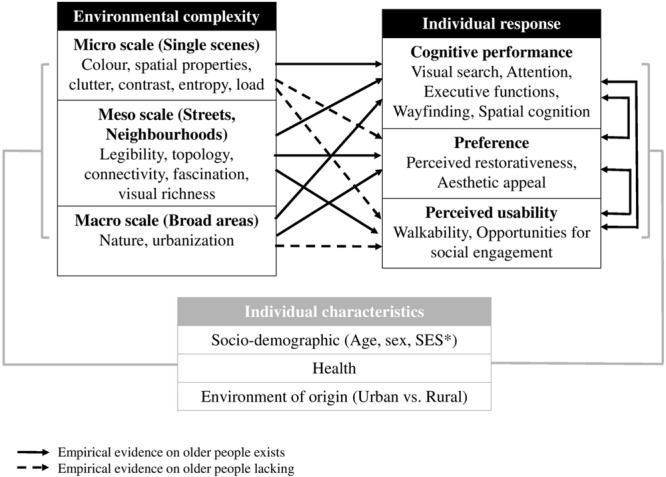
The lived environment is the arena where our cognitive skills, preferences, and attitudes come together to determine our ability to interact with the world. The mechanisms through which lived environments can benefit cognitive health in older age are yet to be fully understood. The existing literature suggests that environments which are perceived as stimulating, usable and aesthetically appealing can improve or facilitate cognitive performance both in young and older age. Importantly, optimal stimulation for cognition seems to depend on experiencing sufficiently stimulating environments while not too challenging. Environmental complexity is an important contributor to determining whether an environment provides such an optimal stimulation. The present paper reviews a selection of studies which have explored complexity in relation to perceptual load, environmental preference and perceived usability to propose a framework which explores direct and indirect environmental influences on cognition, and to understand these influences in relation to aging processes. We identify ways to define complexity at different environmental scales, going from micro low-level perceptual features of scenes, to design qualities of proximal environments (e.g., streets, neighborhoods), to broad geographical areas (i.e., natural vs. urban environments). We propose that studying complexity at these different scales will provide new insight into the design of cognitive-friendly environments.
Keywords: aging; cognition; environmental complexity; environmental preference; perceptual load; usability.
Figures
References
-
- Abkar M., Mustafa Kamal M. S., Maulan S., Davoodi S. R. (2011). Determining the visual preference of urban landscapes. Sci. Res. Essays 6 1991–1997. 10.5897/SRE11.171 - DOI
-
- Adkins A., Dill J., Luhr G. A., Neal M. B. (2012). Unpacking walkability: testing the influence of urban design features on perceptions of walking environment attractiveness. J. Urban Des. 17 499–510. 10.1080/13574809.2012.706365 - DOI
-
- Badland H. M., Schofield G. M. (2005). The built environment and transport-related physical activity: what we do and do not know. J. Phys. Act. Health 2 433–442. 10.1123/jpah.2.4.435 - DOI
-
- Barker R. G. (1968). Ecological Psychology: Concepts and Methods for Studying the Environment of Human Behavior. Palo Alto, CA: Stanford University Press.
Publication types
LinkOut - more resources
Full Text Sources
Other Literature Sources
Research Materials
