. 2016 Mar 1;3(1):23-33.
doi: 10.1089/soro.2015.0019.

Soft Robotic Grippers for Biological Sampling on Deep Reefs

Affiliations

Soft Robotic Grippers for Biological Sampling on Deep Reefs

Kevin C Galloway et al. Soft Robot. .

Abstract

This article presents the development of an underwater gripper that utilizes soft robotics technology to delicately manipulate and sample fragile species on the deep reef. Existing solutions for deep sea robotic manipulation have historically been driven by the oil industry, resulting in destructive interactions with undersea life. Soft material robotics relies on compliant materials that are inherently impedance matched to natural environments and to soft or fragile organisms. We demonstrate design principles for soft robot end effectors, bench-top characterization of their grasping performance, and conclude by describing in situ testing at mesophotic depths. The result is the first use of soft robotics in the deep sea for the nondestructive sampling of benthic fauna.


Figures
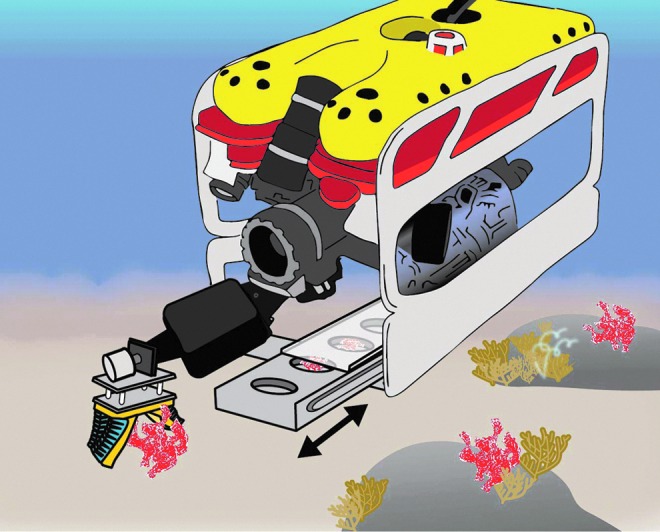
<b>FIG. 1.</b>
FIG. 1.
Concept figure of Seaeye Falcon remotely operated vehicle (ROV) with soft robotic manipulator handling an urchin. Color images available online at www.liebertpub.com/soro
<b>FIG. 2.</b>
FIG. 2.
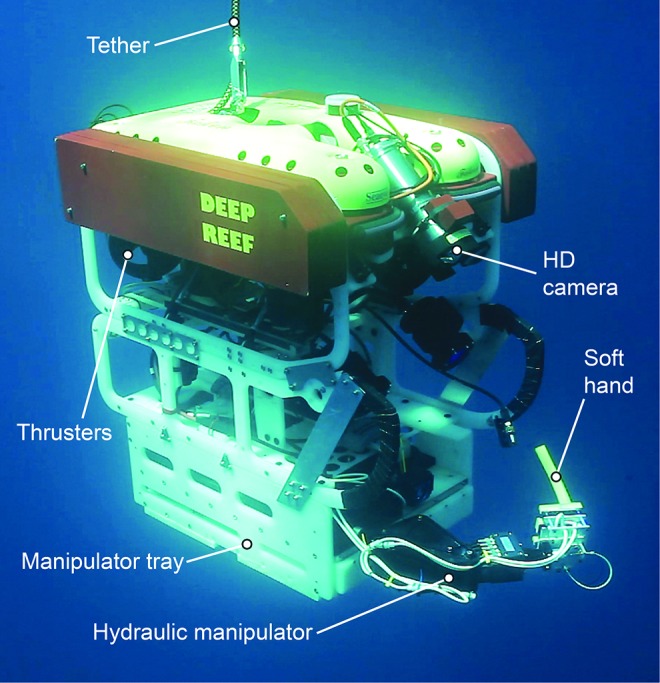
The Seaeye Falcon submersible—aka Deep Reef ROV—was the platform used for all the deep sea soft robotic gripper experiments. Color images available online at www.liebertpub.com/soro
<b>FIG. 3.</b>
FIG. 3.
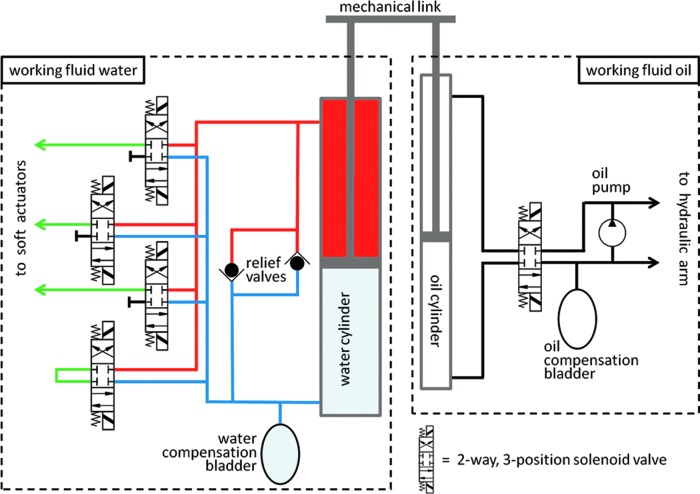
Schematic of the hydraulic system used to power the soft robotic gripper. Color images available online at www.liebertpub.com/soro
<b>FIG. 4.</b>
FIG. 4.
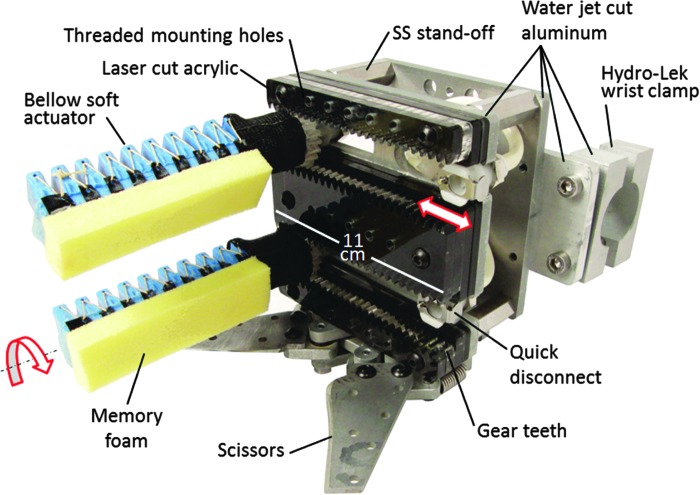
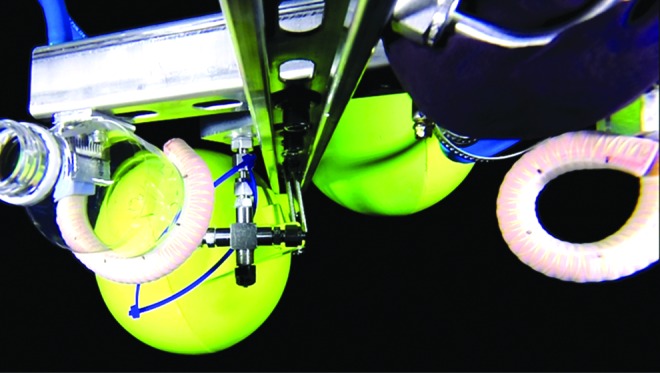
Assembled soft robotic gripper featuring two bellows-style soft actuators with memory foam textures. The rectangular shaped palm measures 11 × 10 cm. SS, stainless steel. Color images available online at www.liebertpub.com/soro
<b>FIG. 5.</b>
FIG. 5.
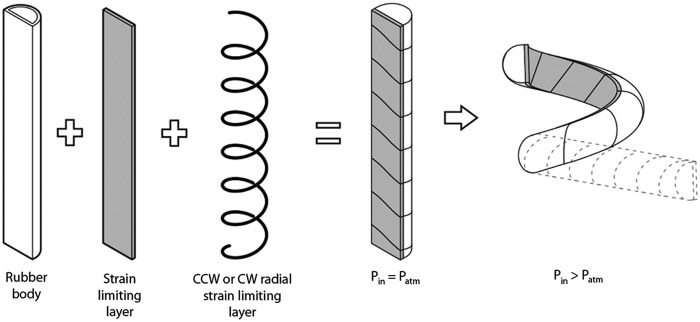
Components of a fiber-reinforced boa-type actuator (adapted from Polygerinos et al.).
<b>FIG. 6.</b>
FIG. 6.
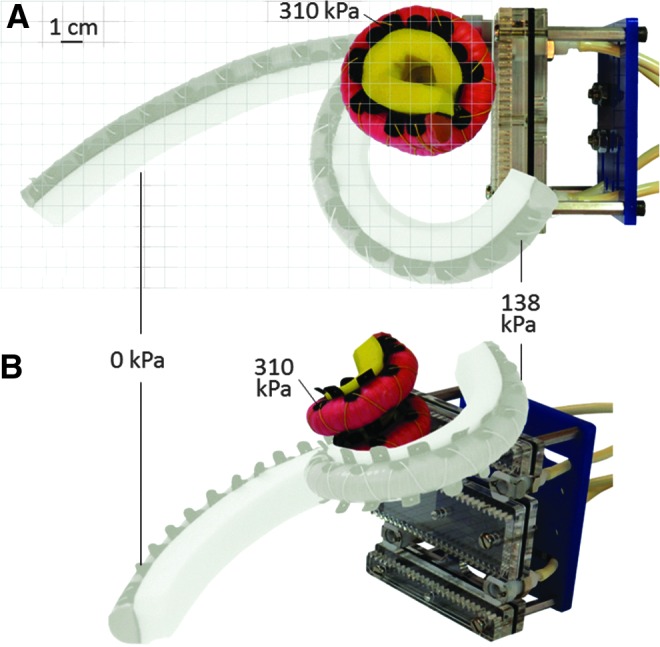
(A) Top view of the boa-type actuator's range of motion against an approximated grid scale. (B) Isometric view of the actuator's range of motion. Color images available online at www.liebertpub.com/soro
<b>FIG. 7.</b>
FIG. 7.
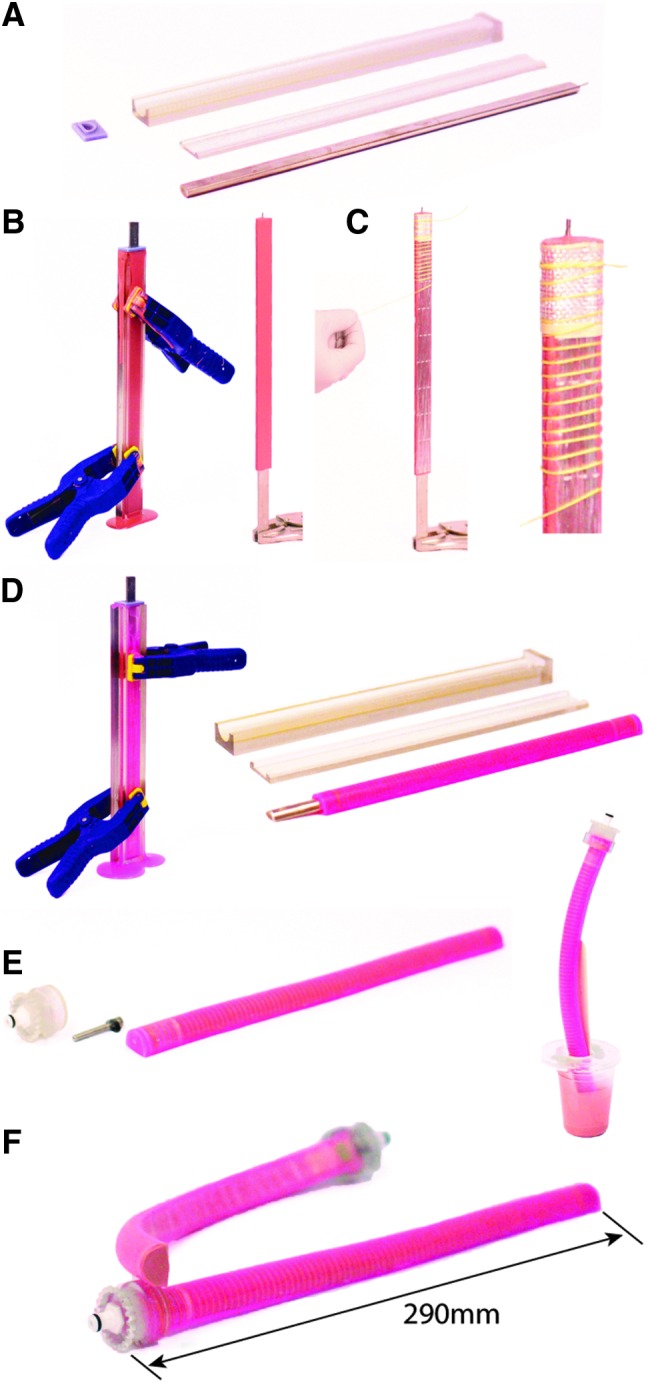
Schematic diagram outlining the stages of the boa-type actuator fabrication process. (A) The actuator bladder is molded using 3D-printed molds and the internal geometry is formed with a half-round steel rod. (B) Liquid polymer (M4601 by Wacker Chemical, Inc.) is poured into the clamped mold and the half-round rod is inserted into the center. The polymer is cured and removed from the mold. (C) Strain-limiting materials (i.e., fiber reinforcements) are applied to the exterior of the bladder. (D) The fiber-reinforced bladder is inserted into a second mold filled with liquid polymer (Dragon Skin 20 by Smooth On) to add a thin skin (∼1 mm thick) around the actuator body to hold the strain-limiting materials in place. The actuator body is then removed from the mold. (E) The half-round rod is removed and coupling hardware is installed on one end of the actuator. The other end of the actuator is sealed with more polymer. (F) Excess polymer is trimmed from the end and the actuator is complete. Color images available online at www.liebertpub.com/soro
<b>FIG. 8.</b>
FIG. 8.
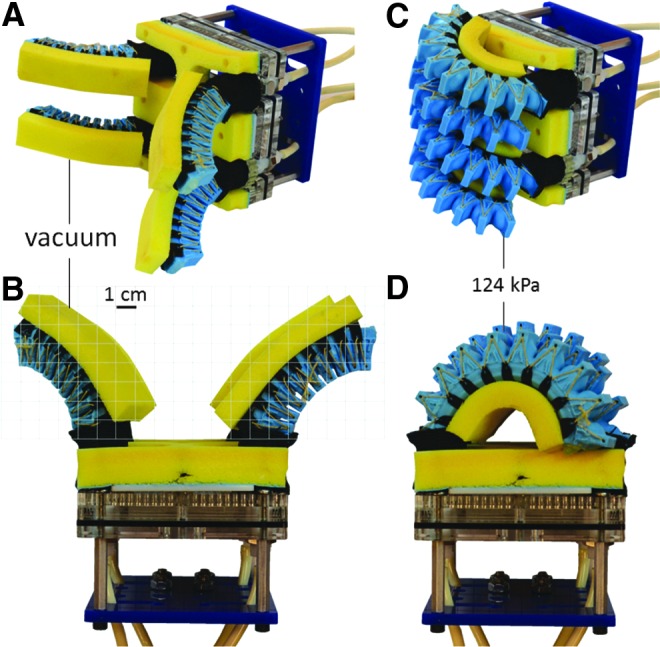
(A, B) Isometric and top view, respectively, of the bellows-type soft actuators under vacuum in the open pose state. The grid scale is approximated. (C, D) Isometric and top view of the bellows-type soft actuators pressurized to 124 kPa (18 psi). Color images available online at www.liebertpub.com/soro
<b>FIG. 9.</b>
FIG. 9.
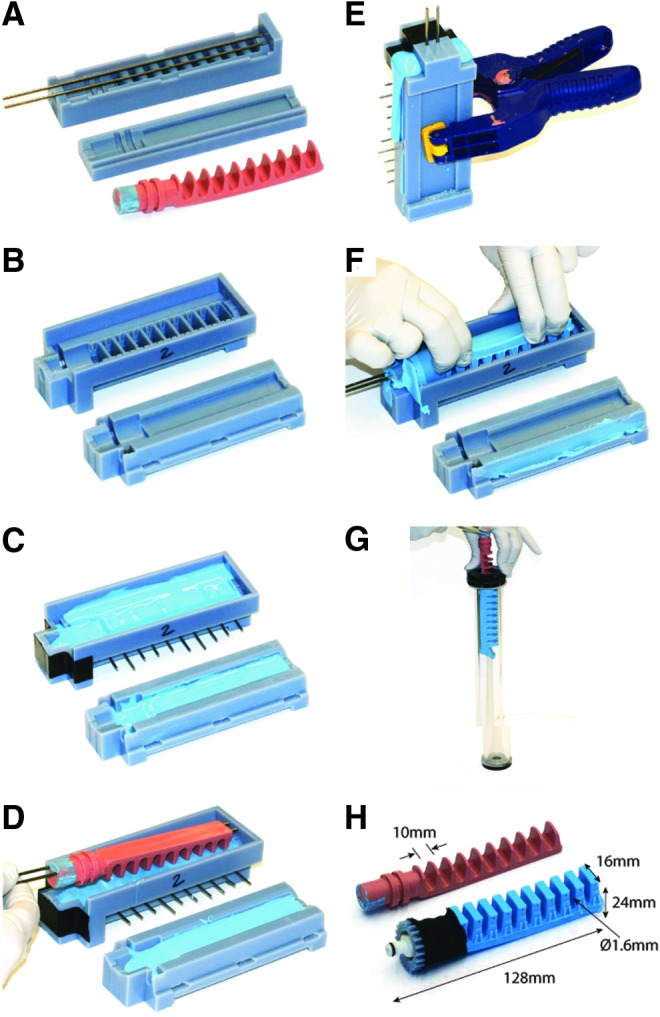
Schematic diagram outlining the stages of the soft, bellows-type actuator fabrication process. (A) A silicone form—a soft core—for the actuator's internal geometry is molded in 3D-printed molds. (B) 3D-printed molds define the actuator's exterior geometry. (C) Liquid polymer fills both halves of the mold. (D) The soft core form is positioned in the mold. (E) The two mold halves are clamped together and polymer is allowed to cure. (F) The actuator is removed from the mold as one piece. (G) The soft core is extracted with assistance from a vacuum tube. (H) Hardware for pneumatic coupling is installed. Color images available online at www.liebertpub.com/soro
<b>FIG. 10.</b>
FIG. 10.
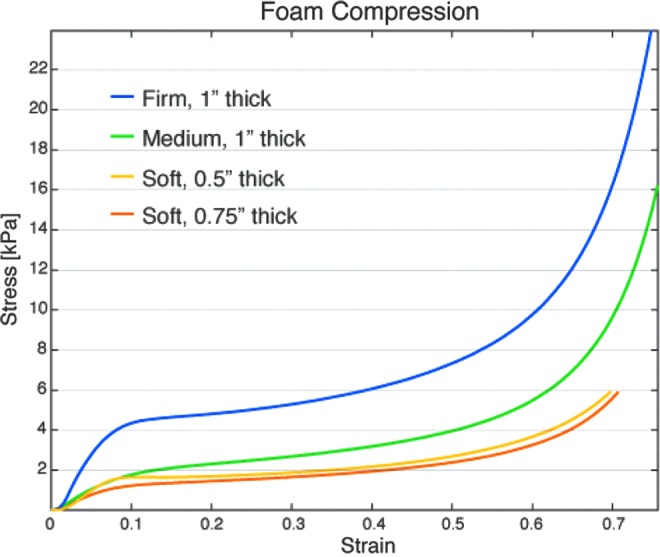
Stress–strain response of open-cell memory foam under compression. The nonlinear behavior supports a relatively consistent distribution of load for strains from 10% to 50%. Color images available online at www.liebertpub.com/soro
<b>FIG. 11.</b>
FIG. 11.
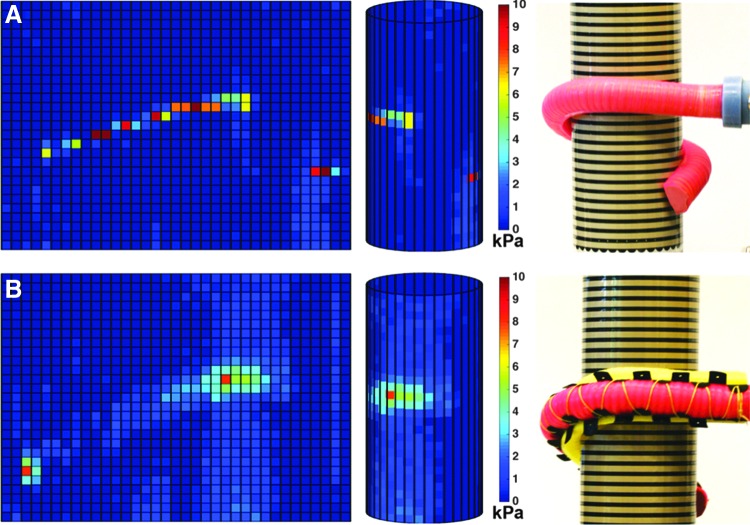
Pressure map of a boa-type fiber-reinforced soft actuator—without (A) and with (B) memory foam liner—wrapping around a 2 inch diameter cylinder with a Tekscan pressure map sensor. Both configurations apply relatively low contact forces (<10 kPa) to the cylinder; however, the memory foam liner (B) improves pressure distribution and reduces peak forces. Color images available online at www.liebertpub.com/soro
<b>FIG. 12.</b>
FIG. 12.
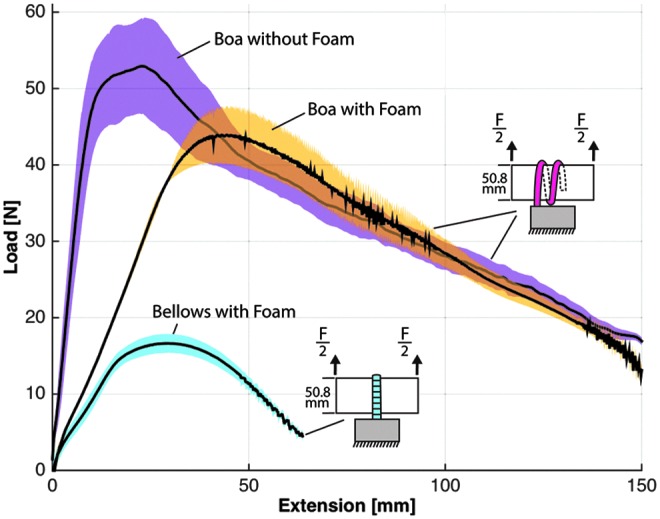
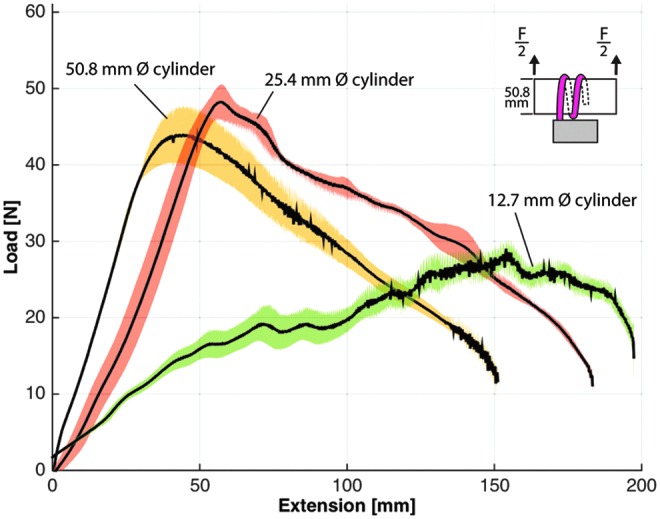
Vertical load–extension response of the boa-type gripper with and without a foam inner surface and the bellows-type gripper with foam gripping a 50.8-mm diameter. Color images available online at www.liebertpub.com/soro
<b>FIG. 13.</b>
FIG. 13.
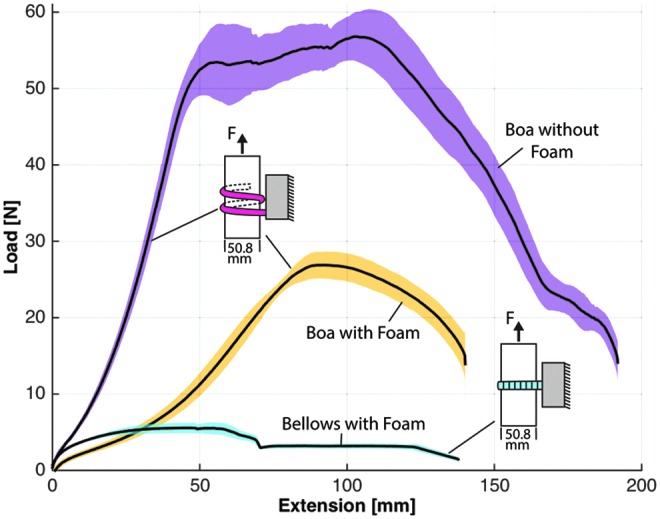
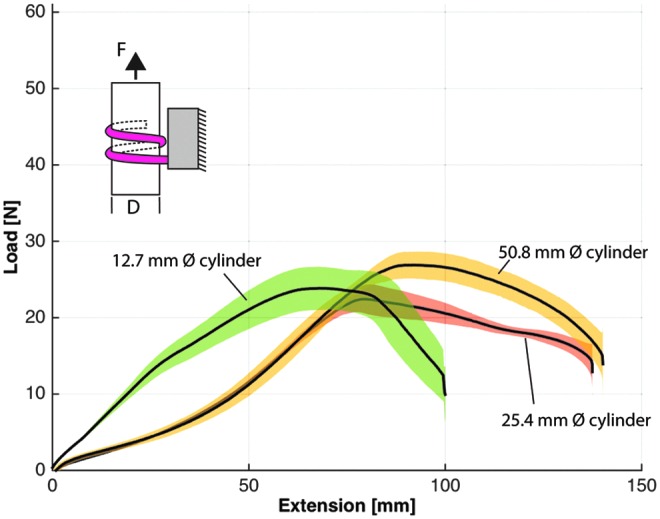
Horizontal load–extension response of the boa-type gripper with and without foam and the bellows-type actuators with foam gripping a 50.8-mm diameter acrylic tube. Color images available online at www.liebertpub.com/soro
<b>FIG. 14.</b>
FIG. 14.
Vertical load–extension response of the boa-type gripper with foam for three different diameter acrylic tubes—12.7, 25.4, and 50.8 mm diameter. Color images available online at www.liebertpub.com/soro
<b>FIG. 15.</b>
FIG. 15.
Horizontal load–extension response of the boa-type gripper with foam for three different diameter acrylic tubes—12.7, 25.4, and 50.8 mm diameter. Color images available online at www.liebertpub.com/soro
<b>FIG. 16.</b>
FIG. 16.
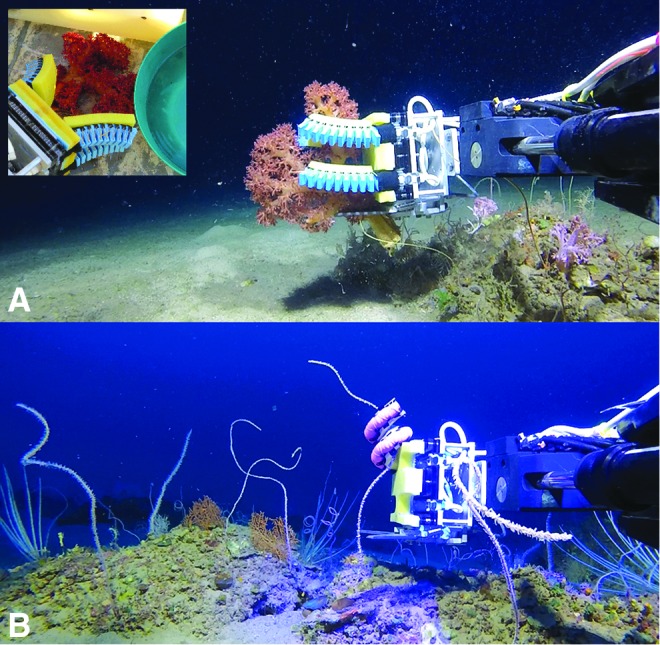
(A) Bellows-type gripper collecting soft coral (Dendronephthya sp.) with inset image showing the sample on the deck of the ship. (B) Boa-type gripper collecting an Alcyonacean whip coral at a depth of 100 m. The arm and gripper were visually controlled using the Deep Reef's onboard cameras. Color images available online at www.liebertpub.com/soro
<b>APPENDIX FIG. A1.</b>
APPENDIX FIG. A1.
A test rig lowered more than 800 m to evaluate the influence of high-hydrostatic forces on the soft fiber-reinforced actuators. Color images available online at www.liebertpub.com/soro

References

    1. Darwin CR. The Structure and Distribution of Coral Reefs, 3rd ed. New York: Appleton and Co., 1889.
    1. Fricke H, Vareschi E, Oecologia DS. Photoecology of the coral Leptoseris fragilis in the Red Sea twilight zone (an experimental study by submersible). Oecologia 1987;733:371–381 - PubMed
    1. Sparks J, Gruber D. A new mesophotic clingfish (Teleostei: Gobiesocidae) from the bahamas. Copeia 2012;2:251–256
    1. Nir O, Gruber DF, Einbinder S, Kark S, Tchernov D. Changes in scleractinian coral Seriatopora hystrix morphology and its endocellular Symbiodinium characteristics along a bathymetric gradient from shallow to mesophotic reef. Coral Reefs 2011;30:1089–1100
    1. Roth MS, Padilla-Gamiño JL, Pochon X, Bidigare RR, Gates RD, Smith CM, et al. . Fluorescent proteins in dominant mesophotic reef-building corals. Mar Ecol Prog Ser 2015;521:63–79