Review
. 2016 Sep 12;8(9):246.
doi: 10.3390/v8090246.

On the Selective Packaging of Genomic RNA by HIV-1

Affiliations
Review

On the Selective Packaging of Genomic RNA by HIV-1

Mauricio Comas-Garcia et al. Viruses. .

Abstract

Like other retroviruses, human immunodeficiency virus type 1 (HIV-1) selectively packages genomic RNA (gRNA) during virus assembly. However, in the absence of the gRNA, cellular messenger RNAs (mRNAs) are packaged. While the gRNA is selected because of its cis-acting packaging signal, the mechanism of this selection is not understood. The affinity of Gag (the viral structural protein) for cellular RNAs at physiological ionic strength is not much higher than that for the gRNA. However, binding to the gRNA is more salt-resistant, implying that it has a higher non-electrostatic component. We have previously studied the spacer 1 (SP1) region of Gag and showed that it can undergo a concentration-dependent conformational transition. We proposed that this transition represents the first step in assembly, i.e., the conversion of Gag to an assembly-ready state. To explain selective packaging of gRNA, we suggest here that binding of Gag to gRNA, with its high non-electrostatic component, triggers this conversion more readily than binding to other RNAs; thus we predict that a Gag-gRNA complex will nucleate particle assembly more efficiently than other Gag-RNA complexes. New data shows that among cellular mRNAs, those with long 3'-untranslated regions (UTR) are selectively packaged. It seems plausible that the 3'-UTR, a stretch of RNA not occupied by ribosomes, offers a favorable binding site for Gag.

Keywords: HIV-1; RNA-protein interactions; capsid; encapsidation; genomic RNA; packaging; retroviral RNA; retroviruses; selective RNA packaging; virus assembly.


Conflict of interest statement

The authors declare no conflict of interest. The founding sponsors had no role in the design of the study; in the collection, analyses, or interpretation of data; in the writing of the manuscript, and in the decision to publish the results.

Figures
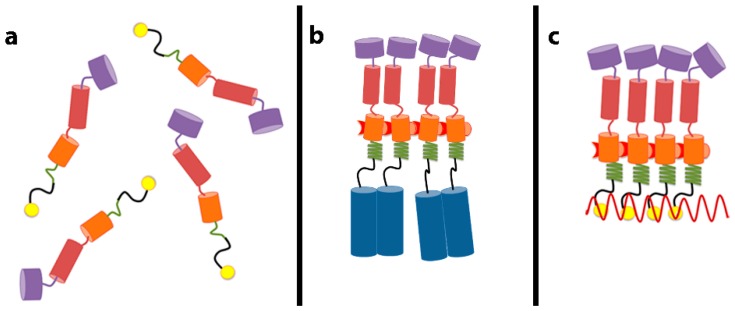
Figure 1
Figure 1
Schematic depiction of changes in Gag leading to assembly. (a) Gag contains several domains: matrix (MA, purple), the N-terminal domain of capsid (CA, red), the C-terminal domain of CA (orange), spacer 1 (SP1) (green), nucleocapsid (NC, yellow), and spacer 2 (SP2) and p6 (not shown). SP1 is unstructured in free Gag; (b) When NC is replaced by a dimerizing leucine zipper (blue cylinders), the dimerization mediated by the zipper induces SP1 to fold into a helical conformation. We propose that this leads to the appearance of new interfaces within CA for Gag–Gag interaction; (c) Gag molecules can also be brought into close proximity by binding cooperatively to an RNA molecule (wavy red line). This also causes helix formation in SP1 and interface formation in CA. We propose that this is a step in normal virion assembly.
Figure 2
Figure 2
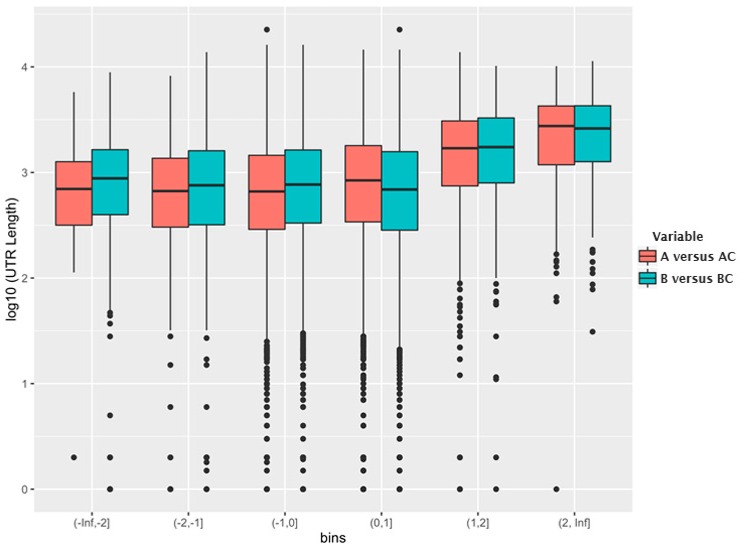
Relationship between bins of similar log2 (fold change) on the x-axis and the log10 (UTR length) on the y-axis. A, mRNAs encapsidated in HIV-1 virus-like particles (VLPs); AC, mRNAs in cells producing HIV-1 VLPs; B, mRNAs encapsidated in murine leukemia virus (MLV) VLPs; BC, mRNAs in cells producing MLV VLPs.
Figure 3
Figure 3
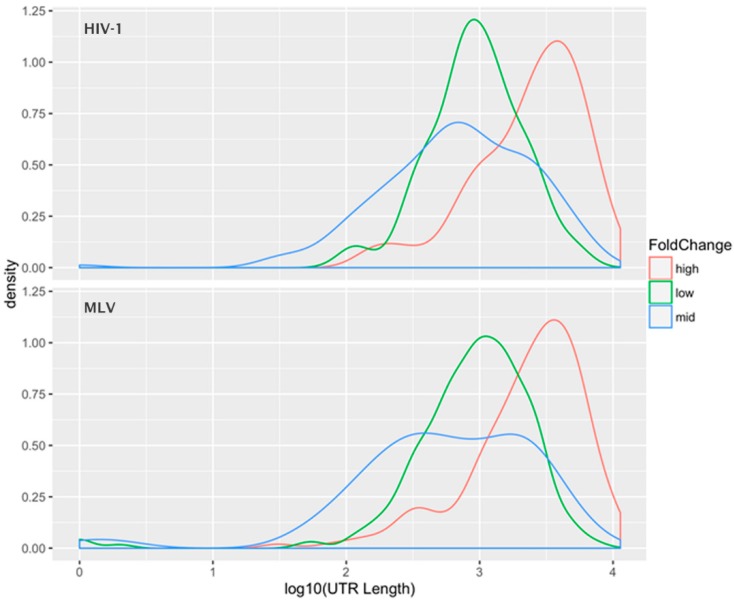
Preferential encapsidation of messenger RNA (mRNA) molecules with long 3′ UTRs. The log fold changes between messenger RNA (mRNA) measurements in the cellular and viral components were divided into groups of 1000 genes. The 1000 most excluded RNA species, labeled low; an “average” group representing the middle 1000 genes; and the 1000 most enriched mRNAs, the “high” group, are represented by different colored density plots. The plot depicts the log10 (UTR length) on the x-axis and the density on the y-axis. Upper panel: HIV-1; lower panel, MLV.
Figure 4
Figure 4
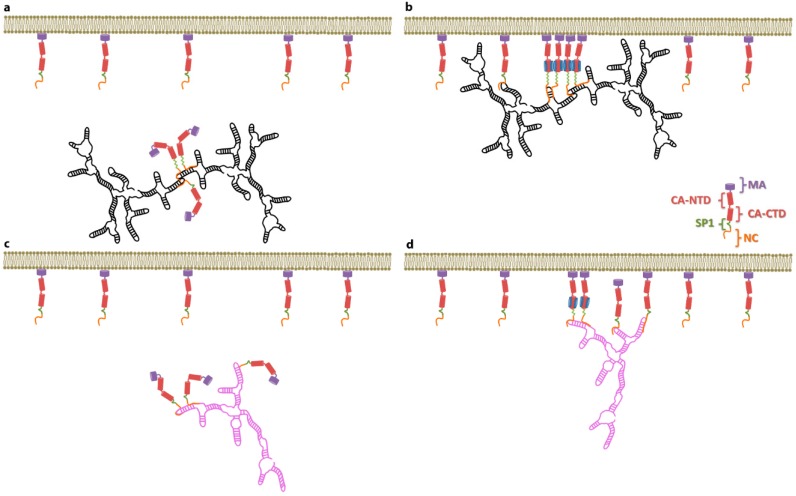
Schematic representation of the binding of HIV-1 Gag to the dimeric HIV-1 genomic RNA (gRNA) (a,b) and to non-Ψ RNA (c,d). (a) In the cytoplasm Gag binds to the HIV-1 gRNA by recognizing the RNA dimeric interface. Binding of Gag to Ψ increases the local concentration of Gag, thus promoting a conformational change in the SP1 domain from a random coil to an α-helix (green portion of Gag); (b) Once the HIV-1 Gag–dimeric gRNA complexes are bound to the plasma membrane, the specific Gag–RNA interactions promote a conformational change in Gag that enables high-order Gag–Gag interactions (blue interface); (c) In the absence of the HIV-1 gRNA Gag binds to mRNAs; however, because these interactions are non-specific, a higher Gag concentration is required to induce the conformational change in Gag; (d) When Gag–non-Ψ RNA complexes are bound to the plasma membrane, the local concentration of Gag is high enough to promote high-order Gag–Gag interactions. MA: matrix; CA-NTD: N-terminal domain of the capsid; CA-CTD: C-terminal domain of the capsid; SP1: spacer 1; NC: nucleocapsid.

References

    1. Moore M.D., Hu W.S. HIV-1 RNA dimerization: It takes two to tango. AIDS Rev. 2009;11:91–102. - PMC - PubMed
    1. Paillart J.C., Shehu-Xhilaga M., Marquet R., Mak J. Dimerization of retroviral RNA genomes: An inseparable pair. Nat. Rev. Microbiol. 2004;2:461–472. doi: 10.1038/nrmicro903. - DOI - PubMed
    1. Aldovini A., Young R.A. Mutations of RNA and protein sequences involved in human immunodeficiency virus type 1 packaging result in production of noninfectious virus. J. Virol. 1990;64:1920–1926. - PMC - PubMed
    1. Lever A., Gottlinger H., Haseltine W., Sodroski J. Identification of a sequence required for efficient packaging of human immunodeficiency virus type 1 RNA into virions. J. Virol. 1989;63:4085–4087. - PMC - PubMed
    1. Gorelick R.J., Nigida S.M., Jr., Bess J.W., Jr., Arthur L.O., Henderson L.E., Rein A. Noninfectious human immunodeficiency virus type 1 mutants deficient in genomic RNA. J. Virol. 1990;64:3207–3211. - PMC - PubMed

Publication types