


Effect of Intensive Chemotherapy on Physical, Cognitive, and Emotional Health of Older Adults with Acute Myeloid Leukemia
- PMID: 27627675
- PMCID: PMC5072995
- DOI: 10.1111/jgs.14301
Effect of Intensive Chemotherapy on Physical, Cognitive, and Emotional Health of Older Adults with Acute Myeloid Leukemia
Abstract
Objectives: To measure short-term changes in physical and cognitive function and emotional well-being of older adults receiving intensive chemotherapy for acute myeloid leukemia (AML).
Design: Prospective observational study.
Setting: Single academic institution.
Participants: Individuals aged 60 and older with newly diagnosed AML who received induction chemotherapy (N = 49, mean age 70 ± 6.2, 56% male).
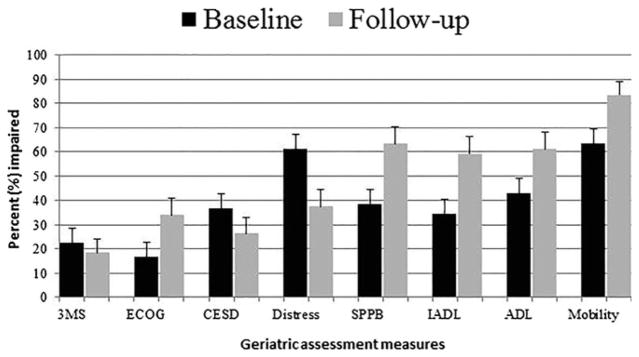
Measurements: Geriatric assessment (GA) was performed during inpatient examination for AML and within 8 weeks after hospital discharge after induction chemotherapy. Measures were the Pepper Assessment Tool for Disability (activity of daily living, instrumental activity of daily living (IADL), mobility questions), Short Physical Performance Battery (SPPB), grip strength, Modified Mini-Mental State examination, Center for Epidemiologic Studies Depression Scale, and the Distress Thermometer. Changes in GA measures were assessed using paired t-tests. Analysis of variance models were used to evaluate relationships between GA variables and change in function over time.
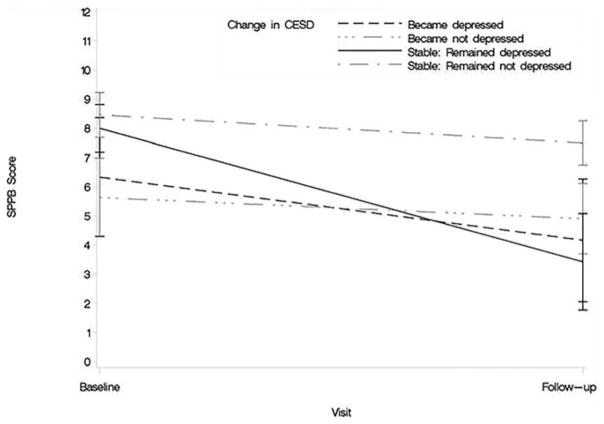
Results: After chemotherapy, IADL dependence worsened (mean 1.4 baseline vs 2.1 follow-up, P < .001), as did mean SPPB scores (7.5 vs 5.9, P = .02 for total). Grip strength also declined (38.9 ± 7.7 vs 34.2 ± 10.3 kg, P < .001 for men; 24.5 ± 4.8 vs 21.8 ± 4.7 kg, P = .007 for women). No significant changes in cognitive function (mean 84.7 vs 85.1, P = .72) or depressive symptoms (14.0 vs. 11.3, P = .11) were detected, but symptoms of distress declined (5.0 vs 3.2, P < .001). Participants with depressive symptoms at baseline and follow-up had greater declines in SPPB scores those without at both time points.
Conclusions: Short-term survivors of intensive chemotherapy for AML had clinically meaningful declines in physical function. These data support the importance of interventions to maintain physical function during and after chemotherapy. Depressive symptoms before and during chemotherapy may be linked to potentially modifiable physical function declines.
Keywords: cognition; depression; elderly; function; leukemia.
© 2016, Copyright the Authors Journal compilation © 2016, The American Geriatrics Society.
Figures
References
-
- [Accessed July 30, 2015];SEER Cancer Statistics Review 1975–2009. [on-line]. Available at http://seercancergov/publications/
-
- Kantarjian H, O’Brien S, Cortes J, et al. Results of intensive chemotherapy in 998 patients age 65 years or older with acute myeloid leukemia or high-risk myelodysplastic syndrome: Predictive prognostic models for outcome. Cancer. 2006;106:1090–1098. - PubMed
-
- Etienne A, Esterni B, Charbonnier A, et al. Comorbidity is an independent predictor of complete remission in elderly patients receiving induction chemotherapy for acute myeloid leukemia. Cancer. 2007;109:1376–1383. - PubMed
Publication types
MeSH terms
Grants and funding
LinkOut - more resources
Full Text Sources
Other Literature Sources
Medical
