


CEP78 is mutated in a distinct type of Usher syndrome
- PMID: 27627988
- PMCID: PMC6235689
- DOI: 10.1136/jmedgenet-2016-104166
CEP78 is mutated in a distinct type of Usher syndrome
Abstract
Background: Usher syndrome is a genetically heterogeneous disorder featured by combined visual impairment and hearing loss. Despite a dozen of genes involved in Usher syndrome having been identified, the genetic basis remains unknown in 20-30% of patients. In this study, we aimed to identify the novel disease-causing gene of a distinct subtype of Usher syndrome.
Methods: Ophthalmic examinations and hearing tests were performed on patients with Usher syndrome in two consanguineous families. Target capture sequencing was initially performed to screen causative mutations in known retinal disease-causing loci. Whole exome sequencing (WES) and whole genome sequencing (WGS) were applied for identifying novel disease-causing genes. RT-PCR and Sanger sequencing were performed to evaluate the splicing-altering effect of identified CEP78 variants.
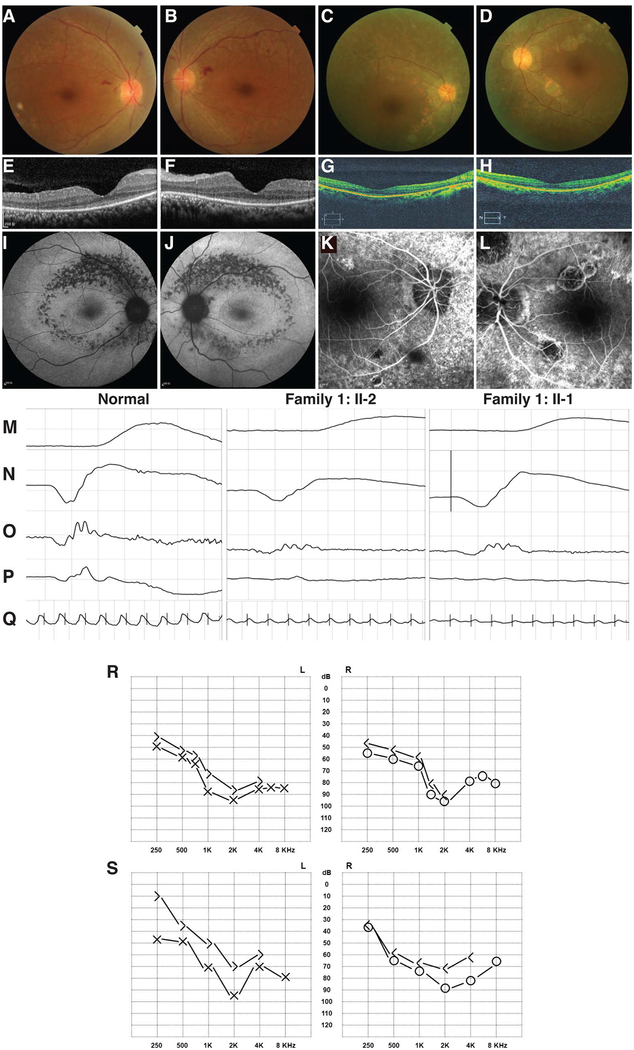
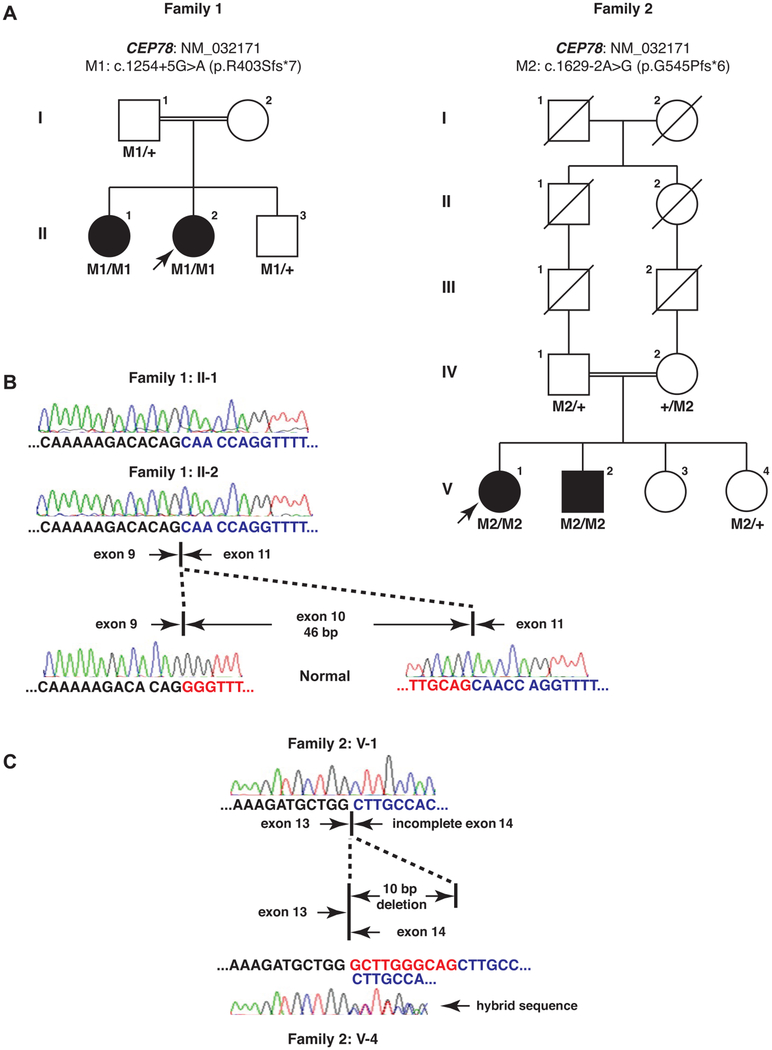
Results: Patients from the two independent families show a mild Usher syndrome phenotype featured by juvenile or adult-onset cone-rod dystrophy and sensorineural hearing loss. WES and WGS identified two homozygous rare variants that affect mRNA splicing of a ciliary gene CEP78. RT-PCR confirmed that the two variants indeed lead to abnormal splicing, resulting in premature stop of protein translation due to frameshift.
Conclusions: Our results provide evidence that CEP78 is a novel disease-causing gene for Usher syndrome, demonstrating an additional link between ciliopathy and Usher protein network in photoreceptor cells and inner ear hair cells.
Keywords: CEP78; Usher syndrome; cone-rod dystrophy; next-generation sequencing.
Published by the BMJ Publishing Group Limited. For permission to use (where not already granted under a licence) please go to http://www.bmj.com/company/products-services/rights-and-licensing/.
Conflict of interest statement
Figures
References
-
- Singla V, Reiter JF. The primary cilium as the cell’s antenna: signaling at a sensory organelle. Science 2006;313:629–33. - PubMed
-
- Sorusch N, Wunderlich K, Bauss K, Nagel-Wolfrum K, Wolfrum U. Usher syndrome protein network functions in the retina and their relation to other retinal ciliopathies. Adv Exp Med Biol 2014;801:527–33. - PubMed
-
- Maerker T, van Wijk E, Overlack N, Kersten FF, McGee J, Goldmann T, Sehn E, Roepman R, Walsh EJ, Kremer H, Wolfrum U. A novel Usher protein network at the periciliary reloading point between molecular transport machineries in vertebrate photoreceptor cells. Hum Mol Genet 2008;17:71–86. - PubMed
Publication types
MeSH terms
Substances
Grants and funding
LinkOut - more resources
Full Text Sources
Other Literature Sources
Medical
Molecular Biology Databases
