Review
. 2016 Oct;7(4):207-221.
doi: 10.1080/21541248.2016.1232583. Epub 2016 Sep 14.

Rho GTPases: Regulation and roles in cancer cell biology

Affiliations
Review

Rho GTPases: Regulation and roles in cancer cell biology

Raquel B Haga et al. Small GTPases. 2016 Oct.

Abstract

Rho GTPases are well known for their roles in regulating cell migration, and also contribute to a variety of other cellular responses. They are subdivided into 2 groups: typical and atypical. The typical Rho family members, including RhoA, Rac1 and Cdc42, cycle between an active GTP-bound and inactive GDP-bound conformation, and are regulated by GEFs, GAPs and GDIs, whereas atypical Rho family members have amino acid substitutions that alter their ability to interact with GTP/GDP and hence are regulated by different mechanisms. Both typical and atypical Rho GTPases contribute to cancer progression. In a few cancers, RhoA or Rac1 are mutated, but in most cancers expression levels and/or activity of Rho GTPases is altered. Rho GTPase signaling could therefore be therapeutically targeted in cancer treatment.

Keywords: Rho GTPases; cancer progression; cell migration; signal transduction.


Figures

Figure 1.
Figure 1.
Signaling pathways regulated by RhoA and Rac1. Examples of signaling by RhoA and Rac1 to the actin cytoskeleton are shown. Different types of cell surface receptors, such as integrins, G-protein-coupled receptors (GPCRs), and tyrosine kinase receptors, activate guanine nucleotide exchange factors (GEFs) for RhoA and Rac1. RhoA and Rac1 then interact with and activate a variety of effectors that are involved in actin polymerization, focal adhesion and stress fiber formation, including protein kinases (e.g. ROCKs, PAKs) and proteins that stimulate actin polymerization (e.g., mDia formins, the WAVE regulatory complex that stimulates the Arp2/3 complex).
Figure 2.
Figure 2.
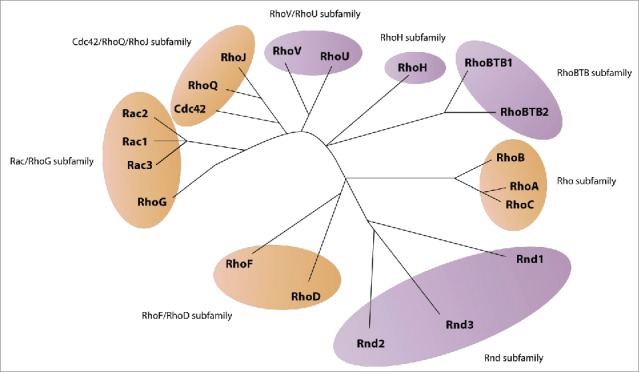
The human Rho GTPase family. The Rho GTPase family consists of 20 genes in humans, which are present in all mammals. The family is subdivided into 8 subfamilies: Rac/RhoG subfamily, Rho subfamily, Cdc42/RhoQ/RhoJ subfamily, RhoF/RhoD subfamily, Rnd subfamily, RhoBTB subfamily, RhoH subfamily and RhoU/RhoV subfamily. These subfamilies can be classified as typical (orange circles) or atypical (purple circles) depending on the mode of regulation: typical proteins are regulated by GTP/GDP cycling, whereas atypical proteins have amino acid differences from typical proteins that alter their interactions with GTP and/or GDP. The unrooted phylogenetic tree is based on a ClustIW alignment of the amino-acid sequences of the Rho domains of 20 human Rho GTPase proteins. This does not include splice variants of Rac1 or Cdc42. The figure is modified from ref. .
Figure 3.
Figure 3.
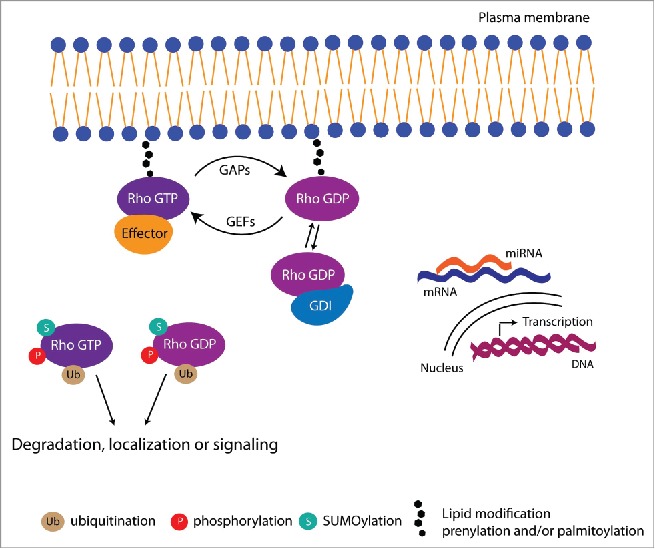
Regulation of Rho GTPases. Most Rho GTPases are regulated by GEFs, GAPs and GDIs. These proteins control the cycling between the active GTP-bound form and the inactive GDP-bound form. RhoGDIs can also regulate the localization and degradation of Rho GTPases. The expression of Rho GTPases are regulated at transcriptional and post-transcriptional (miRNA) levels. Rho GTPases are also be regulated by post-translational modifications (lipid modification, phosphorylation, ubiquitination and SUMOylation), which alter their intracellular localization, their stability and/or their ability to signal to downstream effectors.
Figure 4.
Figure 4.
Roles of Rho GTPases in single cell migration. Single cell migration is a multistep process in which cells extend membrane protrusions at the cell front (lamellipodia, filopodia and/or membrane blebs), form new adhesions, contract the cell body and detach the cell rear from the surrounding environment. In lamellipodium-based migration (left), lamellipodium and filopodium formation involves new actin polymerization, and requires actin nucleators such as the Arp2/3 complex that are activated by Rac and Cdc42. Actin polymerization in lamellipodia can also be mediated by formins after RhoA activation. Formation of integrin-based focal adhesions by Rho/ROCK signaling stabilizes lamellipodia and mediates interaction with the extracellular matrix. Actomyosin-mediated contractility and detachment of the cell rear are controlled by Rho/ROCK signaling. In bleb-based migration (right), actomyosin contractility driven by RhoA and/or RhoC activation of ROCKs leads to the extension of blebs, which are protrusions of the cell membrane caused by actomyosin contraction of the cell cortex. Bleb-based migration is less dependent on integrin-mediated adhesion than lamelllipodium-based migration.

References

    1. Etienne-Manneville S, Hall A. Rho GTPases in cell biology. Nature 2002; 420:629-635; PMID:12478284; http://dx.doi.org/ 10.1038/nature01148 - DOI - PubMed
    1. Vega FM, Ridley AJ. Rho GTPases in cancer cell biology. FEBS Lett 2008; 582:2093-101; PMID:18460342; http://dx.doi.org/ 10.1016/j.febslet.2008.04.039 - DOI - PubMed
    1. Hall A. Rho family GTPases. Biochem Soc Trans. 2012; 40:1378-82; PMID:23176484; http://dx.doi.org/ 10.1042/BST20120103 - DOI - PubMed
    1. Schwartz M. Rho signalling at a glance. J Cell Sci. 2004; 117:5457-8; PMID:15509861; http://dx.doi.org/ 10.1242/jcs.01582 - DOI - PubMed
    1. Heasman SJ, Ridley AJ. Mammalian Rho GTPases: new insights into their functions from in vivo studies. Nat Rev Mol Cell Biol 2008; 9:690-701; PMID:18719708; http://dx.doi.org/ 10.1038/nrm2476 - DOI - PubMed

Substances