Review
. 2016 Sep 14;80(4):929-54.
doi: 10.1128/MMBR.00003-16. Print 2016 Dec.

Marine Bacterial and Archaeal Ion-Pumping Rhodopsins: Genetic Diversity, Physiology, and Ecology

Affiliations
Review

Marine Bacterial and Archaeal Ion-Pumping Rhodopsins: Genetic Diversity, Physiology, and Ecology

Jarone Pinhassi et al. Microbiol Mol Biol Rev. .

Abstract

The recognition of a new family of rhodopsins in marine planktonic bacteria, proton-pumping proteorhodopsin, expanded the known phylogenetic range, environmental distribution, and sequence diversity of retinylidene photoproteins. At the time of this discovery, microbial ion-pumping rhodopsins were known solely in haloarchaea inhabiting extreme hypersaline environments. Shortly thereafter, proteorhodopsins and other light-activated energy-generating rhodopsins were recognized to be widespread among marine bacteria. The ubiquity of marine rhodopsin photosystems now challenges prior understanding of the nature and contributions of "heterotrophic" bacteria to biogeochemical carbon cycling and energy fluxes. Subsequent investigations have focused on the biophysics and biochemistry of these novel microbial rhodopsins, their distribution across the tree of life, evolutionary trajectories, and functional expression in nature. Later discoveries included the identification of proteorhodopsin genes in all three domains of life, the spectral tuning of rhodopsin variants to wavelengths prevailing in the sea, variable light-activated ion-pumping specificities among bacterial rhodopsin variants, and the widespread lateral gene transfer of biosynthetic genes for bacterial rhodopsins and their associated photopigments. Heterologous expression experiments with marine rhodopsin genes (and associated retinal chromophore genes) provided early evidence that light energy harvested by rhodopsins could be harnessed to provide biochemical energy. Importantly, some studies with native marine bacteria show that rhodopsin-containing bacteria use light to enhance growth or promote survival during starvation. We infer from the distribution of rhodopsin genes in diverse genomic contexts that different marine bacteria probably use rhodopsins to support light-dependent fitness strategies somewhere between these two extremes.


Figures

FIG 1
FIG 1
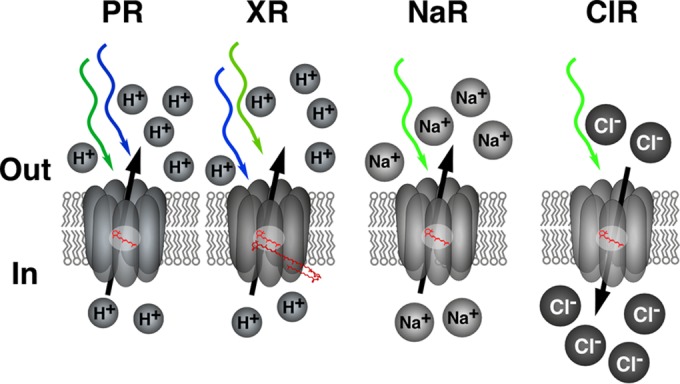
Schematic representation of different proton, sodium, and chloride rhodopsin pumps. Colored arrows show the different wavelengths at which each rhodopsin absorbs. In the case of proteorhodopsin (PR), the arrows represent the absorption of blue-tuned (∼490-nm) and green-tuned (∼530-nm) rhodopsins. For xanthorhodopsin (XR), the arrows represent absorption at different wavelengths (∼470 and 520 nm) due to XR having an additional carotenoid antenna molecule. Peak absorption maxima and ranges of absorption for green- and blue-tuned PRs in the visible light range are detailed in Fig. 3, top panel. NaR, sodium-pumping rhodopsin; ClR, chloride-pumping rhodopsin. (Redrawn and modified from reference .)
FIG 2
FIG 2
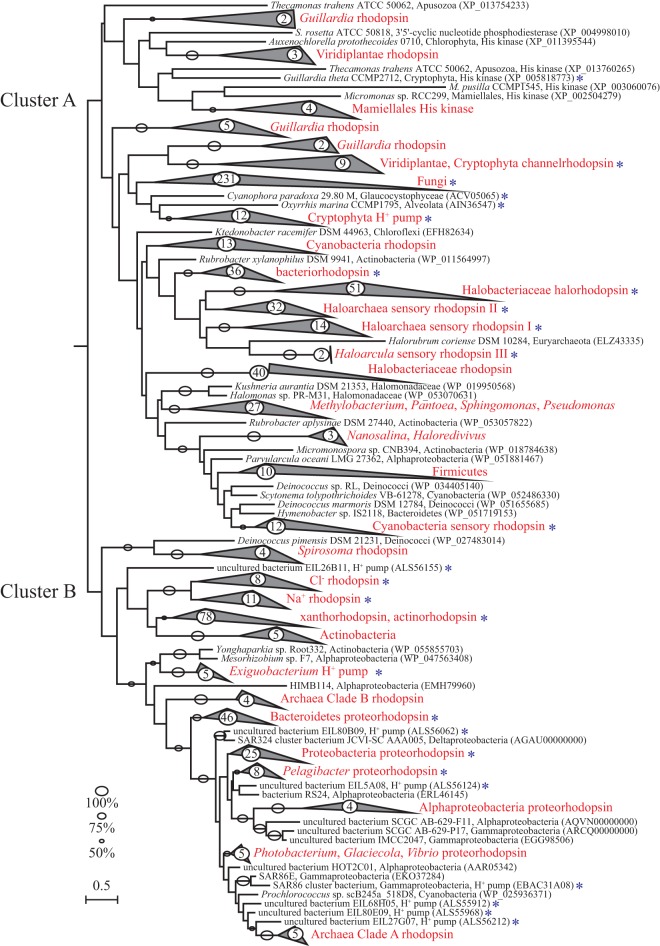
Phylogenetic relationships of rhodopsins. An unrooted tree of rhodopsins from the three domains of life is shown. A total of 756 rhodopsin sequences were downloaded from RefSeq (http://www.ncbi.nlm.nih.gov/refseq/; release 75, 14 March 2016), following identification using the PFAM for bacteriorhodopsin-like protein (Bac_rhodopsin, PF01036). The sequences were aligned using MUSCLE and further edited with Gblocks to eliminate highly divergent regions. The tree was constructed by the maximum-likelihood method using the LG model of amino acid substitution rates with empirical amino acid frequencies and the gamma model of rate heterogeneity (PROTGAMMALGF) in RAxML. Bootstrap support values higher than 50% are shown above branches based on 100 pseudoreplicates. Only the region of the peptide that spans the PFAM protein family specific for rhodopsin was considered in the alignment. GenBank accession numbers are shown in parentheses for the individual sequences. Blue asterisks indicate individual organisms for which there is experimental evidence for the function of the rhodopsin; in the case of collapsed branches (marked in red), asterisks indicate that there is experimental evidence for at least one organism. Numbers within circles are the number of sequences in the collapsed branches. The scale bar represents substitutions per site.
FIG 3
FIG 3
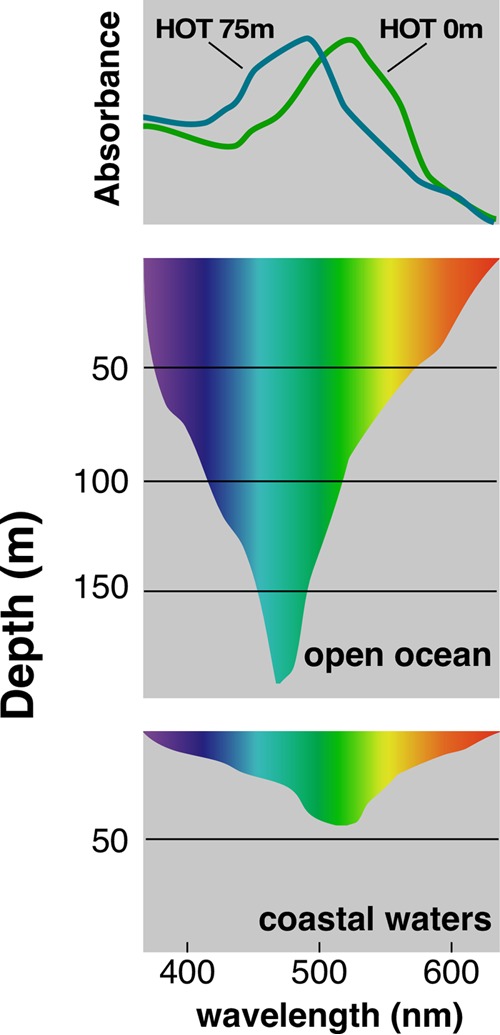
Absorption spectra of PRs in relation to light attenuation patterns in different marine environments. Top panel, spectra of green-tuned PR (GPR) and blue-tuned PR (BPR) collected from different depths at the Hawaii Ocean time series (HOT) station ALOHA. Absorption spectra were obtained following heterologous expression in E. coli. Middle and lower panels, typical light attenuation in open ocean and coastal environments, respectively. (Inspired by reference .)
FIG 4
FIG 4
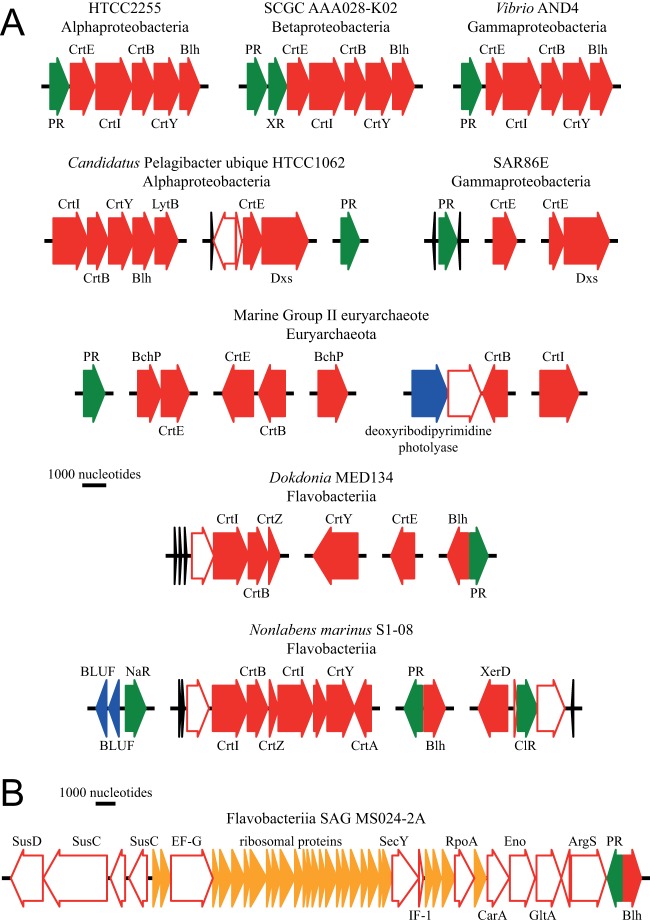
Arrangement of rhodopsin and carotenoid synthesis genes in different bacteria. (A) Carotenoid synthesis genes (crt) and the gene for synthesizing the chromophore retinal (blh) are in red. Rhodopsin variants are shown in green. In blue are genes whose products are known to respond to light. tRNA in black might be involved in lateral gene transfer. Labels above genes denote gene products. (B) Gene arrangement in the Flavobacteriia single amplified genome (SAG) MS024-2A; the PR is next to the conserved cluster of highly expressed genes that includes ribosomal protein, RNA polymerase subunit alpha, and transcription factors genes, in addition to Sec secretion pathway and TCA cycle genes.
FIG 5
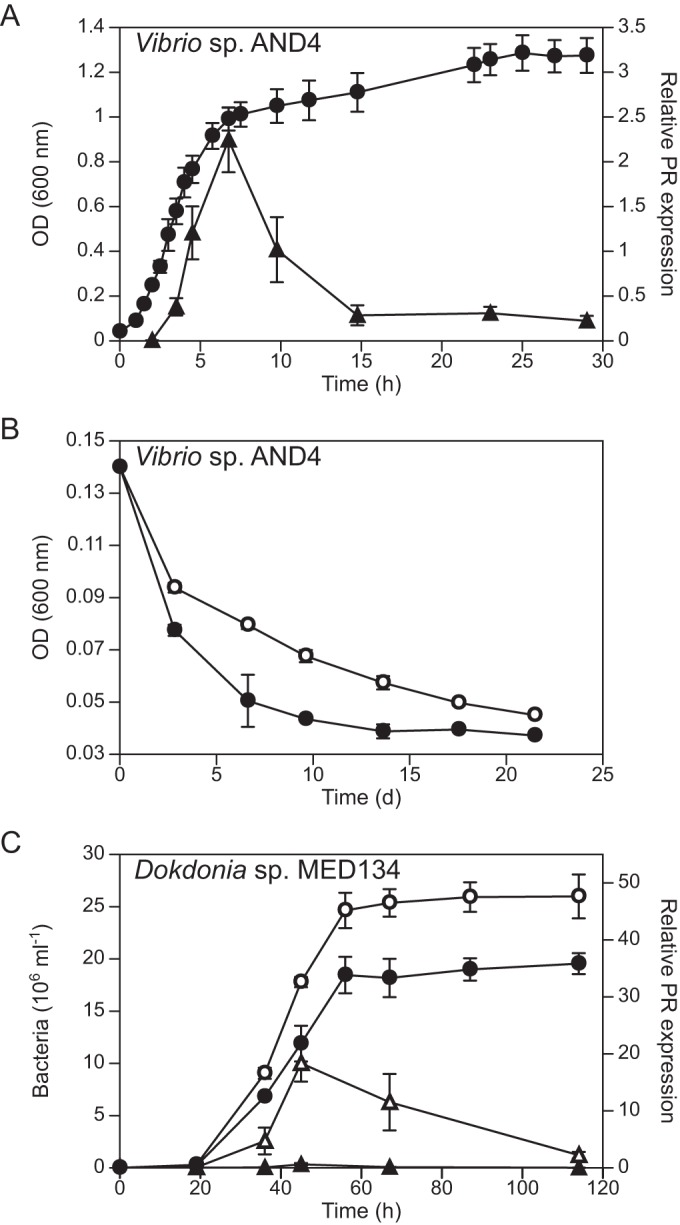
FIG 5
Temporal dynamics in bacterial abundance and proteorhodopsin gene expression. (A) Growth of Vibrio sp. AND4 in Zobell rich medium as measured by optical density (circles) and relative expression of the PR gene (triangles). Relative expression values were obtained by quantitative real-time PCR; the housekeeping genes rpoD and rpoZ were used for normalization. (Redrawn from reference .) (B) Dynamics in optical density of Vibrio sp. AND4 during starvation in constant light (open circles) and in darkness (closed circles). (Redrawn from reference .) (C) Growth of the flavobacterial isolate Dokdonia sp. MED134 in the light (open circles) and in the dark (closed circles) in seawater medium with complex organic matter as a carbon source. Also shown is relative expression of the PR gene in the light (open triangles) and in the dark (closed triangles). Error bars denote the standard deviations from three biological replicates; if not visible, error bars are hidden in the symbols (for gene expression in panel C, error bars denote standard error from biological triplicates). (Redrawn from reference .)
None
None
None
None
None

References

    1. Vershinin A. 1999. Biological functions of carotenoids—diversity and evolution. Biofactors 10:99–104. doi: 10.1002/biof.5520100203. - DOI - PubMed
    1. Hegemann P. 2008. Algal sensory photoreceptors. Annu Rev Plant Biol 59:167–189. doi: 10.1146/annurev.arplant.59.032607.092847. - DOI - PubMed
    1. Bryant DA, Frigaard NU. 2006. Prokaryotic photosynthesis and phototrophy illuminated. Trends Microbiol 14:488–496. doi: 10.1016/j.tim.2006.09.001. - DOI - PubMed
    1. Spudich JL, Yang CS, Jung KH, Spudich EN. 2000. Retinylidene proteins: structures and functions from archaea to humans. Annu Rev Cell Dev Biol 16:365–392. doi: 10.1146/annurev.cellbio.16.1.365. - DOI - PubMed
    1. Ernst OP, Lodowski DT, Elstner M, Hegemann P, Brown LS, Kandori H. 2014. Microbial and animal rhodopsins: structures, functions, and molecular mechanisms. Chem Rev 114:126–163. doi: 10.1021/cr4003769. - DOI - PMC - PubMed

MeSH terms

Substances

LinkOut - more resources