


Polypharmacy Cut-Off for Gait and Cognitive Impairments
- PMID: 27630572
- PMCID: PMC5005954
- DOI: 10.3389/fphar.2016.00296
Polypharmacy Cut-Off for Gait and Cognitive Impairments
Abstract
Background: Polypharmacy is a well-established risk factor for falls, and these are one of the major health problems that affect the quality of life as people age. However, the risk of mobility and cognitive impairments consecutive to polypharmacy has been little addressed, despite the association between these adverse outcomes and falls. Moreover, the rare polypharmacy cut-offs were all but one arbitrarily determined.
Objective: Studying relationships between polypharmacy and both mobility and cognitive impairments, and statistically determining a cut-off point in the number of medicinal molecule beyond which polypharmacy has deleterious consequences with respect to mobility and cognitive impairment.
Methods: We enrolled 113 community-dwelling adults aged 55 years and older with a fall history, with or without injury, in the previous year. We carefully collected information about daily medicinal molecules taken. We assessed basic mobility and global cognition with the Time-Up-and-Go and the Montreal Cognitive Assessment (MoCA) test, respectively (clinicaltrials.gov NCT02292316).
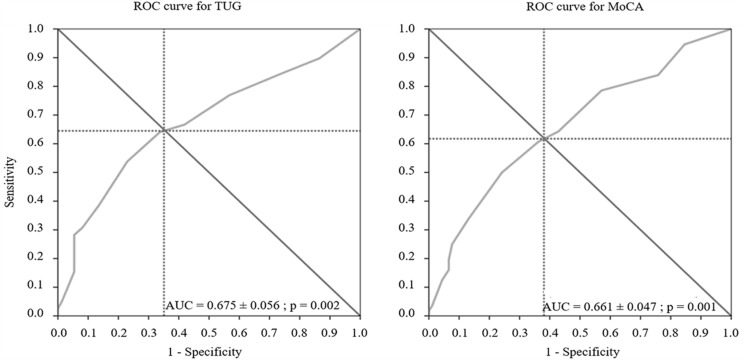
Results: Timed-Up and Go test and MoCA scores were both significantly correlated with the number of molecule, used. Receiver Operating Characteristic curves indicate, with high prediction (p < 0.002), that daily consumption of five or more molecules is associated with risk for both impaired mobility and global cognition. These relationships were independent of the number of comorbidities and of the pharmacological class.
Conclusion: Community-dwelling adults aged 55 years and older who take five or more daily medicinal molecules are at high risk for both mobility and cognitive impairments. Physicians and patients should be aware of these new findings, especially when there are multiple prescribers involved in the care of the patient.
Keywords: aging; cognition; cut-off; gait; middle age; mobility; polypharmacy.
Figures
References
-
- Bennett A., Gnjidic D., Gillett M., Carroll P., Matthews S., Johnell K., et al. (2014). Prevalence and impact of fall-risk-increasing drugs, polypharmacy, and drug–drug interactions in robust versus frail hospitalised falls patients: a prospective cohort study. Drugs Aging 31 225–232. 10.1007/s40266-013-0151-3 - DOI - PubMed
Associated data
LinkOut - more resources
Full Text Sources
Other Literature Sources
Medical
