


Interspecific Bacterial Interactions are Reflected in Multispecies Biofilm Spatial Organization
- PMID: 27630624
- PMCID: PMC5005372
- DOI: 10.3389/fmicb.2016.01366
Interspecific Bacterial Interactions are Reflected in Multispecies Biofilm Spatial Organization
Abstract
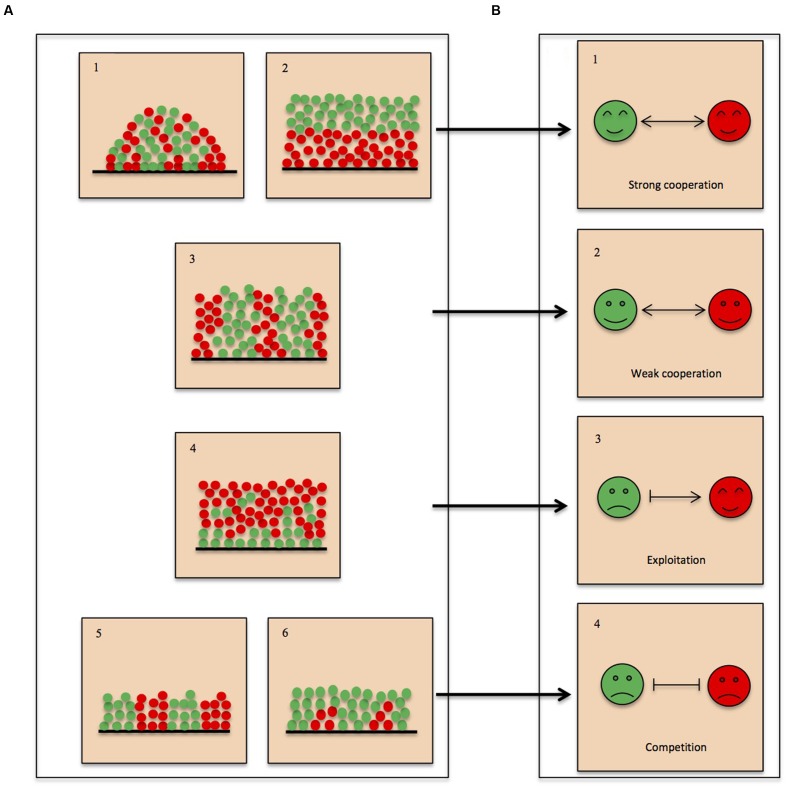
Interspecies interactions are essential for the persistence and development of any kind of complex community, and microbial biofilms are no exception. Multispecies biofilms are structured and spatially defined communities that have received much attention due to their omnipresence in natural environments. Species residing in these complex bacterial communities usually interact both intra- and interspecifically. Such interactions are considered to not only be fundamental in shaping overall biomass and the spatial distribution of cells residing in multispecies biofilms, but also to result in coordinated regulation of gene expression in the different species present. These communal interactions often lead to emergent properties in biofilms, such as enhanced tolerance against antibiotics, host immune responses, and other stresses, which have been shown to provide benefits to all biofilm members not only the enabling sub-populations. However, the specific molecular mechanisms of cellular processes affecting spatial organization, and vice versa, are poorly understood and very complex to unravel. Therefore, detailed description of the spatial organization of individual bacterial cells in multispecies communities can be an alternative strategy to reveal the nature of interspecies interactions of constituent species. Closing the gap between visual observation and biological processes may become crucial for resolving biofilm related problems, which is of utmost importance to environmental, industrial, and clinical implications. This review briefly presents the state of the art of studying interspecies interactions and spatial organization of multispecies communities, aiming to support theoretical and practical arguments for further advancement of this field.
Keywords: interspecies interactions; multispecies biofilms; spatial organization.
Figures
References
Publication types
LinkOut - more resources
Full Text Sources
Other Literature Sources
Miscellaneous
