


Variations of movement disorders in anti-N-methyl-D-aspartate receptor encephalitis: A nationwide study in Taiwan
- PMID: 27631202
- PMCID: PMC5402545
- DOI: 10.1097/MD.0000000000004365
Variations of movement disorders in anti-N-methyl-D-aspartate receptor encephalitis: A nationwide study in Taiwan
Abstract
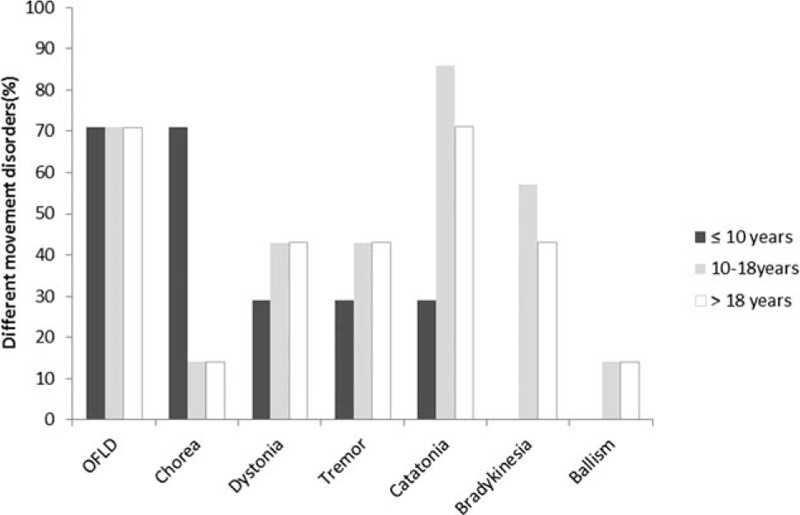
Anti-N-methyl-D-aspartate receptor (NMDAR) encephalitis is one of the most common autoimmune encephalitis that presents with a wide variety of movement disorders. The purpose of our study is to review the manifestations and duration of movement disorders in different ages with NMDAR encephalitis.A retrospective cohort of 28 patients (20 females and 8 males) with positive cerebrospinal fluid (CSF) anti-NMDAR antibody in a 5-year period from major hospitals in Taiwan was enrolled. They were categorized into 3 age groups: 7 patients were ≤10 years, 14 patients were 10 to 18 years, and 7 patients were >18 years.Total 28 patients (20 females and 8 males) with age ranging from 8 months to 38 years were enrolled. Nearly all patients (n = 27/28, 96%) presented with at least 2 types of disorders, including orofacial-lingual dyskinesia (OFLD; n = 20), catatonia (n = 19), tremor (n = 11), bradykinesia (n = 11), dystonia (n = 11), choreoathethosis (n = 9), and ballism (n = 3). Only 1 patient below 10 years presented with isolated periodic choreoathethosis without other movement disorders. OFLD was common in all age groups. Choreoathetosis was most common in patients aged ≤10 years, while catatonia was most common in patients aged >10 years (P = 0.001 and 0.020, respectively). Bradykinesia was also more common in patients aged >10 years (P = 0.020). The clinical presentations of movement disorders were not significantly different in the age of 10 to 18 years and those >18 years. Neither patient ≤10 years old nor male patients had associated tumors. All patients' movement disorders were improved after treatment, while female patients with tumors had worse short-term outcome (P = 0.014). Compared with other disorders, choreoathetosis persisted significantly longer in patients ≤10 years (P = 0.038), while OFLD and catatonia last longer in patients >10 years (P = 0.047 and 0.002, respectively).Our study shows that hyperkinetic movements such as choreoathetosis are more common and last longer in younger age groups, whereas hypokinetic movements such as catatonia and bradykinesia are more common and last longer in older age groups. Female patients with ovarian tumors had worse short-term outcome.
Conflict of interest statement
The authors disclose no conflicts of interest.
Figures
References
-
- Wandinger KP, Saschenbrecker S, Stoecker W, et al. Anti-NMDA-receptor encephalitis: a severe, multistage, treatable disorder presenting with psychosis. J Neuroimmunol 2011; 231:86–91. - PubMed
-
- Hsu MH, Huang CC, Hung PL, et al. Paraneoplastic neurological disorders in children with benign ovarian tumors. Brain Develop 2014; 36:248–253. - PubMed
-
- Baizabal-Carvallo JF, Stocco A, Muscal E, et al. The spectrum of movement disorders in children with anti-NMDA receptor encephalitis. Mov Disord 2013; 28:543–547. - PubMed
Publication types
MeSH terms
LinkOut - more resources
Full Text Sources
Other Literature Sources
Medical
