


The influence of dyadic symptom distress on threat appraisals and self-efficacy in advanced cancer and caregiving
- PMID: 27631435
- PMCID: PMC5130593
- DOI: 10.1007/s00520-016-3385-x
The influence of dyadic symptom distress on threat appraisals and self-efficacy in advanced cancer and caregiving
Abstract
Purpose: Physical and psychological symptoms experienced by patients with advanced cancer influence their well-being; how patient and family caregiver symptom distress influence each other's well-being is less understood. This study examined the influence of patient and caregiver symptom distress on their threat appraisals and self-efficacy to cope with cancer.
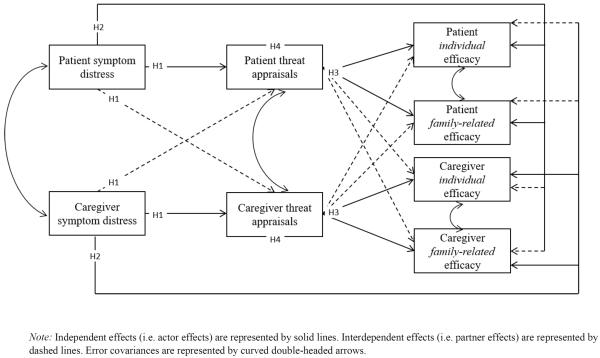
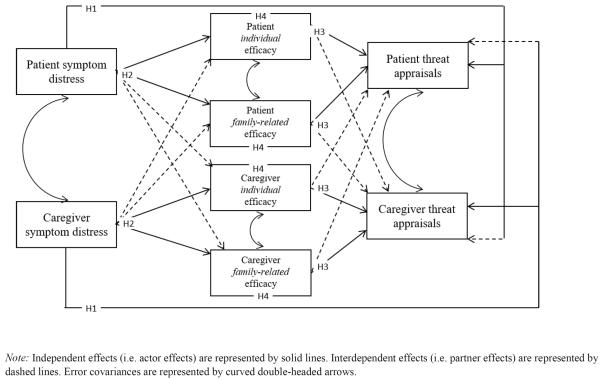
Methods: We conducted a secondary analysis of baseline data from an RCT that enrolled patients with advanced cancer and their family caregivers (N = 484 dyads). Structural equation modeling and the actor-partner interdependence mediation model (APIMeM) were used to examine two models: threat appraisals as a mediator of the relationship between symptom distress and individual and family-related self-efficacy; and, self-efficacy (individual and family dimensions) as mediators of the relationship between symptom distress and threat appraisals.
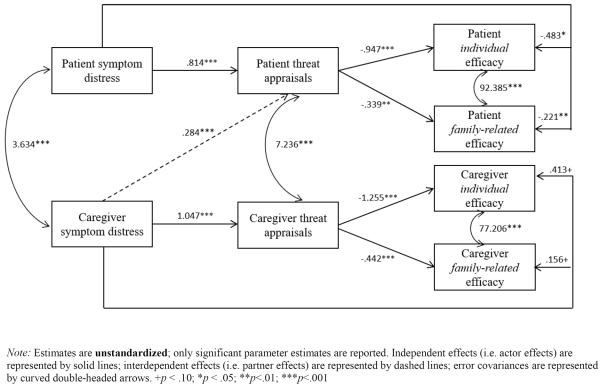
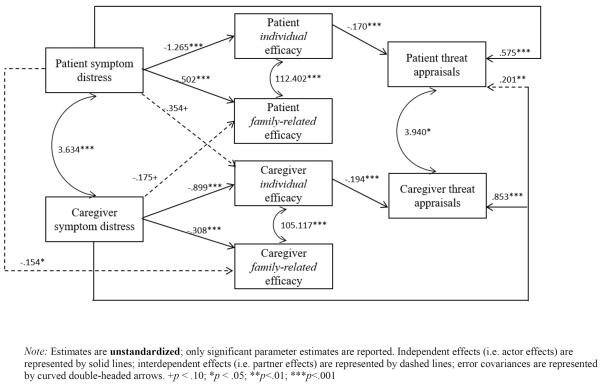
Results: Data suggest the self-efficacy mediation model was the preferred model. More patient and caregiver symptom distress was directly associated with their own lower self-efficacy and more threatening appraisals. Patient and caregiver individual self-efficacy also mediated the relationship between their own symptom distress and threat appraisals. There were also significant interdependent effects. More patient symptom distress was associated with less caregiver family-related self-efficacy, and more caregiver symptom distress was directly associated with more threatening patient appraisals.
Conclusions: Patient and caregiver symptom distress influenced their own and in some cases each other's cognitive appraisals. Limitations of this study include the use of cross-sectional data and assessments of individually-focused (vs. family-focused) threat appraisals. These findings highlight the need to consider the management of patient and caregiver symptoms during advanced cancer.
Keywords: Advanced cancer; Caregiving; Cognitive appraisal; Dyad; Self-efficacy; Symptoms.
Figures
References
-
- Schofield P, Carey M, Love A, Nehill C, Wein S. Would you like to talk about your future treatment options?' Discussing the transition from curative cancer treatment to palliative care. Palliative Medicine. 2006;20(4):397–406. doi:10.1191/0269216306pm1156oa. - PubMed
-
- Lazarus RS, Folkman S. Stress, appraisal, and coping. Springer Pub. Co.; New York: 1984.
-
- Wenzel L, Glanz K, Lerman C. Stress, coping and health behavior. In: Glanz K, Rimer BK, Lewis FM, editors. Health behavior and health education. 3rd edn Jossey-Bass; San Francisco: 2002. pp. 210–239.
-
- Strecher VJ, McEvoy DeVellis B, Becker MH, Rosenstock IM. The role of self-efficacy in achieving health behavior change. Health Education & Behavior. 1986;13(1):73–92. doi:10.1177/109019818601300108. - PubMed
-
- Franks HM, Roesch SC. Appraisals and coping in people living with cancer: a meta-analysis. Psycho-Oncology. 2006;15(12):1027. - PubMed
MeSH terms
Grants and funding
LinkOut - more resources
Full Text Sources
Other Literature Sources
Medical
