


National Outbreak of Multidrug Resistant Salmonella Heidelberg Infections Linked to a Single Poultry Company
- PMID: 27631492
- PMCID: PMC5025200
- DOI: 10.1371/journal.pone.0162369
National Outbreak of Multidrug Resistant Salmonella Heidelberg Infections Linked to a Single Poultry Company
Abstract
Importance: This large outbreak of foodborne salmonellosis demonstrated the complexity of investigating outbreaks linked to poultry products. The outbreak also highlighted the importance of efforts to strengthen food safety policies related to Salmonella in chicken parts and has implications for future changes within the poultry industry.
Objective: To investigate a large multistate outbreak of multidrug resistant Salmonella Heidelberg infections.
Design: Epidemiologic and laboratory investigations of patients infected with the outbreak strains of Salmonella Heidelberg and traceback of possible food exposures.
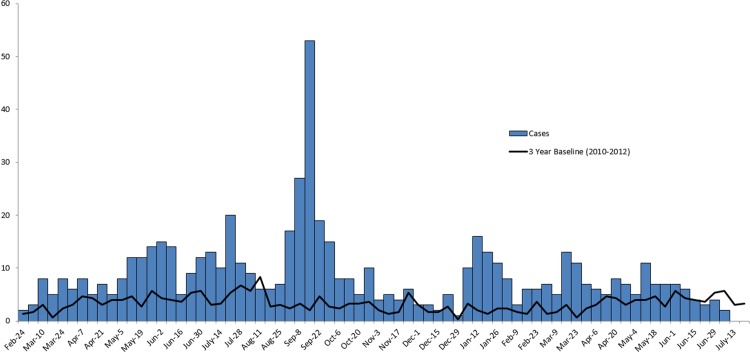
Setting: United States. Outbreak period was March 1, 2013 through July 11, 2014.
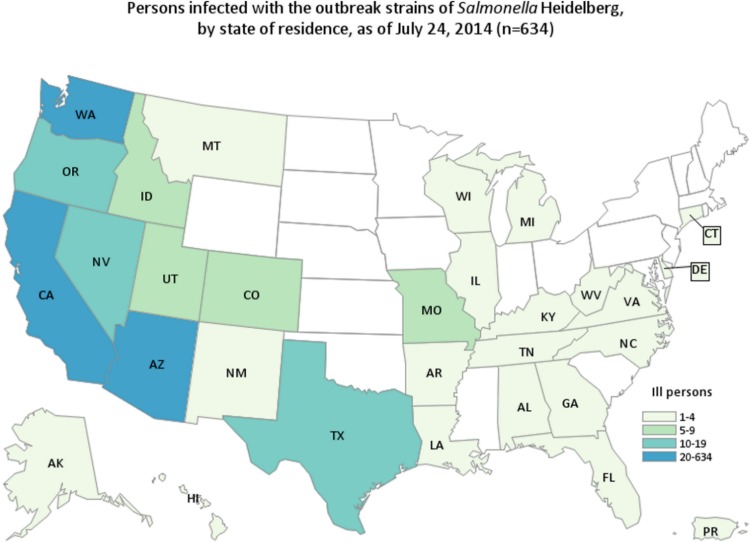
Patients: A case was defined as illness in a person infected with a laboratory-confirmed Salmonella Heidelberg with 1 of 7 outbreak pulsed-field gel electrophoresis (PFGE) XbaI patterns with illness onset from March 1, 2013 through July 11, 2014. A total of 634 case-patients were identified through passive surveillance; 200/528 (38%) were hospitalized, none died.
Results: Interviews were conducted with 435 case-patients: 371 (85%) reported eating any chicken in the 7 days before becoming ill. Of 273 case-patients interviewed with a focused questionnaire, 201 (74%) reported eating chicken prepared at home. Among case-patients with available brand information, 152 (87%) of 175 patients reported consuming Company A brand chicken. Antimicrobial susceptibility testing was completed on 69 clinical isolates collected from case-patients; 67% were drug resistant, including 24 isolates (35%) that were multidrug resistant. The source of Company A brand chicken consumed by case-patients was traced back to 3 California production establishments from which 6 of 7 outbreak strains were isolated.
Conclusions: Epidemiologic, laboratory, traceback, and environmental investigations conducted by local, state, and federal public health and regulatory officials indicated that consumption of Company A chicken was the cause of this outbreak. The outbreak involved multiple PFGE patterns, a variety of chicken products, and 3 production establishments, suggesting a reservoir for contamination upstream from the production establishments. Sources of bacteria and genes responsible for resistance, such as farms providing birds for slaughter or environmental reservoir on farms that raise chickens, might explain how multiple PFGE patterns were linked to chicken from 3 separate production establishments and many different poultry products.
Conflict of interest statement
The authors have declared that no competing interests exist.
Figures
References
-
- National Antimicrobial Resistance Monitoring System for Enteric Bacteria (NARMS): Annual Retail Meat Report: CDC, 2013. (Accessed September 18, 2013, at http://www.fda.gov/AnimalVeterinary/SafetyHealth/AntimicrobialResistance....)
-
- Folster JP, Pecic G, Singh A, Duval B, Rickert R, Ayers S, et al. Characterization of extended-spectrum cephalosporin-resistant Salmonella enterica serovar Heidelberg isolated from food animals, retail meat, and humans in the United States 2009. Foodborne Pathog Dis 2012; 9: 638–45. 10.1089/fpd.2012.1130 - DOI - PMC - PubMed
-
- CDC. Foodborne Diseases Active Surveillance Network (FoodNet): FoodNet Surveillance Report for 2012 (Final Report) Atlanta, Georgia: U.S. Department of Health and Human Services, CDC; 2014.
-
- Centers for Disease Control and Prevention (CDC). Foodborne Active Surveillance Network (FoodNet) Population Survey Atlas of Exposures Atlanta, Georgia: U.S. Department of Health and Human Services, Centers for Disease Control and Prevention, 2006–2007.
MeSH terms
Substances
LinkOut - more resources
Full Text Sources
Other Literature Sources
