. 2016 Sep 15;23(10):495-503.
doi: 10.1101/lm.041830.116. Print 2016 Oct.

Dopamine receptor DOP-4 modulates habituation to repetitive photoactivation of a C. elegans polymodal nociceptor

Affiliations

Dopamine receptor DOP-4 modulates habituation to repetitive photoactivation of a C. elegans polymodal nociceptor

Evan L Ardiel et al. Learn Mem. .

Abstract

Habituation is a highly conserved phenomenon that remains poorly understood at the molecular level. Invertebrate model systems, like Caenorhabditis elegans, can be a powerful tool for investigating this fundamental process. Here we established a high-throughput learning assay that used real-time computer vision software for behavioral tracking and optogenetics for stimulation of the C. elegans polymodal nociceptor, ASH. Photoactivation of ASH with ChR2 elicited backward locomotion and repetitive stimulation altered aspects of the response in a manner consistent with habituation. Recording photocurrents in ASH, we observed no evidence for light adaptation of ChR2. Furthermore, we ruled out fatigue by demonstrating that sensory input from the touch cells could dishabituate the ASH avoidance circuit. Food and dopamine signaling slowed habituation downstream from ASH excitation via D1-like dopamine receptor, DOP-4. This assay allows for large-scale genetic and drug screens investigating mechanisms of nociception modulation.


Figures

Figure 1.
Figure 1.
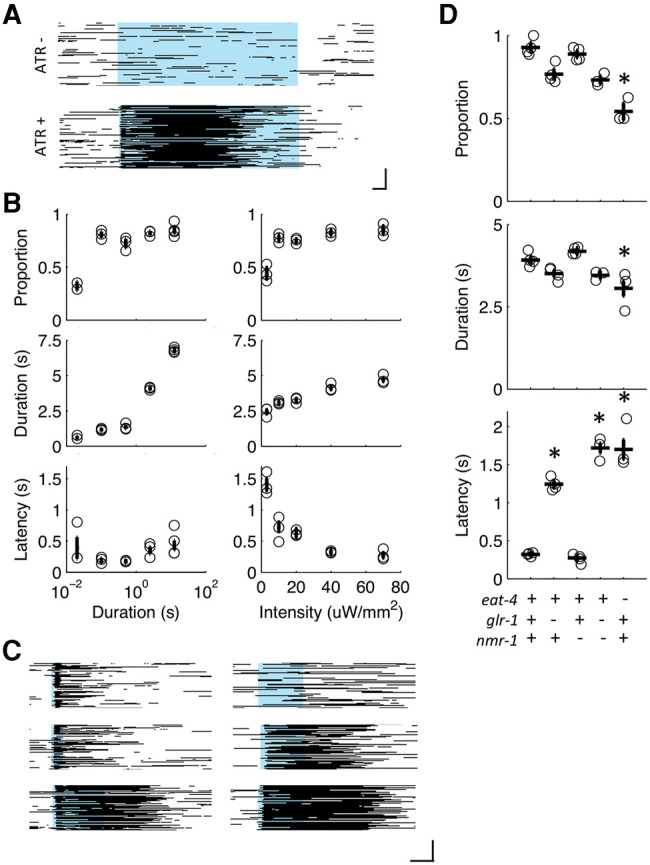
Activation of ChR2 in sra-6 expressing neurons elicits backward locomotion. (A) Raster plots of behavioral state in the presence (ATR+) or absence (ATR−) of all-trans retinal. Each line represents an animal, with black pixels depicting backward locomotion and remaining pixels (white) depicting forward locomotion or no movement. The blue bar represents whole-plate illumination with blue light at 0.07 mW/mm2. Scale bar corresponds to 1 sec (horizontal) and 30 animals (vertical). (B) Three response metrics (proportion, duration, and latency) for a 0.07 mW/mm2 light pulse of several durations (left) and a 2-sec light pulse at several intensities (right). Circles are plate means, crosses are population means ± SEM (n = 2–4 plates). (C) Representative raster plots of behavior in response to a 0.07 mW/mm light pulse of 0.5, 1.5, and 2.5 sec (left) or a 2-sec light pulse at 0.004, 0.02, and 0.07 mW/mm2 (right). (D) Proportion, duration and latency response metrics for glutamate transmission mutants stimulated with a 2-sec light pulse at 0.07 mW/mm2. Circles are plate means, crosses are population means ± SEM (n = 4 plates), and asterisks denote statistically distinguishable groups. All data collected using the ljIs105 ChR2 transgene.
Figure 2.
Figure 2.
Plasticity of reversal responses elicited by repeated photoactivation of sra-6 expressing cells (ASH, ASI, and PVQ; A) or just ASH (B). Three different response metrics: proportion responding with a reversal, duration of any reversals that occurred, and latency to initiate those reversal for thirty 2-sec light pulses administered at 0.1 Hz. Gray lines correspond to the individual plates (n = 6 plates) comprising the mean (black line).
Figure 3.
Figure 3.
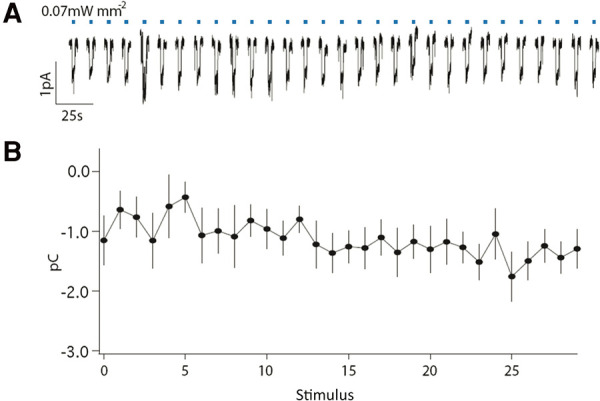
Photocurrents are unaffected by training. (A) Membrane current in ASH for thirty 2-sec light pulses administered at 0.1 Hz. (B) For each stimulus, photocurrents were quantified by calculating the total charge transfer during 2 sec of illumination. Mean ± SEM (n = 11 animals). All data collected using the ljIs105 ChR2 transgene.
Figure 4.
Figure 4.
Generalization of natural and simulated stimuli. (A) Nose touch responding was affected by simulated stimuli (stim = 2-sec light pulse × 20 at 0.1 Hz), as the probability of crawling backward after a head-on collision with an eyelash was significantly reduced by light pulses if animals were reared on the essential opsin cofactor, ATR. # and & denote statistically distinguishable groups (n = 41, 56, 46, 52 animals per group). (B) For control, but not for an osm-9 mutant, preexposure to octanol (oct) decremented the duration and increased the latency of reversals elicited by ChR2 photocurrents, when compared with preexposure to the ethanol vehicle (veh). Circles are plate means, crosses are population means ± SEM (n = 4 plates), asterisks denote statistically distinguishable groups and (n.s.) no significant difference. All data collected using the ljIs105 ChR2 transgene.
Figure 5.
Figure 5.
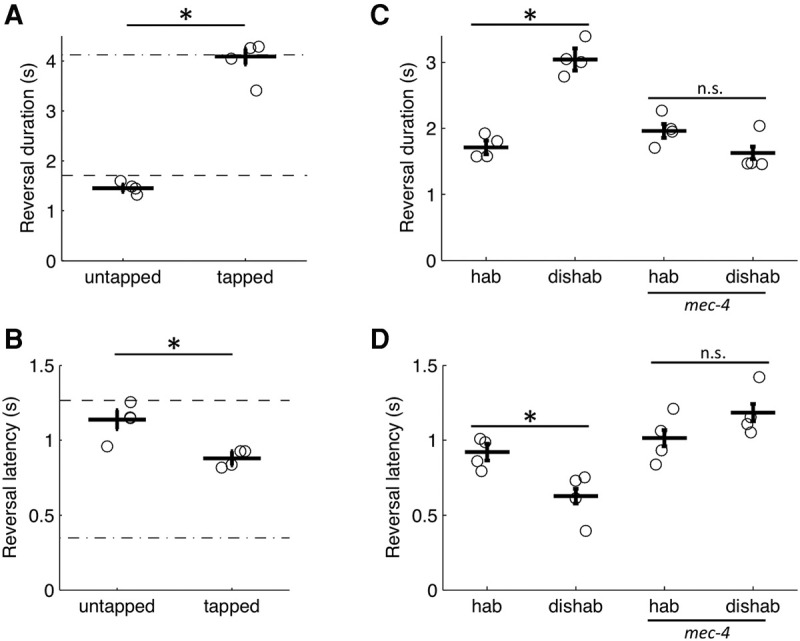
Sensory input from body touch receptors acts as a dishabituating cue. (A) Tap after training reversed the change in response (A) duration and (B) latency associated with repeated ASH activation. The dash-dot line is the initial response level and the dashed line is the habituated response level. (C,D) Habituated responding of a touch insensitive mec-4 mutant was not reversed by tap. Duration (C) and latency (D) of the reversal response elicited by the final 2-sec light pulse of training (hab) and after a dishabituating tap (dishab). Circles are plate means, crosses are population means ± SEM (n = 4 plates), asterisks denote statistically distinguishable groups, and (n.s.) no significant difference. All data collected using the ljIs105 ChR2 transgene.
Figure 6.
Figure 6.
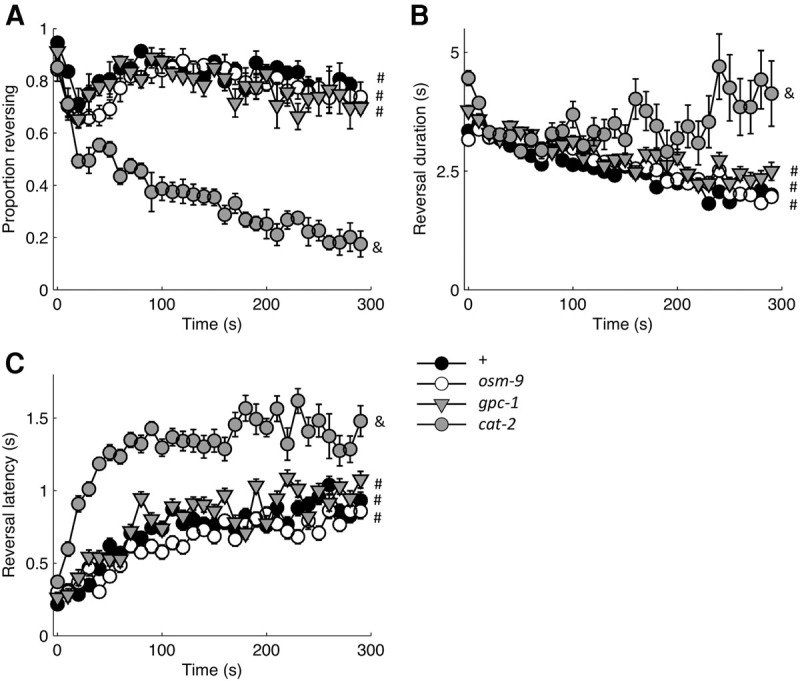
Analysis of mutations in genes previously implicated in repeated responding to naturally sensed ASH stimuli. Response probability (A), duration (B), and latency (C) for reversals elicited by thirty 2-sec light pulses administered at 0.1 Hz (n = 4 plates). # and & denote statistically distinguishable groups based on the response to the final stimulus. All data collected using the ljIs105 ChR2 transgene.
Figure 7.
Figure 7.
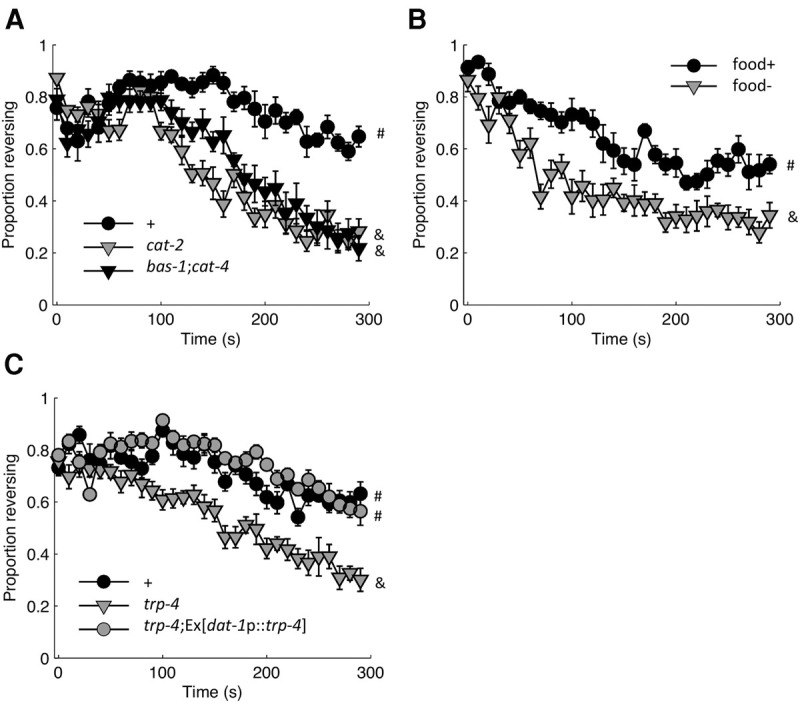
Dopamine signaling promotes responding during habituation training. (A) Loss of monoamine biosynthetic enzymes (CAT-2, BAS-1, CAT-4) altered the probability of responding relative to control (+; n = 6 plates). (B) Comparing populations off of food (food−) with those tested on a bacterial lawn (food+; n = 6 plates). Although all other experiments were conducted in the presence of a bacterial lawn, the food+ condition for Figure 7B refers to a very thin bacterial lawn that was spread with liquid culture at most 2 h before testing (compared with the usual 24 h or more before testing), thus the more rapid decline in responding than was observed for other trials with food (n = 6 plates). (C) Loss of trp-4 recapitulated the dopamine deficient cat-2 mutant phenotype. Loss of trp-4 could be compensated for by restoring trp-4 expression to dopaminergic neurons (n = 8 plates). Mean ± SEM. # and & denote statistically distinguishable groups based on the likelihood of responding to the final stimulus. All data collected using the ljIs114 ChR2 transgene.
Figure 8.
Figure 8.
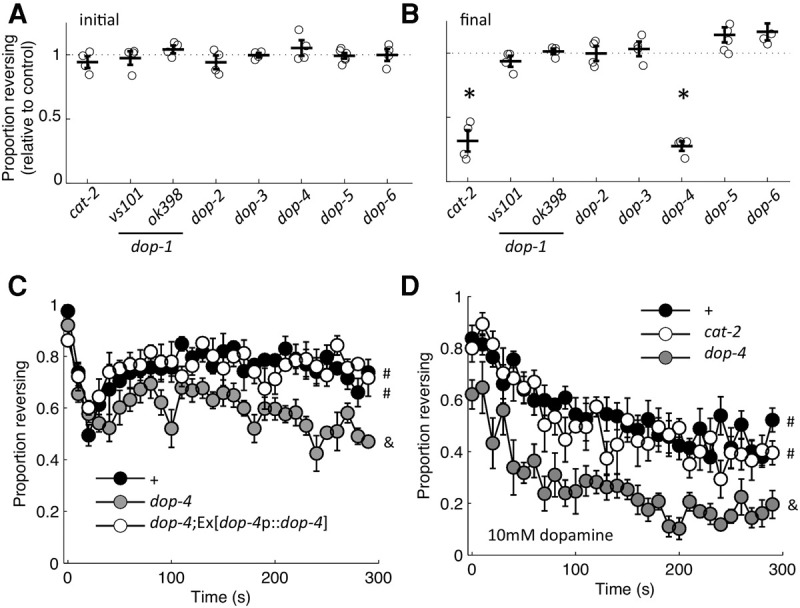
Loss of dop-4 recapitulates the phenotype of a dopamine deficient cat-2 mutant. Proportion of the population reversing relative to control for the initial (A) and 30th (B) 2-sec light pulse delivered at 0.1 Hz. Circles are plate means, crosses are population means± SEM (n = 4 plates), and the asterisks denote statistically distinguishable groups. (C) Proportion of animals responding to each stimulus of habituation training, with reintroduction of dop-4 (dop-4p::dop-4) rescuing the rapid response decrement of the dop-4 mutant (n = 4 plates). Mean ± SEM. # and & denote statistically distinguishable groups based on the likelihood of responding to the final stimulus. (D) Proportion of animals responding on 10 mM exogenous dopamine (n = 6 plates). Mean± SEM. # and & denote statistically distinguishable groups based on the likelihood of responding to the final stimulus. All data collected using the ljIs105 ChR2 transgene, except for dop-2 and dop-5 mutants, which had the ljIs114 ChR2 transgene.

References

    1. Ardiel EL, Rankin CH. 2010. An elegant mind: learning and memory in Caenorhabditis elegans. Learn Mem 17: 191–201. - PubMed
    1. Bargmann CI, Thomas JH, Horvitz HR. 1990. Chemosensory cell function in the behavior and development of Caenorhabditis elegans. Cold Spring Harb Symp Quant Biol 55: 529–538. - PubMed
    1. Bettinger JC, McIntire SL. 2004. State-dependency in C. elegans. Genes Brain Behav 3: 266–272. - PubMed
    1. Bozorgmehr T, Ardiel EL, McEwan AH, Rankin CH. 2013. Mechanisms of plasticity in a Caenorhabditis elegans mechanosensory circuit. Front Physiol 4: 88. - PMC - PubMed
    1. Braff DL, Grillon C, Geyer MA. 1992. Gating and habituation of the startle reflex in schizophrenic patients. Arch Gen Psychiatry 49: 206–215. - PubMed

Publication types

MeSH terms

LinkOut - more resources