


Hughes Abdominal Repair Trial (HART) - Abdominal wall closure techniques to reduce the incidence of incisional hernias: study protocol for a randomised controlled trial
- PMID: 27634489
- PMCID: PMC5025615
- DOI: 10.1186/s13063-016-1573-0
Hughes Abdominal Repair Trial (HART) - Abdominal wall closure techniques to reduce the incidence of incisional hernias: study protocol for a randomised controlled trial
Abstract
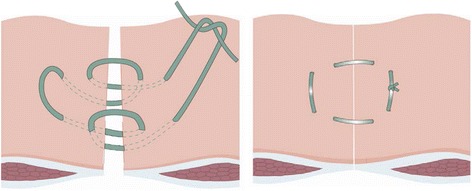
Background: Incisional hernias are common complications of midline closure following abdominal surgery and cause significant morbidity, impaired quality of life and increased health care costs. The 'Hughes Repair' combines a standard mass closure with a series of horizontal and two vertical mattress sutures within a single suture. This theoretically distributes the load along the incision length as well as across it. There is evidence to suggest that this technique is as effective as mesh repair for the operative management of incisional hernias; however, no trials have compared the Hughes Repair with standard mass closure for the prevention of incisional hernia formation following a midline incision.
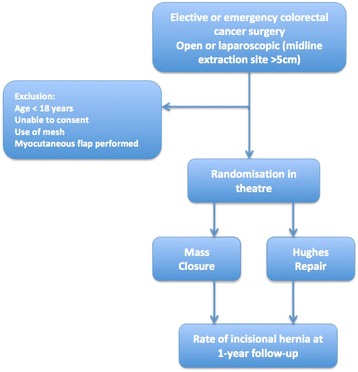
Methods/design: This is a 1:1 randomised controlled trial comparing two suture techniques for the closure of the midline abdominal wound following surgery for colorectal cancer. Full ethical approval has been gained (Wales REC 3, MREC 12/WA/0374). Eight hundred patients will be randomised from approximately 20 general surgical units within the United Kingdom. Patients undergoing open or laparoscopic (more than a 5-cm midline incision) surgery for colorectal cancer, elective or emergency, are eligible. Patients under the age of 18 years, those having mesh inserted or undergoing musculofascial flap closure of the perineal defect in abdominoperineal wound closure, and those unable to give informed consent will be excluded. Patients will be randomised intraoperatively to either the Hughes Repair or standard mass closure. The primary outcome measure is the incidence of incisional hernias at 1 year as assessed by standardised clinical examination. The secondary outcomes include quality of life patient-reported outcome measures, cost-utility analysis, incidence of complete abdominal wound dehiscence and C-POSSUM scores. The incidence of incisional hernia at 1 year, assessed by computerised tomography, will form a tertiary outcome.
Discussion: A feasibility phase has been completed. The results of the study will be used to inform current and future practice and potentially reduce the risk of incisional hernia formation following midline incisions.
Trial registration number: ISRCTN 25616490 . Registered on 1 January 2012.
Keywords: Abdominal closure; Hughes repair; Incisional hernia; Mass closure; Quality of life.
Figures
References
Publication types
MeSH terms
Associated data
Grants and funding
LinkOut - more resources
Full Text Sources
Other Literature Sources
Medical
