Review
. 2016 Aug 25:5:F1000 Faculty Rev-2078.
doi: 10.12688/f1000research.9207.1. eCollection 2016.

mTOR inhibitors in cancer therapy

Affiliations
Review

mTOR inhibitors in cancer therapy

Jianling Xie et al. F1000Res. .

Abstract

The mammalian target of rapamycin, mTOR, plays key roles in cell growth and proliferation, acting at the catalytic subunit of two protein kinase complexes: mTOR complexes 1 and 2 (mTORC1/2). mTORC1 signaling is switched on by several oncogenic signaling pathways and is accordingly hyperactive in the majority of cancers. Inhibiting mTORC1 signaling has therefore attracted great attention as an anti-cancer therapy. However, progress in using inhibitors of mTOR signaling as therapeutic agents in oncology has been limited by a number of factors, including the fact that the classic mTOR inhibitor, rapamycin, inhibits only some of the effects of mTOR; the existence of several feedback loops; and the crucial importance of mTOR in normal physiology.

Keywords: cancer therapy; mTOR; mTOR inhibitors; rapamycin.


Conflict of interest statement

The authors declare that they have no competing interests. No competing interests were disclosed. No competing interests were disclosed. No competing interests were disclosed.

Figures
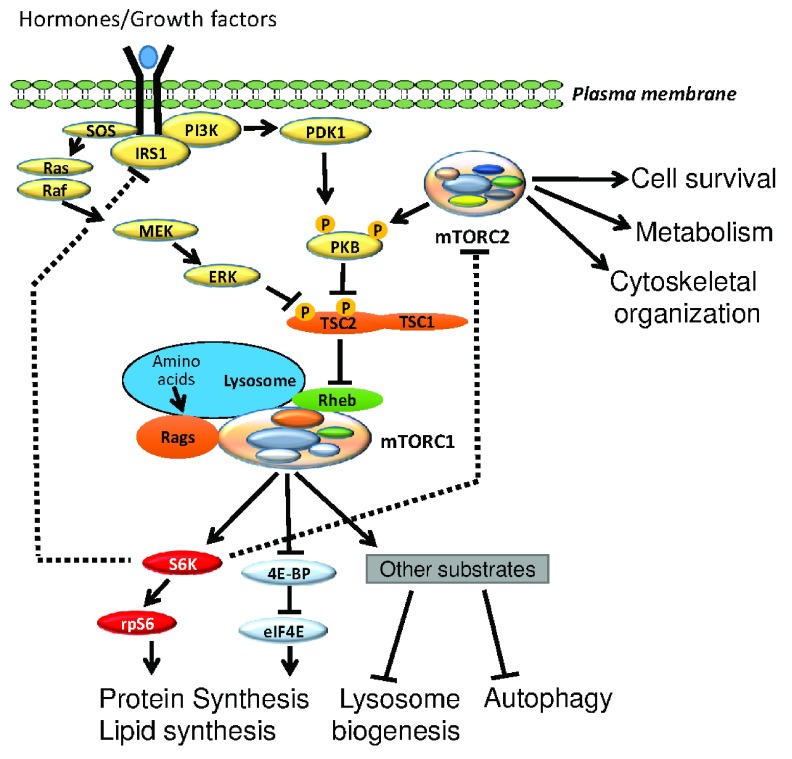
Figure 1.
Figure 1.. Schematic representation of signaling pathways involving the two mTOR complexes.
Typically, hormones and growth factors activate mTOR complex 1 (mTORC1) through the SOS/Ras/Raf-MEK-ERK (MAPK) or the IRS1/PI3K-PDK1-PKB pathways or both. mTORC2 also contributes to the activation of PKB through the direct phosphorylation of its turn motif as well as its hydrophobic motif. These pathways impinge on the tuberous sclerosis complex (TSC), which serves as a GTPase activator protein for the small G-protein Rheb. Upon inhibitory phosphorylation evoked by upstream kinases such as PKB, the activity of TSC is suppressed, promoting the accumulation of GTP-bound Rheb, which in turn activates mTORC1 on the surface of lysosomes. Amino acids also activate mTORC1 by bringing the latter onto lysosomes via the Rag GTPases. S6K-rpS6 and 4EBP1-eIF4E are the best-characterized mTORC1 downstream targets and are responsible for controlling a variety of anabolic effects driven by mTORC1. Dashed lines indicate feedback mechanisms. mTOR, mammalian target of rapamycin; PI3K, phosphoinositide 3-kinase.
Figure 2.
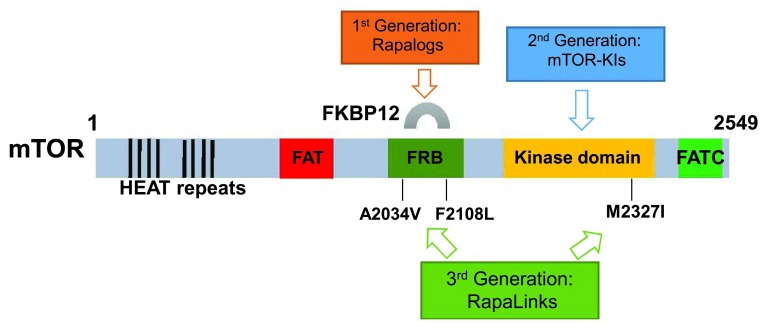
Figure 2.. Domains of the mTOR protein and three generations of mTOR inhibitors.
mTOR is composed of 2,549 amino acids which can be divided into several structural domains, including HEAT (for anti-parallel α-helices found in Huntingtin, elongation factor 3, PP2 A and TOR1) repeats and FAT (for FRAP, ATM, TRAP), FRB, kinase, and FATC (for C-terminal FAT) domains. The HEAT repeats, located close to the N-terminus of mTOR, are required for mTOR multimerization. The FRB—FK506 binding protein 12 (FKBP12)–rapamycin binding—domain, as its name implies, is the binding site of mTOR to FKBP12 and rapamycin. FAT, kinase, and FATC domains are conserved within the phosphatidylinositol 3-kinase-related kinases (PIKKs) and are essential for maintaining the activity of PIKKs. The first-generation mTOR inhibitors, including rapamycin itself, bind to FKBP12, which in turn interacts with the FRB domain of mTOR to inhibit mTOR activity. The second-generation mTOR inhibitors are ATP-competitive mTOR inhibitors which act as ATP analogues and compete with ATP for the binding to the kinase domain of mTOR. The newly developed third generation of mTOR inhibitors can potentially overcome the drug resistance of cancer cells bearing mTOR FRB/kinase domain mutation; that is, FRB domain mutations (mTOR A2034V and mTOR F2108L) confer resistance to rapalogs (first generation), and a kinase domain mutation (mTOR M2327I) renders resistance to mTOR-KIs (second generation). mTOR, mammalian target of rapamycin.
Figure 3.
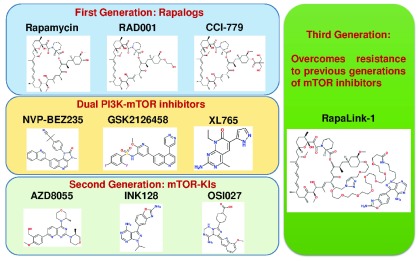
Figure 3.. Selected examples of three generations of mTOR inhibitors and dual PI3K/mTOR inhibitors.
Chemical structures were drawn by using the website www.emolecules.com. mTOR, mammalian target of rapamycin; PI3K, phosphoinositide 3-kinase.

References

    1. Kennedy BK, Lamming DW: The Mechanistic Target of Rapamycin: The Grand ConducTOR of Metabolism and Aging. Cell Metab. 2016;23(6):990–1003. 10.1016/j.cmet.2016.05.009 - DOI - PMC - PubMed
    1. Shimobayashi M, Hall MN: Making new contacts: the mTOR network in metabolism and signalling crosstalk. Nat Rev Mol Cell Biol. 2014;15(3):155–62. 10.1038/nrm3757 - DOI - PubMed
    1. Kim YC, Guan KL: mTOR: a pharmacologic target for autophagy regulation. J Clin Invest. 2015;125(1):25–32. 10.1172/JCI73939 - DOI - PMC - PubMed
    1. Jewell JL, Russell RC, Guan KL: Amino acid signalling upstream of mTOR. Nat Rev Mol Cell Biol. 2013;14(3):133–9. 10.1038/nrm3522 - DOI - PMC - PubMed
    1. Zoncu R, Efeyan A, Sabatini DM: mTOR: from growth signal integration to cancer, diabetes and ageing. Nat Rev Mol Cell Biol. 2011;12(1):21–35. 10.1038/nrm3025 - DOI - PMC - PubMed