


tRNA evolution from the proto-tRNA minihelix world
- PMID: 27636862
- PMCID: PMC5066508
- DOI: 10.1080/21541264.2016.1235527
tRNA evolution from the proto-tRNA minihelix world
Abstract
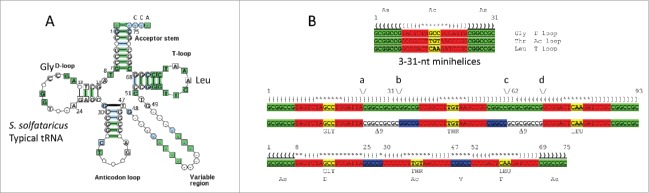
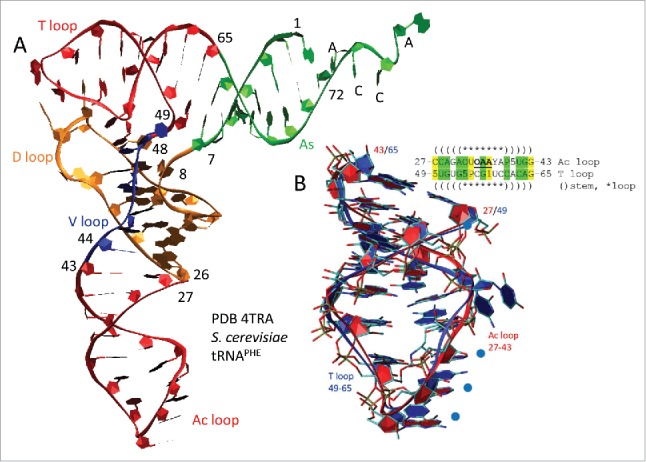
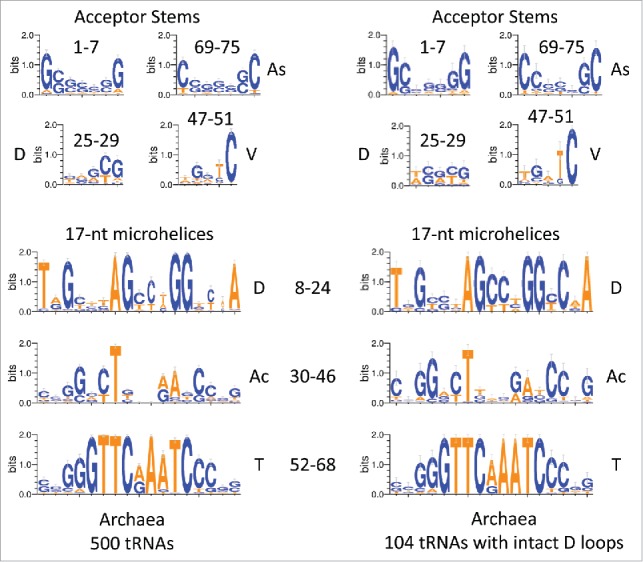
Multiple models have been advanced for the evolution of cloverleaf tRNA. Here, the conserved archaeal tRNA core (75-nt) is posited to have evolved from ligation of three proto-tRNA minihelices (31-nt) and two-symmetrical 9-nt deletions within joined acceptor stems (93 - 18 = 75-nt). The primary evidence for this conclusion is that the 5-nt stem 7-nt anticodon loop and the 5-nt stem 7-nt T loop are structurally homologous and related by coding sequence. We posit that the D loop was generated from a third minihelix (31-nt) in which the stem and loop became rearranged after 9-nt acceptor stem deletions and cloverleaf folding. The most 3´-5-nt segment of the D loop and the 5-nt V loop are apparent remnants of the joined acceptor stems (14 - 9 = 5-nt). Before refolding in the tRNA cloverleaf, we posit that the 3'-5-nt segment of the D loop and the 5-nt V loop were paired, and, in the tRNA cloverleaf, frequent pairing of positions 29 (D loop) and 47 (V loop) remains (numbered on a 75-nt tRNA cloverleaf core). Amazingly, after >3.5 billion years of evolutionary pressure on the tRNA cloverleaf structure, a model can be constructed that convincingly describes the genesis of 75/75-nt conserved archaeal tRNA core positions. Judging from the tRNA structure, cloverleaf tRNA appears to represent at least a second-generation scheme (and possibly a third-generation scheme) that replaced a robust 31-nt minihelix protein-coding system, evidence for which is preserved in the cloverleaf structure. Understanding tRNA evolution provides insights into ribosome and rRNA evolution.
Keywords: D loop; T loop; V loop; acceptor stems; anticodon loop; proto-tRNA minihelices; rRNA evolution; ribosome evolution; tRNA evolution; tRNA microhelices; tRNA structure.
Figures
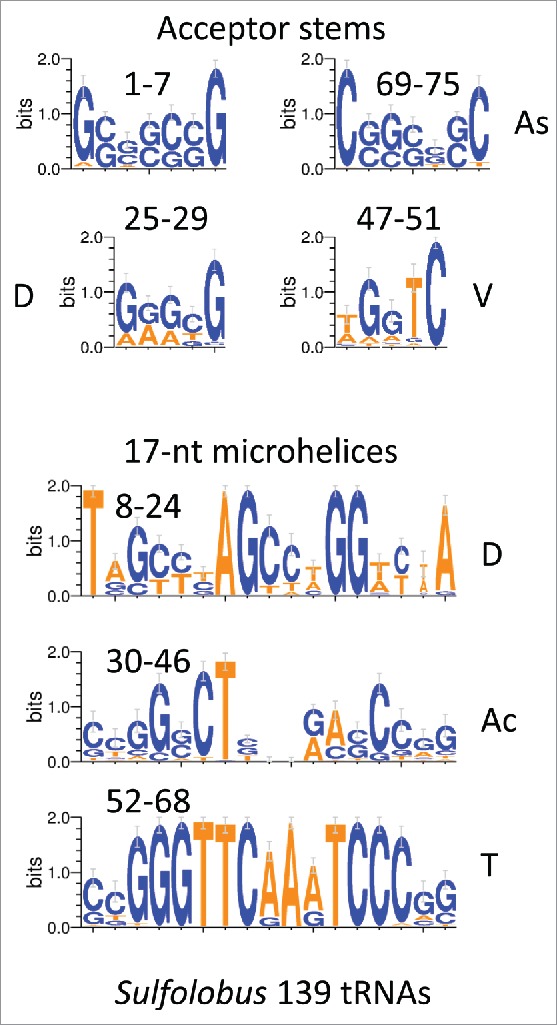
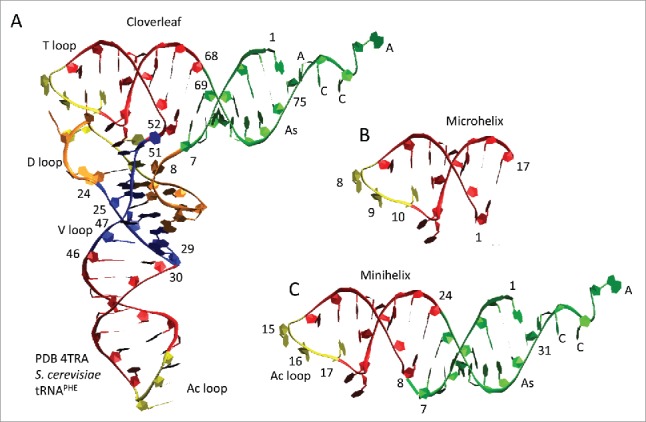
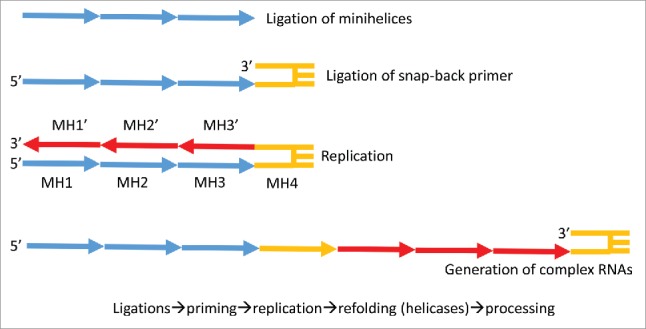
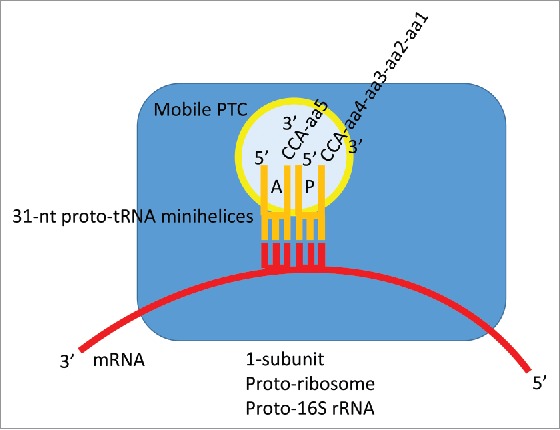
References
-
- Root-Bernstein RS, Dillon PF. Molecular complementarity I: the complementarity theory of the origin and evolution of life. J Theor Biol 1997; 188:447-479; PMID:9367734; http://dx.doi.org/ 10.1006/jtbi.1997.0476 - DOI - PubMed
-
- Root-Bernstein R. A modular hierarchy-based theory of the chemical origins of life based on molecular complementarity. Acc Chem Res 2012; 45:2169-2177. - PubMed
-
- Burton ZF, Opron K, Wei G, Geiger JH. A model for genesis of transcription systems. Transcription 2016; 7(1):1-13; PMID:26735411; http://dx.doi.org/ 10.1080/21541264.2015.1128518 - DOI - PMC - PubMed
-
- Burton ZF. The Old and New Testaments of gene regulation: Evolution of multi-subunit RNA polymerases and co-evolution of eukaryote complexity with the RNAP II CTD. Transcription 2014; 5:e28674; PMID:25764332; http://dx.doi.org/ 10.4161/trns.28674 - DOI - PMC - PubMed
-
- Iyer LM, Koonin EV, Aravind L. Evolutionary connection between the catalytic subunits of DNA-dependent RNA polymerases and eukaryotic RNA-dependent RNA polymerases and the origin of RNA polymerases. BMC Struct Biol 2003; 3:1; PMID:12553882; http://dx.doi.org/ 10.1186/1472-6807-3-1 - DOI - PMC - PubMed
MeSH terms
Substances
LinkOut - more resources
Full Text Sources
Other Literature Sources
Research Materials
