


Down-regulated resistin level in consequence of decreased neutrophil counts in untreated Grave's disease
- PMID: 27637079
- PMCID: PMC5346669
- DOI: 10.18632/oncotarget.12019
Down-regulated resistin level in consequence of decreased neutrophil counts in untreated Grave's disease
Abstract
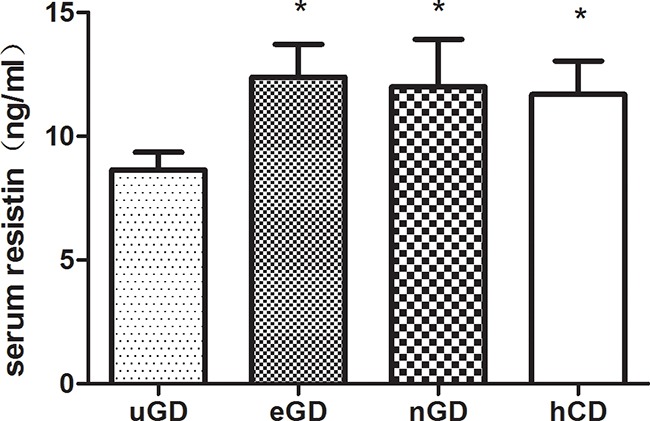
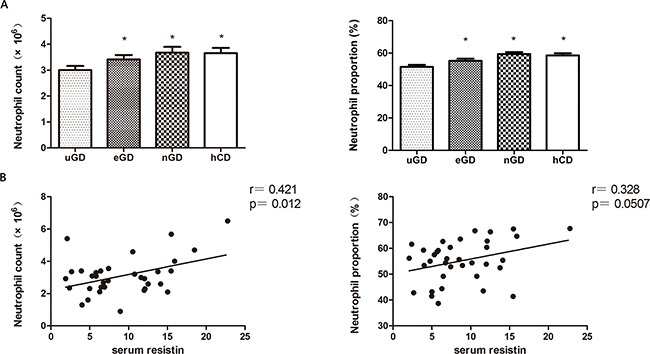
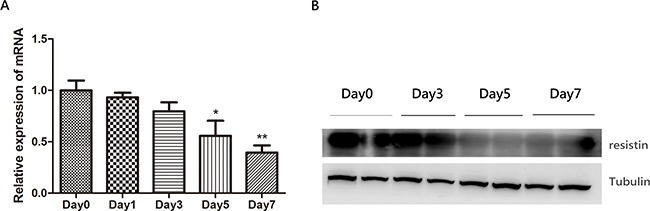
Resistin, belongs to cysteine-rich secretory protein, is mainly produced by circulating leukocytes, such as neutrophils monocytes and macrophages in humans. To date, few but controversial studies have reported about resistin concentrations in hyperthyroid patients, especially in Graves' disease (GD). We undertaked a controlled, prospective study to explore the serum resistin concentration in GD patients before and after -MMI treatment. In addition, we also investigated the main influencing factor on serum resistin level and discuessed the potential role of serum resistin plays in GD patients. 39 untreated GD (uGD) patients, including 8 males and 31 females, were enrolled in our investigation. All of these patients were prescribed with MMI treatment, in addition to 25 healthy controls. Anthropometric parameters and hormone assessment were measured. Enzyme-linked immunosorbent assay was used to detect serum resistin concentration in different stages of GD patients. Furthermore, neutrophil cell line NB4 with or without T3 treatment to detect the effect of thyroid hormones on resistin expression. The serum resistin level and neutrophil counts in untreated GD patients were significantly declined. And all of these parameters were recovered to normal after MMI treatment in ethyroid GD (eGD) and TRAb-negative conversion (nGD) patients. Resistin concentration exhibited a negative correlation with FT3 and FT4, but a positive correlation with absolute number of neutrophiles in uGD patients, whereas did not correlate with thyroid autoimmune antibodies and BMI. Neutrophile cell line, NB4, produced decreased expression of resistin when stimulated with T3. Our study showed a decrease of serum resistin level in GD patients and we suggested that the serum resistin might primarily secreted from circulating neutrophils and down-regulated by excessive thyroid hormones in GD patients.
Keywords: Graves’ disease; T3; neutrophils; resistin.
Figures
References
-
- Steppan CM, Bailey ST, Bhat S, Brown EJ, Banerjee RR, Wright CM, Patel HR, Ahima RS, Lazar MA. The hormone resistin links obesity to diabetes. Nature. 2001;409:307–312. - PubMed
-
- Kim KH, Lee K, Moon YS, Sul HS. A cysteine-rich adipose tissue-specific secretory factor inhibits adipocyte differentiation. The Journal of biological chemistry. 2001;276:11252–11256. - PubMed
-
- Rajala MW, Qi Y, Patel HR, Takahashi N, Banerjee R, Pajvani UB, Sinha MK, Gingerich RL, Scherer PE, Ahima RS. Regulation of resistin expression and circulating levels in obesity, diabetes, and fasting. Diabetes. 2004;53:1671–1679. - PubMed
-
- Banerjee RR, Rangwala SM, Shapiro JS, Rich AS, Rhoades B, Qi Y, Wang J, Rajala MW, Pocai A, Scherer PE, Steppan CM, Ahima RS, Obici S, et al. Regulation of fasted blood glucose by resistin. Science (New York, NY) 2004;303:1195–1198. - PubMed
-
- Li FP, He J, Li ZZ, Luo ZF, Yan L, Li Y. Effects of resistin expression on glucose metabolism and hepatic insulin resistance. Endocrine. 2009;35:243–251. - PubMed
MeSH terms
Substances
LinkOut - more resources
Full Text Sources
Other Literature Sources
