Review
. 2017 Jun 1;9(6):a028167.
doi: 10.1101/cshperspect.a028167.

Primary Cilia and Coordination of Receptor Tyrosine Kinase (RTK) and Transforming Growth Factor β (TGF-β) Signaling

Affiliations
Review

Primary Cilia and Coordination of Receptor Tyrosine Kinase (RTK) and Transforming Growth Factor β (TGF-β) Signaling

Søren T Christensen et al. Cold Spring Harb Perspect Biol. .

Abstract

Since the beginning of the millennium, research in primary cilia has revolutionized our way of understanding how cells integrate and organize diverse signaling pathways during vertebrate development and in tissue homeostasis. Primary cilia are unique sensory organelles that detect changes in their extracellular environment and integrate and transmit signaling information to the cell to regulate various cellular, developmental, and physiological processes. Many different signaling pathways have now been shown to rely on primary cilia to function properly, and mutations that lead to ciliary dysfunction are at the root of a pleiotropic group of diseases and syndromic disorders called ciliopathies. In this review, we present an overview of primary cilia-mediated regulation of receptor tyrosine kinase (RTK) and transforming growth factor β (TGF-β) signaling. Further, we discuss how defects in the coordination of these pathways may be linked to ciliopathies.


Figures

Figure 1.
Figure 1.
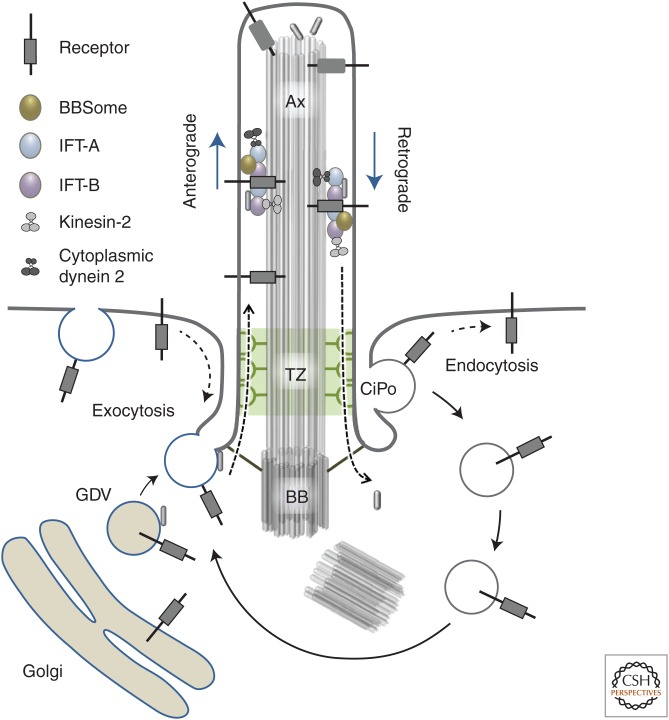
Overview on trafficking pathways involved in ciliary assembly, homeostasis, and signaling. IFT-A/B, Intraflagellar transport complexes A/B; Ax, axoneme; TZ, ciliary transition zone; BB, basal body; GDV, Golgi-derived vesicle; CiPo, ciliary pocket. Please see text for further details and references.
Figure 2.
Figure 2.
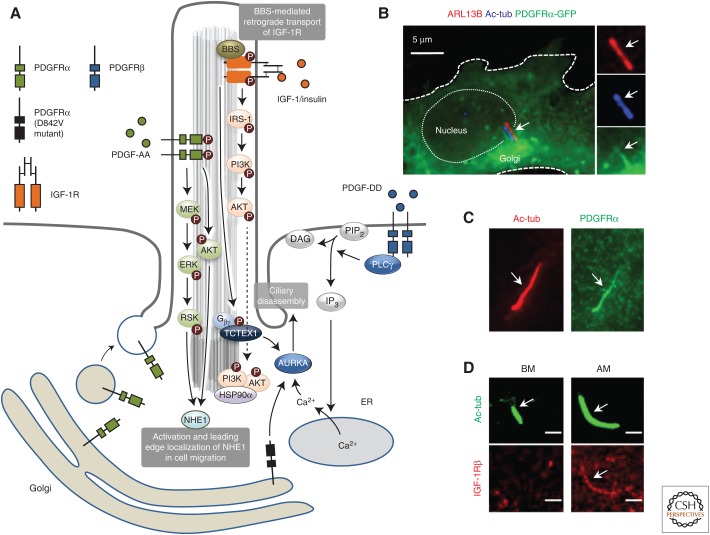
Overview on receptor tyrosine kinase (RTK) signaling in the primary cilium. (A) Cartoon illustrating signaling pathways regulated by platelet-derived growth factor receptor (PDGFR)αα and insulin-like growth factor (IGF)-1R in the primary cilium as well as extraciliary RTK signaling in ciliary disassembly. (B) Fluorescence microscopy analysis on the localization of green fluorescent protein (GFP)-PDGFRα (green) to the Golgi and the primary cilium in retinal pigment epithelium (RPE) cells. Cilia (arrows) were costained with anti-ARL13B (red) and antiacetylated α-tubulin (Ac-tub, blue). (Panel from Nielsen et al. 2015; reprinted, with permission, from Company of Biologists.) (C) Fluorescence microscopy analysis on the localization of endogenous PDGFRα (green) to the primary cilium (Ac-tub, red) in mouse embryonic fibroblasts. (Panel from Schneider et al. 2005; reprinted, with permission, from Elsevier.) (D) Fluorescence microscopy analysis on ciliary length and localization of endogenous IGF-1Rβ (red) to primary cilia (Ac-tub, green) in human mesenchymal stem cells (hMSCs) cultured in basal media (BM), adipogenic media (AM), and basal medium (BM), and after 5 days. Scale bar, 10 µm. (Panel from Dalbay et al. 2015; reprinted under the terms of the Creative Commons Attribution License.)
Figure 3.
Figure 3.
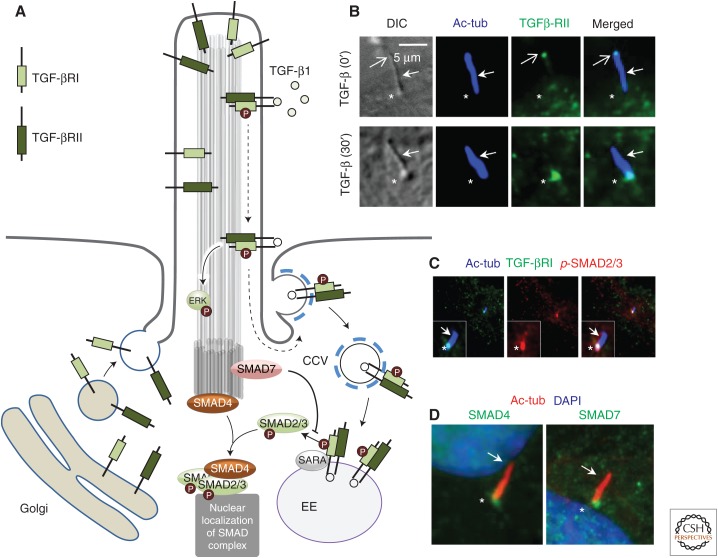
Overview of transforming growth factor β (TGF-β) signaling in the primary cilium. (A) Cartoon illustrating TGF-β signaling at the primary cilium. (B) Fluorescence microcopy analysis on the localization of endogenous TGF-βRII (green) at the primary cilium before (0′) and 30 min after TGF-β1 stimulation (30′). Primary cilia are shown with differential interference contrast microcopy (DIC) and stained with antiacetylated α-tubulin (Ac-tub, blue, closed arrows). The ciliary base region is marked with asterisks and the ciliary tip with open arrows. (C) Fluorescence microcopy analysis on the accumulation of TGF-βRI (green) and phospho-SMAD2/3 (p-SMAD2/3, red) at the ciliary base region after 30 min of TGF-β1 stimulation. (D) Fluorescence microscopy analysis of localization of SMAD4 (green, left panel) and SMAD7 (green, right panel) to the ciliary base region (asterisks). The cilium (Ac-tub, red) is marked with closed arrows, and nuclei were stained with DAPI (blue). All images were obtained from cultures of human foreskin fibroblasts. (From Clement et al. 2013a; reprinted, with permission, from Elsevier.)

References

    1. Absalon S, Blisnick T, Bonhivers M, Kohl L, Cayet N, Toutirais G, Buisson J, Robinson D, Bastin P. 2008. Flagellum elongation is required for correct structure, orientation and function of the flagellar pocket in Trypanosoma brucei. J Cell Sci 121: 3704–3716. - PubMed
    1. Al JA, Lemaitre AI, Delgehyr N, Faucourt M, Spassky N, Meunier A. 2014. Centriole amplification by mother and daughter centrioles differs in multiciliated cells. Nature 516: 104–107. - PubMed
    1. Anderson CT, Stearns T. 2009. Centriole age underlies asynchronous primary cilium growth in mammalian cells. Curr Biol 19: 1498–1502. - PMC - PubMed
    1. Andrae J, Gallini R, Betsholtz C. 2008. Role of platelet-derived growth factors in physiology and medicine. Genes Dev 22: 1276–1312. - PMC - PubMed
    1. Ascenzi MG, Blanco C, Drayer I, Kim H, Wilson R, Retting KN, Lyons KM, Mohler G. 2011. Effect of localization, length and orientation of chondrocytic primary cilium on murine growth plate organization. J Theor Biol 285: 147–155. - PMC - PubMed

MeSH terms

Substances

LinkOut - more resources