. 2016 Nov 15;214(10):1579-1587.
doi: 10.1093/infdis/jiw420. Epub 2016 Sep 16.

Genomic Epidemiology of Gonococcal Resistance to Extended-Spectrum Cephalosporins, Macrolides, and Fluoroquinolones in the United States, 2000-2013

Affiliations

Genomic Epidemiology of Gonococcal Resistance to Extended-Spectrum Cephalosporins, Macrolides, and Fluoroquinolones in the United States, 2000-2013

Yonatan H Grad et al. J Infect Dis. .

Abstract

Background: Treatment of Neisseria gonorrhoeae infection is empirical and based on population-wide susceptibilities. Increasing antimicrobial resistance underscores the potential importance of rapid diagnostic tests, including sequence-based tests, to guide therapy. However, the usefulness of sequence-based diagnostic tests depends on the prevalence and dynamics of the resistance mechanisms.

Methods: We define the prevalence and dynamics of resistance markers to extended-spectrum cephalosporins, macrolides, and fluoroquinolones in 1102 resistant and susceptible clinical N. gonorrhoeae isolates collected from 2000 to 2013 via the Centers for Disease Control and Prevention's Gonococcal Isolate Surveillance Project.

Results: Reduced extended-spectrum cephalosporin susceptibility is predominantly clonal and associated with the mosaic penA XXXIV allele and derivatives (sensitivity 98% for cefixime and 91% for ceftriaxone), but alternative resistance mechanisms have sporadically emerged. Reduced azithromycin susceptibility has arisen through multiple mechanisms and shows limited clonal spread; the basis for resistance in 36% of isolates with reduced azithromycin susceptibility is unclear. Quinolone-resistant N. gonorrhoeae has arisen multiple times, with extensive clonal spread.

Conclusions: Quinolone-resistant N. gonorrhoeae and reduced cefixime susceptibility appear amenable to development of sequence-based diagnostic tests, whereas the undefined mechanisms of resistance to ceftriaxone and azithromycin underscore the importance of phenotypic surveillance. The identification of multidrug-resistant isolates highlights the need for additional measures to respond to the threat of untreatable gonorrhea.

Keywords: Neisseria gonorrhoeae; antibiotic resistance; cephalosporins; fluoroquinolones; genomic epidemiology; gonorrhea; macrolides; molecular diagnostics.


Figures

Figure 1.
Figure 1.
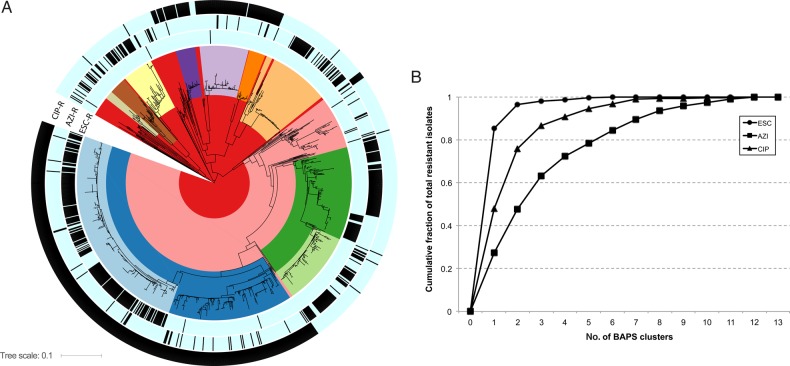
A, Maximum likelihood whole-genome-sequence phylogeny of 1102 Neisseria gonorrhoeae isolates, based on single nucleotide polymorphisms from mapping to the FA1090 reference genome. The coloring in the clades reflects the groups predicted from Bayesian analysis of population structure (BAPS). The black hashes in the 3 outer rings reflect (from inner to outer rings) reduced susceptibility to the extended-spectrum cephalosporins (ESCs), reduced susceptibility to azithromycin (AZI), and ciprofloxacin (CIP) resistance. B, Plot of cumulative fraction of isolates for the ESCs, AZI, and CIP by number of BAPS groups.
Figure 2.
Figure 2.
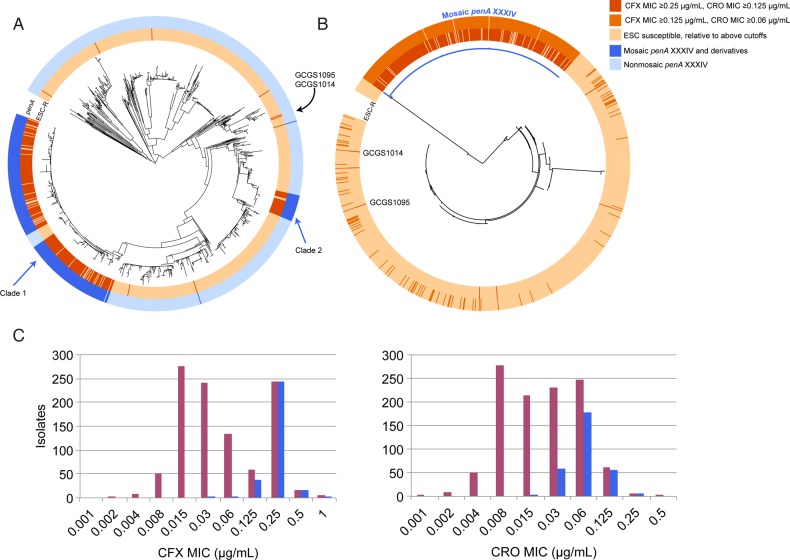
A, Maximum likelihood whole-genome-sequence phylogeny of 1102 Neisseria gonorrhoeae isolates, based on single-nucleotide polymorphisms from mapping to the FA1090 reference genome, with the inner annotation ring representing those isolates with reduced extended-spectrum cephalosporin (ESC) susceptibility and the outer ring representing which isolates have a mosaic penA XXXIV or derivative allele. Clades 1 and 2 are identified. A lineage within clade 1 lacks the mosaic penA XXXIV and is susceptible; these isolates appear to have undergone a recombination that replaced the mosaic penA XXXIV allele with mosaic penA XXXVIII allele. B, Maximum likelihood phylogeny of the penA locus, extracted from the de novo–assembled genomes for each of the isolates. The branch in blue indicates isolates with the mosaic penA XXXIV and derivative alleles. The coloring along the inner and outer annotation rings indicate isolates by the minimum inhibitory concentration (MIC) threshold defined in the key. C, Histograms indicating the number of isolates by cefixime (CFX) and ceftriaxone (CRO) MICs. The histogram in purple indicates the total number of isolates—those with and without a mosaic penA XXXIV-like allele—per MIC, and the histogram in blue indicates the number of isolates with a mosaic penA XXXIV–like allele.
Figure 4.
Figure 4.
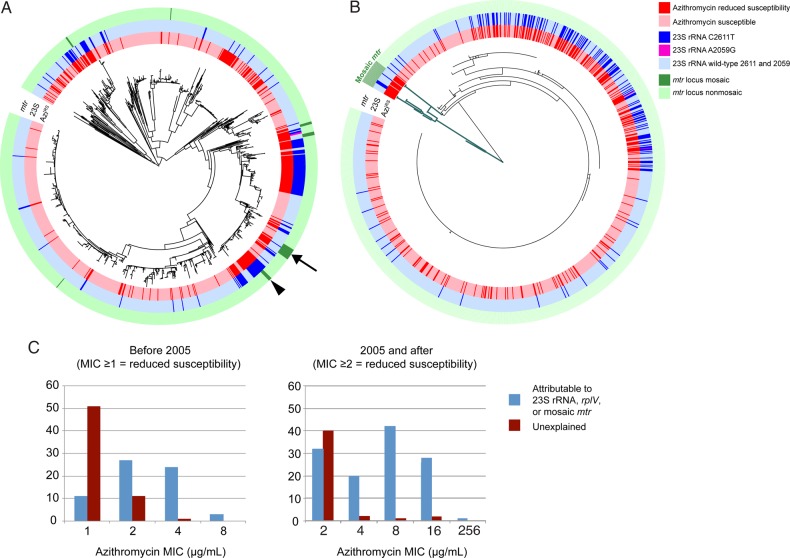
A, Maximum likelihood whole-genome-sequence phylogeny of 1102 Neisseria gonorrhoeae isolates, based on single-nucleotide polymorphisms from mapping to the FA1090 reference genome, with the inner annotation ring representing reduced azithromycin susceptibility, the middle annotation ring indicating isolates with at least 2 copies of the C2611T 23S ribosomal RNA (rRNA) mutation and 2 isolates with 4 copies of the A2059G 23S rRNA mutation, and the outer annotation ring indicating isolates with a mosaic mtr locus. The arrow indicates an example where the mtr locus mosaic is inferred to have appeared first, followed by acquisition of the C2611T mutation, and the wedge indicates an example with the opposite order of acquisition. B, Maximum likelihood phylogeny of the mtrR locus including the 200 base pairs upstream of the coding sequence start site, extracted from the de novo–assembled genomes for each of the isolates. The branches in green indicate isolates with mosaic mtr loci. As in panel A, the annotation rings proceed from the innermost being reduced azithromycin susceptibility to the outermost being the mosaic mtr loci. C, Histograms indicating the azithromycin minimum inhibitory concentrations (MICs), separated into 2 sections by when there was a change in the azithromycin MIC testing protocol, such that the cutoff changed from 1 to 2 µg/mL.
Figure 5.
Figure 5.
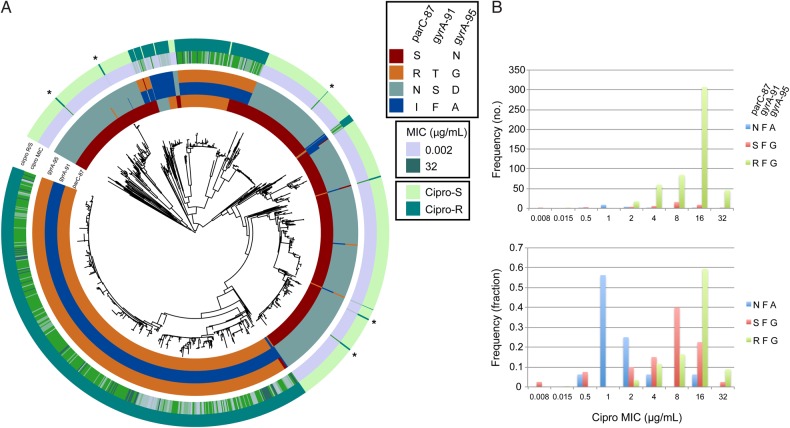
A, Maximum likelihood whole-genome-sequence phylogeny of 1102 Neisseria gonorrhoeae isolates, based on single-nucleotide polymorphisms from mapping to the FA1090 reference genome, with the inner annotation rings representing amino acid residues at ParC-87, GyrA-91, and GyrA-95. The outer annotation rings represent ciprofloxacin (Cipro) minimum inhibitory concentrations (MICs) and dichotomized resistance (R) and susceptibility (S; cutoff for resistance at 1 µg/mL). The asterisks indicate quinolone-resistant N. gonorrhoeae that lack the ParC-87, GyrA-91, and GyrA-95 variants. B, Histograms of Cipro MICs of isolates based on haplotypes at ParC-87, GyrA-91, and GyrA-95 in absolute frequency (upper histogram) and in fraction (lower histogram).
Figure 3.
Figure 3.
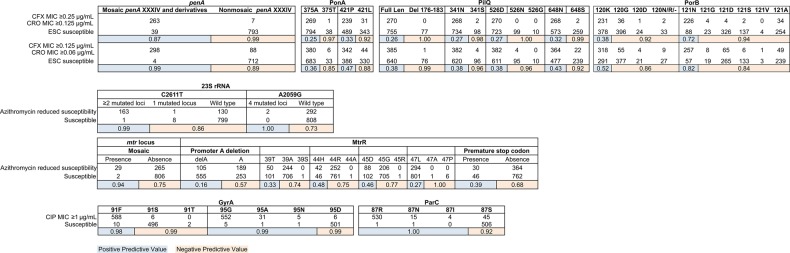
Positive (blue) and negative (tan) predictive values for resistance to the ESCs, azithromycin, and ciprofloxacin as determined in the dataset of 1102 gonococcal genomes. Two MIC thresholds are presented for the ESCs, representing the current threshold for reduced susceptibility and one dilution lower. Azithromycin reduced susceptibility is defined by MIC ≥ 1µg/mL for isolates between 2000-2004 and ≥ 2µg/mL starting in 2005, due to a change in the media used for agar dilution testing (see Supplemental Methods). Abbreviations: CFX, cefixime; CRO, ceftriaxone; ESC, extended-spectrum cephalosporin; MIC, minimum inhibitory concentration; rRNA, ribosomal RNA.

Comment in

References

    1. Grad YH, Kirkcaldy RD, Trees D et al. . Genomic epidemiology of Neisseria gonorrhoeae with reduced susceptibility to cefixime in the USA: a retrospective observational study. Lancet Infect Dis 2014; 14:220–6. - PMC - PubMed
    1. Workowski KA, Bolan GA, Centers for Disease Control and Prevention. Sexually transmitted diseases treatment guidelines, 2015. MMWR Recomm Rep 2015; 64:1–137. - PMC - PubMed
    1. Siedner MJ, Pandori M, Castro L et al. . Real-time PCR assay for detection of quinolone-resistant Neisseria gonorrhoeae in urine samples. J Clin Microbiol 2007; 45:1250–4. - PMC - PubMed
    1. Hemarajata P, Yang S, Soge OO, Humphries RM, Klausner JD. Performance and verification of a real-time PCR assay targeting the gyrA gene for prediction of ciprofloxacin resistance in Neisseria gonorrhoeae. J Clin Microbiol 2016; 54:805–8. - PMC - PubMed
    1. Update to CDC's sexually transmitted diseases treatment guidelines, 2006: fluoroquinolones no longer recommended for treatment of gonococcal infections. MMWR Morb Mortal Wkly Rep 2007; 56:332–6. - PubMed