. 2016 Sep 18:20:2331216516668302.
doi: 10.1177/2331216516668302.

Clinically Paired Electrodes Are Often Not Perceived as Pitch Matched

Affiliations

Clinically Paired Electrodes Are Often Not Perceived as Pitch Matched

Justin M Aronoff et al. Trends Hear. .

Abstract

For bilateral cochlear implant (CI) patients, electrodes that receive the same frequency allocation often stimulate locations in the left and right ear that do not yield the same perceived pitch, resulting in a pitch mismatch. This pitch mismatch may be related to degraded binaural abilities. Pitch mismatches have been found for some bilateral CI users and the goal of this study was to determine whether pitch mismatches are prevalent in bilateral CI patients, including those with extensive experience with bilateral CIs. To investigate this possibility, pitch matching was conducted with 16 bilateral CI patients. For 14 of the 16 participants, there was a significant difference between those electrodes in the left and right ear that yielded the same pitch and those that received the same frequency allocation in the participant's clinical map. The results suggest that pitch mismatches are prevalent with bilateral CI users. The results also indicated that pitch mismatches persist even with extended bilateral CI experience. Such mismatches may reduce the benefits patients receive from bilateral CIs.

Keywords: bilateral cochlear implants; current steering; perceptual misalignment; pitch matching.


Figures

Figure 1.
Figure 1.
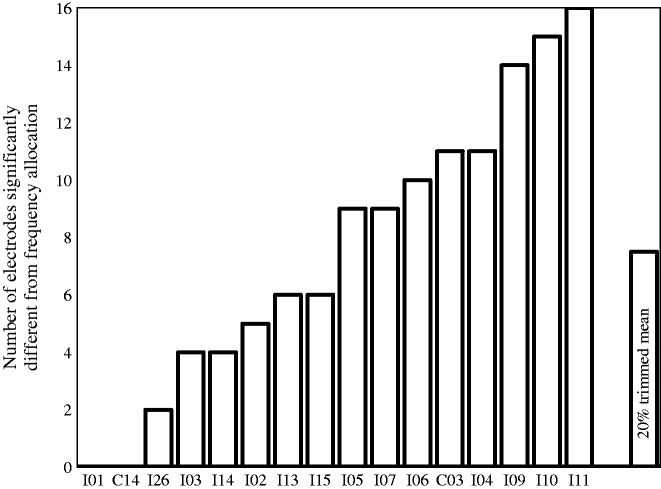
Number of electrodes that significantly deviate from the clinical pairings for each participant.
Figure 2.
Figure 2.
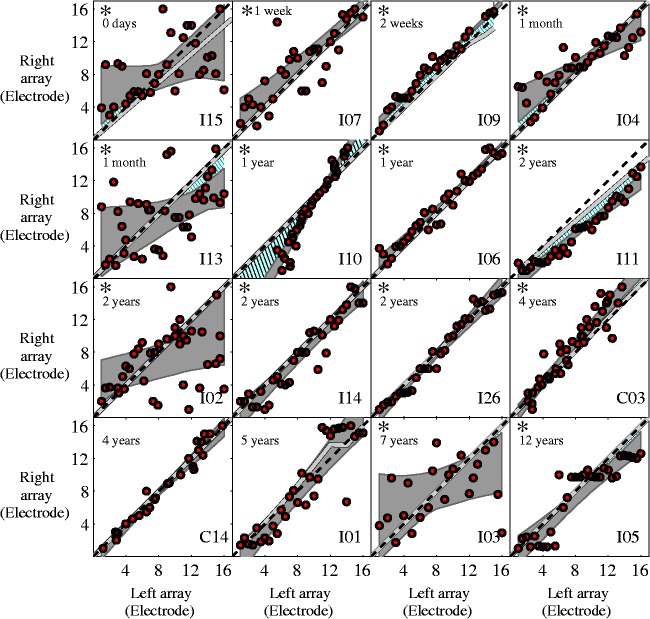
Individual pitch-matching data showing that, for most participants, pitch-matched electrode pairs significantly deviate from the isoline for at least part of the array. Panels are organized from shortest bilateral CI experience (top left) to longest bilateral CI experience (bottom right). The duration of bilateral CI experience is indicated in the top left corner of each panel. Circles indicate one pitch-matching trial. The dashed line represents the matches based on electrode numbers in the left and right processor. The gray line represents the matches based on frequency allocations in the left and right processor. The gray area indicates the 95% confidence interval for a linear fit of the pitch-matching data. The blue hatched area highlights the regions where there is a significant deviation from the frequency allocation. Asterisks in the upper left corner of a plot indicate that there was a significant deviation from clinically paired electrodes for at least part of the array for that participant.
Figure 3.
Figure 3.
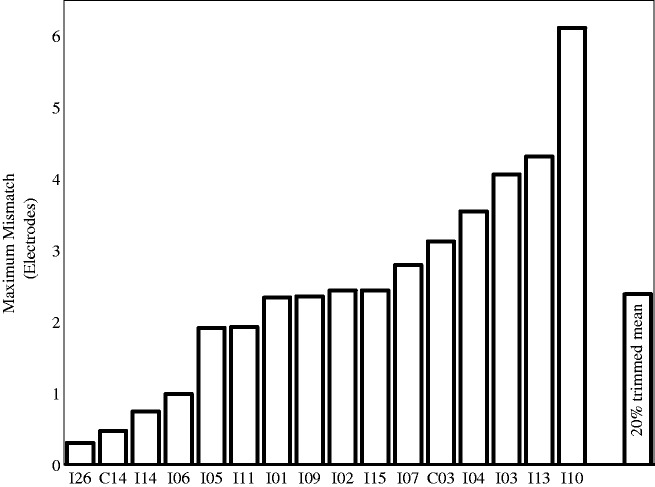
Maximum magnitude of the difference between the pitch-matched electrode pairs and the clinical pairings for each participant.
Figure 4.
Figure 4.
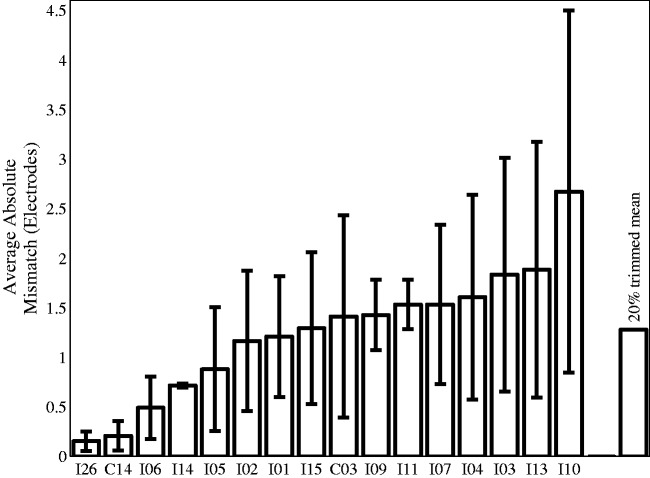
Average magnitude and standard deviation of the difference between the pitch-matched electrode pairs and the clinical pairings for each participant.
None

References

    1. Aronoff J. M., Shayman C., Prasad A., Suneel D., Stelmach J. (2015) Unilateral spectral and temporal compression reduces binaural fusion for normal hearing listeners with cochlear implant simulations. Hearing Research 320: 24–29. - PMC - PubMed
    1. Aronoff J. M., Stelmach J., Padilla M., Landsberger D. M. (2016) Interleaved processors improve cochlear implant patients’ spectral resolution. Ear and Hearing 37(2): e85–e90. - PMC - PubMed
    1. Aschendorff A., Kubalek R., Turowski B., Zanella F., Hochmuth A., Schumacher M., Laszig R. (2005) Quality control after cochlear implant surgery by means of rotational tomography. Otology & Neurotology 26(1): 34–37. - PubMed
    1. Dunn C. C., Tyler R. S., Oakley S., Gantz B. J., Noble W. (2008) Comparison of speech recognition and localization performance in bilateral and unilateral cochlear implant users matched on duration of deafness and age at implantation. Ear and Hearing 29(3): 352–359. - PMC - PubMed
    1. Eapen R. J., Buss E., Adunka M. C., Pillsbury H. C., 3rd, Buchman C. A. (2009) Hearing-in-noise benefits after bilateral simultaneous cochlear implantation continue to improve 4 years after implantation. Otology & Neurotology 30(2): 153–159. - PMC - PubMed

LinkOut - more resources