


Intravenous alpha-1 antitrypsin augmentation therapy for treating patients with alpha-1 antitrypsin deficiency and lung disease
- PMID: 27644166
- PMCID: PMC6457738
- DOI: 10.1002/14651858.CD007851.pub3
Intravenous alpha-1 antitrypsin augmentation therapy for treating patients with alpha-1 antitrypsin deficiency and lung disease
Abstract
Background: Alpha-1 antitrypsin deficiency is an inherited disorder that can cause chronic obstructive pulmonary disease (COPD). People who smoke are more seriously affected and have a greater risk of dying from the disease. Therefore, the primary treatment is to help people give up smoking. There are now also preparations available that contain alpha-1 antitrypsin, but it is uncertain what their clinical effect is.
Objectives: To review the benefits and harms of augmentation therapy with intravenous alpha-1 antitrypsin in patients with alpha-1 antitrypsin deficiency and lung disease.
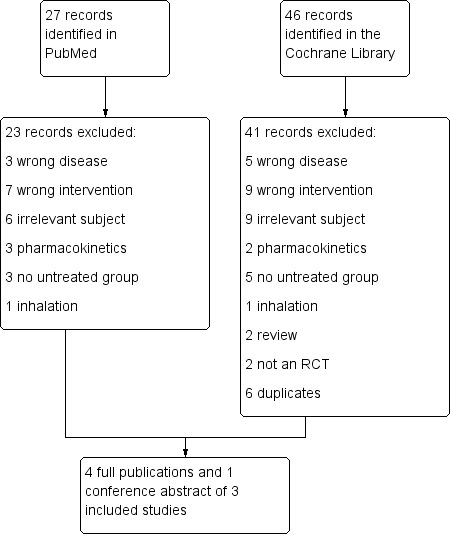
Search methods: We searched the Cochrane Central Register of Controlled Trials (CENTRAL), PubMed and ClinicalTrials.gov to 25 March 2016.
Selection criteria: We included randomised trials of augmentation therapy with alpha-1 antitrypsin compared with placebo or no treatment.
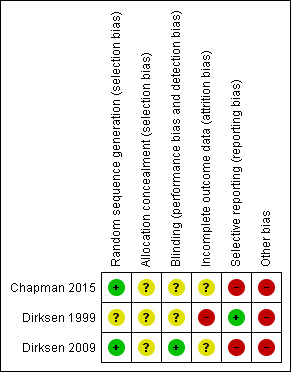
Data collection and analysis: The two review authors independently selected trials, extracted outcome data and assessed the risk of bias.
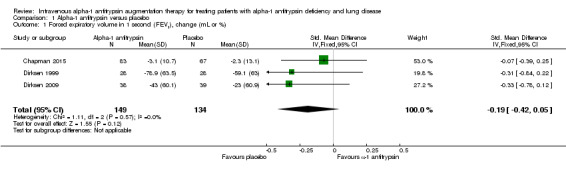
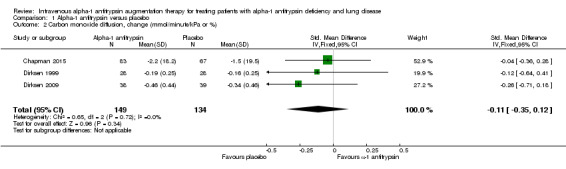
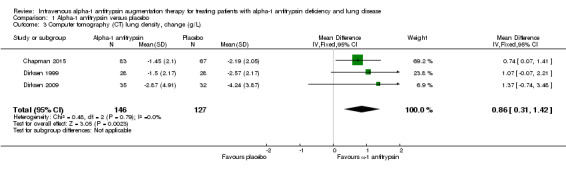
Main results: We included three trials (283 participants in the analyses) that ran for two to three years. All participants were ex- or never-smokers and had genetic variants that carried a high risk of developing COPD. Only one trial reported mortality data (one person of 93 died in the treatment group and three of 87 died in the placebo group). There was no information on harms in the oldest trial. Another trial reported serious adverse events in 10 participants in the treatment group and 18 participants in the placebo group. In the most recent trial, serious adverse events occurred in 28 participants in each group. None of the trials reported mean number of lung infections or hospital admissions. In the two trials that reported exacerbations, there were more exacerbations in the treatment group than in the placebo group, but the results of both trials included the possibility of no difference. Quality of life was similar in the two groups. Forced expiratory volume in one second (FEV1) deteriorated more in participants in the treatment group than in the placebo group but the confidence interval (CI) included no difference (standardised mean difference -0.19, 95% CI -0.42 to 0.05; P = 0.12). For carbon monoxide diffusion, the difference was -0.11 mmol/minute/kPa (95% CI -0.35 to 0.12; P = 0.34). Lung density measured by computer tomography (CT) scan deteriorated significantly less in the treatment group than in the placebo group (mean difference (MD) 0.86 g/L, 95% CI 0.31 to 1.42; P = 0.002). Several secondary outcomes were unreported in the largest and most recent trial whose authors had numerous financial conflicts of interest.
Authors' conclusions: This review update added one new study and 143 new participants, but the conclusions remain unchanged. Due to sparse data, we could not arrive at a conclusion about the impact of augmentation therapy on mortality, exacerbations, lung infections, hospital admission and quality of life, and there was uncertainty about possible harms. Therefore, it is our opinion that augmentation therapy with alpha-1 antitrypsin cannot be recommended.
Conflict of interest statement
We have no conflicts of interest.
Figures
Update of
References
References to studies included in this review
Chapman 2015 {published data only}
-
- Chapman KR, Burdon JG, Piitulainen E, Sandhaus RA, Seersholm N, Stocks JM, et al. Intravenous augmentation treatment and lung density in severe α1 antitrypsin deficiency (RAPID): a randomised, double‐blind, placebo‐controlled trial. Lancet 2015;386:360‐8. - PubMed
-
- Chapman KR, Burdon JGW, Piitulainen E, Sandhaus RA, Seersholm N, Stocks JM. Alpha‐1 antitrypsin (A1AT) preserves lung density In homozygous Alpha‐1 antitrypsin deficiency (A1ATD): a randomized, placebo‐controlled trial. American Journal of Respiratory and Critical Care Medicine 2013;187:A6069.
-
- NCT00261833. Zemaira in subjects with emphysema due to alpha1‐proteinase inhibitor deficiency. clinicaltrials.gov/ct2/show/NCT00261833 (accessed 7 August 2015).
Dirksen 1999 {published data only}
-
- Dirksen A, Dijkman JH, Madsen F, Stoel B, Hutchison DC, Ulrik CS, et al. A randomized clinical trial of alpha(1)‐antitrypsin augmentation therapy. American Journal of Respiratory and Critical Care Medicine 1999;160(5 Pt 1):1468‐72. - PubMed
Dirksen 2009 {published data only}
-
- NCT00263887. Alpha‐1‐antitrypsin (AAT) to treat emphysema in AAT‐deficient patients (EXACTLE) (trial registration). clinicaltrials.gov/ct2/show/NCT00263887?term=antitrypsin&rank=7 (accessed 5 January 2010).
References to ongoing studies
NCT01983241 {published data only}
-
- Efficacy and safety of alpha1‐proteinase inhibitor (human), modified process (alpha‐1 MP) in subjects with pulmonary emphysema due to alpha1 antitrypsin deficiency (AATD) (SPARTA). clinicaltrials.gov/ct2/show/NCT01983241 (accessed 16 June 2016).
Additional references
Alpha‐1 Foundation 2008
-
- Alpha‐1 Foundation Homepage. www.alphaone.org/ (accessed 9 May 2008).
Chalmers 1990
-
- Chalmers TC, Frank CS, Reitman D. Minimizing the three stages of publication bias. JAMA 1990;263:1392‐5. - PubMed
Chapman 2009
-
- Chapman KR, Stockley RA, Dawkins C, Wilkes MM, Navickis RJ. Augmentation therapy for alfa‐1 antitrypsin deficiency: a meta‐analysis. COPD: Journal of Chronic Obstructive Pulmonary Disease 2009;6(3):177‐84. - PubMed
Chen 2007
-
- Chen S, Farahati F, Marciniuk D, Mayers I, Boudreau R, Keating T. Human α1‐proteinase inhibitor for patients with α1‐antitrypsin deficiency [Technology report no 74]. Ottawa: Canadian Agency for Drugs and Technologies in Health 2007.
CLS Behring 2008
-
- CLS Behring 2008. www.cslbehring.com/s1/cs/enco/1154398192290/content/1154398189443/conten... (accessed 9 May 2008).
Evald 1990
-
- Evald T, Dirksen A, Keittelmann S, Viskum K, Kok‐Jensen A. Decline in pulmonary function in patients with alpha‐1‐antitrypsin deficiency. Lung 1990;168(Suppl):579‐85. - PubMed
Genetics Home Reference 2007
-
- Genetics Home Reference. Alpha‐1 antitrypsin deficiency, 2007. ghr.nlm.nih.gov/condition=alpha1antitrypsindeficiency (accessed 16 November 2008).
Gøtzsche 1996
-
- Gøtzsche PC, Liberati A, Luca P, Torri V. Beware of surrogate outcome measures. International Journal of Technology Assessment in Health Care 1996;12:238‐46. - PubMed
Gøtzsche 2006a
Gøtzsche 2006b
-
- Gøtzsche PC, Hróbjartsson A, Johansen HK, Haahr MT, Altman DG, Chan A‐W. Constraints on publication rights in industry‐initiated clinical trials. Journal of the American Medical Association 2006;295:1645‐6. - PubMed
Heresi 2008
-
- Heresi GA, Stoller JK. Augmentation therapy in a‐1 antitrypsin deficiency. Expert Opinion on Biological Therapy 2008;8:515‐26. - PubMed
Higgins 2003
Higgins 2011
-
- Higgins JPT, Green S (editors). Cochrane Handbook for Systematic Reviews of Interventions Version 5.1.0 [updated March 2011]. The Cochrane Collaboration, 2011. Available from www.cochrane‐handbook.org.
Hutchison 1988
-
- Hutchison DCS. Natural history of alpha1‐protease inhibitor deficiency. American Journal of Medicine 1988;84(Suppl 6A):3‐12. - PubMed
Larsson 1978
-
- Larsson C. Natural history and life expectancy in severe alpha1‐antitrypsin deficiency, Pi Z. Acta Medica Scandinavica 1978;204(5):345‐51. - PubMed
Marciniuk 2012
Nissen 2007
-
- Nissen SE, Wolski K. Effect of rosiglitazone on the risk of myocardial infarction and death from cardiovascular causes. New England Journal of Medicine 2007;356:2457‐71. - PubMed
O'Brien 1978
-
- O'Brien ML, Buist NR, Murphey WH. Neonatal screening for alpha1‐antitrypsin deficiency. Journal of Pediatrics 1978;92(6):1006‐10. - PubMed
Seersholm 2007
-
- Seersholm N, Dirksen A, Hansen NCG, Harving H og Dansk Lungemedicinsk Selskab. Retningslinjer for erstatningsbehandling til patienter med alfa‐1‐antitrypsinmangel, 2007 [Guidelines for replacement therapy in patients with alpha‐1 antitrypsin deficiency]. www.lungemedicin.dk/guidelines/alfa1erstat.pdf (accessed 09 May 2008).
Shah 2001
Sharp 1971
-
- Sharp HL. Alpha‐one‐antitrypsin deficiency. Hospital Practice 1971;6:83‐96.
Silverman 2009
-
- Silverman EK, Sandhaus RA. Alpha1‐antitrypsin deficiency. New England Journal of Medicine 2009;360:2749‐57. - PubMed
Stockley 2010
Sveger 1976
-
- Sveger T. Liver disease in alpha1‐antitrypsin deficiency detected by screening of 200,000 infants. New England Journal of Medicine 1976;294(24):1316‐21. - PubMed
Sveger 1978
-
- Sveger T. Alpha 1‐antitrypsin deficiency in early childhood. Pediatrics 1978;62(1):22‐5. - PubMed
References to other published versions of this review
Publication types
LinkOut - more resources
Full Text Sources
Other Literature Sources
Miscellaneous
