


Vision-related quality of life in patients receiving intravitreal ranibizumab injections in routine clinical practice: baseline data from the German OCEAN study
- PMID: 27644469
- PMCID: PMC5029004
- DOI: 10.1186/s12955-016-0536-1
Vision-related quality of life in patients receiving intravitreal ranibizumab injections in routine clinical practice: baseline data from the German OCEAN study
Abstract
Background: Vision-related quality of life (vrQoL) is advancing more and more into the focus of interest in ophthalmological clinical research. However, to date only little information is available about vrQoL from large non-interventional studies in terms of "real-world evidence". The purpose of this investigation was to describe baseline VFQ-25 visual function scores, to evaluate whether they differ from previous phase III clinical trials, to determine which contributing factors (e.g. indication, age, gender) affect VFQ-25 scores and to identify its impact on driving.
Methods: The non-interventional OCEAN study (Observation of treatment patterns with LuCEntis and real life ophthalmic monitoring, including optional OCT in Approved iNdications) is the largest ophthalmic study conducted in Germany, to evaluate the real world situation of patients treated with ranibizumab (NCT02194803). The NEI-VFQ-25 questionnaire was conducted at baseline, months 4, 12 and 24. Descriptive statistics was used to analyse the baseline data. ANOVA was performed to evaluate the impact of various contributing factors on composite and selected subscale scores.
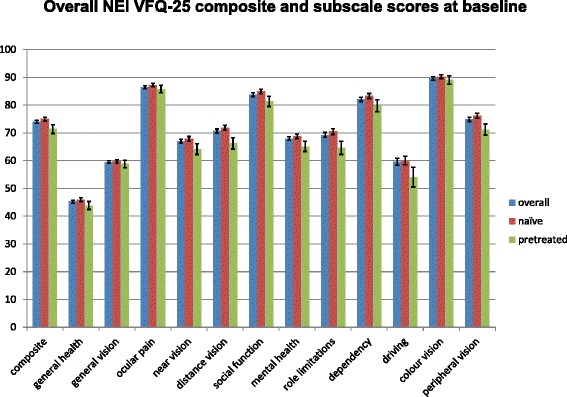
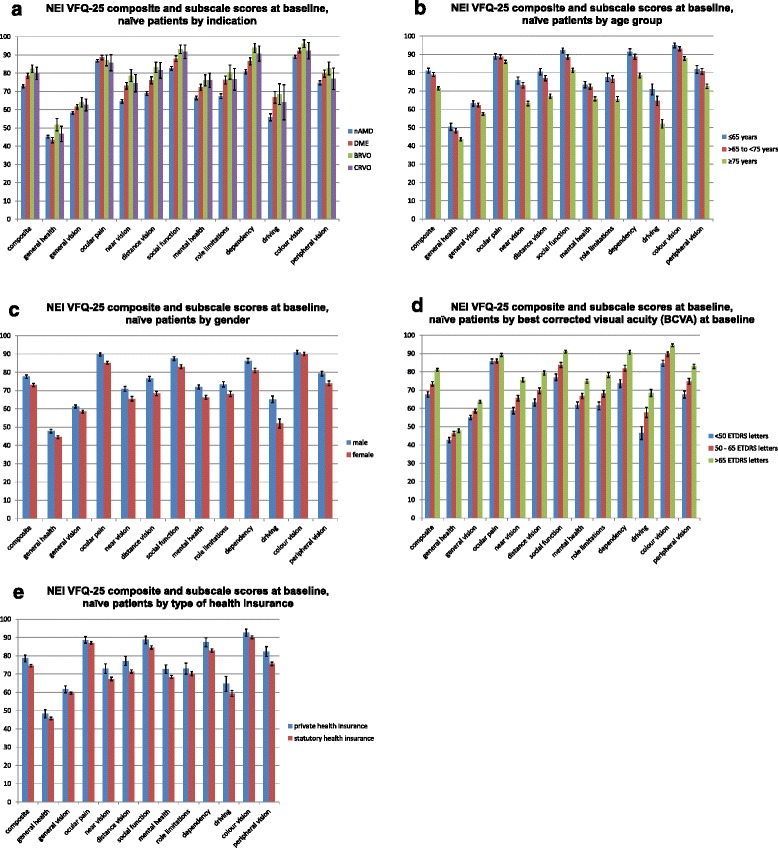
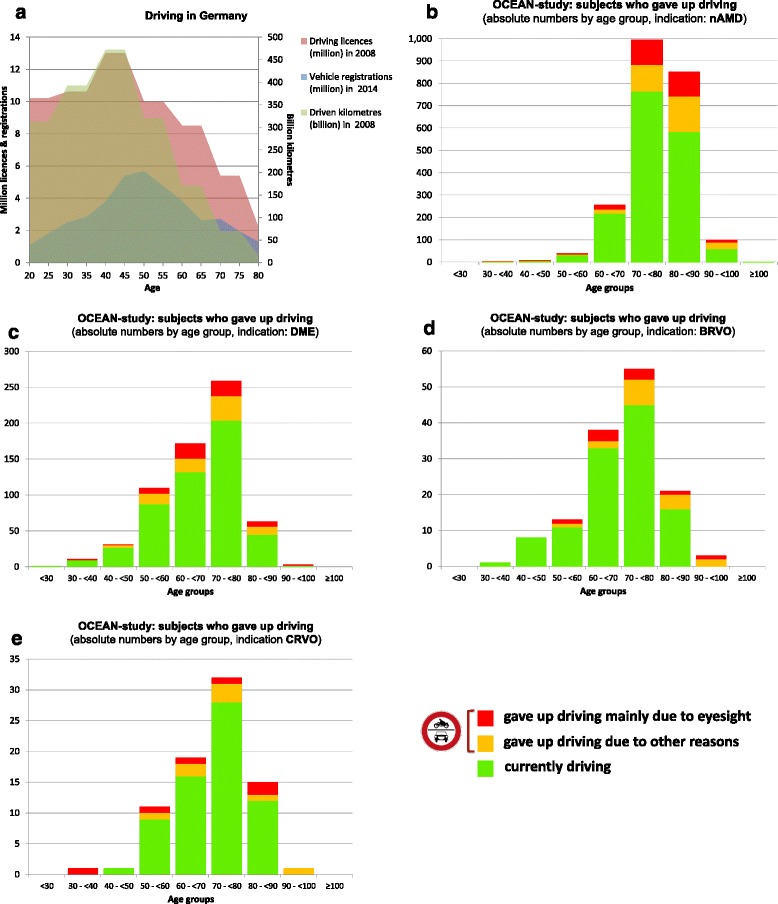
Results: Overall, 4844 (84.1 %) of all 5760 OCEAN patients completed the VFQ-25 questionnaire at baseline. Thereof, 3414 treatment-naïve patients were further analysed. Overall, the VFQ subscore general health was most affected by the ocular disease, followed by general vision. No major differences were detected in comparison to corresponding VFQ-25 scores of previous phase III clinical trials, except in DME patients, or with respect to possible contributing factors. A tendency towards a more decreased VFQ-25 composite score was observed for nAMD, for elderly patients ≥75 years of age, for female patients, for patients with low baseline visual acuity (VA; <50 letters) and for those with statutory health insurance. Indication, age, gender, baseline VA (all p <0.01) and the interaction of age and indication, as well as baseline VA and indication (p <0.01 each) had a significant impact on composite, general vision and distance vision scores (ANOVA). About 10 % of patients gave up driving due to eyesight issues.
Conclusions: The knowledge of a patient's subjective disease burden is crucial to understanding anxieties and mental anguish. Additionally, the understanding of the impact of various contributing factors on the VFQ-25 scores and the extent to which they can be influenced help to optimize patient care. It demonstrates the need for medical and mental support by all medical staff, to encourage patients' compliance with a comprehensive anti-VEGF therapy, to increase BCVA and, consecutively, VFQ-25 scores.
Trial registration: NCT02194803.
Keywords: Age-related macular degeneration; Anti-VEGF; Diabetic macular edema; Intravitreal injection; OCEAN study; Optical coherence tomography (OCT); Ranibizumab; Real-world evidence; Retinal vein occlusion; Visual acuity (VA).
Figures
References
Publication types
MeSH terms
Substances
LinkOut - more resources
Full Text Sources
Other Literature Sources
Medical
