. 2016 Oct;26(10):1333-1341.
doi: 10.1101/gr.207076.116. Epub 2016 Sep 19.

NGS-based reverse genetic screen for common embryonic lethal mutations compromising fertility in livestock

Affiliations

NGS-based reverse genetic screen for common embryonic lethal mutations compromising fertility in livestock

Carole Charlier et al. Genome Res. 2016 Oct.

Abstract

We herein report the result of a large-scale, next generation sequencing (NGS)-based screen for embryonic lethal (EL) mutations in Belgian beef and New Zealand dairy cattle. We estimated by simulation that cattle might carry, on average, ∼0.5 recessive EL mutations. We mined exome sequence data from >600 animals, and identified 1377 stop-gain, 3139 frame-shift, 1341 splice-site, 22,939 disruptive missense, 62,399 benign missense, and 92,163 synonymous variants. We show that cattle have a comparable load of loss-of-function (LoF) variants (defined as stop-gain, frame-shift, or splice-site variants) as humans despite having a more variable exome. We genotyped >40,000 animals for up to 296 LoF and 3483 disruptive missense, breed-specific variants. We identified candidate EL mutations based on the observation of a significant depletion in homozygotes. We estimated the proportion of EL mutations at 15% of tested LoF and 6% of tested disruptive missense variants. We confirmed the EL nature of nine candidate variants by genotyping 200 carrier × carrier trios, and demonstrating the absence of homozygous offspring. The nine identified EL mutations segregate at frequencies ranging from 1.2% to 6.6% in the studied populations and collectively account for the mortality of ∼0.6% of conceptuses. We show that EL mutations preferentially affect gene products fulfilling basic cellular functions. The resulting information will be useful to avoid at-risk matings, thereby improving fertility.


Figures

Figure 1.
Figure 1.
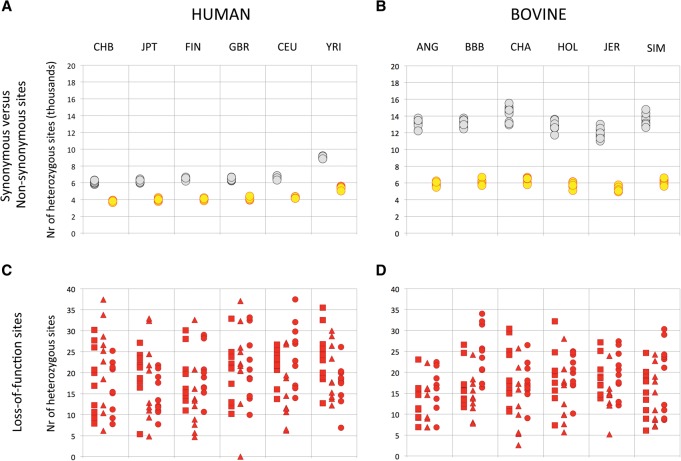
(A,B) Number of heterozygous synonymous (gray) and nonsynonymous (yellow) sites per individual (A: humans; B: bovine). (C,D) Number of heterozygous stop-gain (squares), splice-site (triangles), and frame-shift (circles) sites per individual. CHB: Chinese; JPT: Japanese; FIN: Finns; GBR: Britons; CEU: Northern Europeans; YRI: Yorubans; ANG: Angus; BBB: Belgian Blue; CHA: Charolais; HOL: Holstein-Friesian; JER: Jerseys; SIM: Simmentals.
Figure 2.
Figure 2.
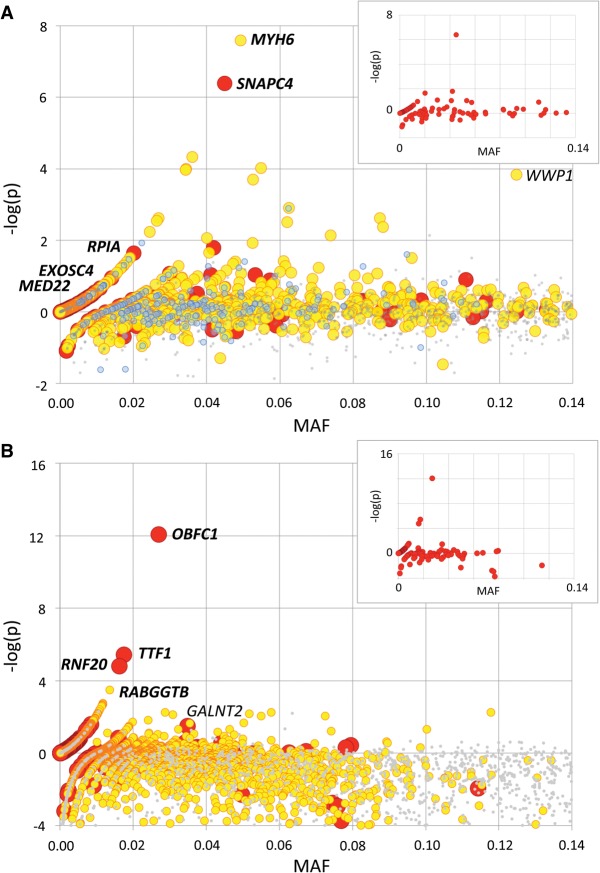
Statistical significance [−log(p): y-axis] of the depletion (positive values) or excess (negative values) in homozygotes for loss-of-function (red; defined as frame-shift, splice-site, and stop-gain variants), missense (yellow), matched synonymous (blue), and random neutral (small gray) variants ordered by minor allele frequency (MAF: x-axis), based on the genotyping of 6385 healthy BBC (A) and 35,219 healthy NZDC (B) animals. Variants that have been subsequently tested in carrier × carrier matings and proven to be embryonic lethals (EL) are labeled in italics and bold. WWP1, shown to affect muscularity, and GALNT2, shown to cause growth retardation, are labeled in italics. For NZDC (B), MAFs were computed across breeds (NZ Holstein-Friesian, NZ Jersey, and NZ cross-bred), explaining the differences with the within-breed MAF reported in Table 2, and the high proportion of variants with negative −log(p) values. Insets: loss-of-function-variants-alone graphs for the corresponding BBC (A) and NZDC (B) populations.

References

    1. The 1000 Genomes Project Consortium. 2010. A map of human genome variation from population-scale sequencing. Nature 467: 1061–1073. - PMC - PubMed
    1. The 1000 Genomes Project Consortium. 2012. An integrated map of genetic variation from 1,092 human genomes. Nature 491: 56–65. - PMC - PubMed
    1. Adzhubei IA, Schmidt S, Peshkin L, Ramensky V, Gerasimova A, Bork P, Kondrashov A, Sunyaev S. 2010. A method and server for predicting damaging missense mutations. Nat Methods 7: 248–249. - PMC - PubMed
    1. Alkuraya FS. 2015. Human knockout research: new horizons and opportunities. Trends Genet 31: 108–115. - PubMed
    1. Bittles AH, Neel JV. 1994. The costs of human inbreeding and their implications for variations at the DNA level. Nat Genet 8: 117–121. - PubMed

Publication types