


Vasectomy and Prostate Cancer Incidence and Mortality in a Large US Cohort
- PMID: 27646949
- PMCID: PMC6366294
- DOI: 10.1200/JCO.2015.66.2361
Vasectomy and Prostate Cancer Incidence and Mortality in a Large US Cohort
Abstract
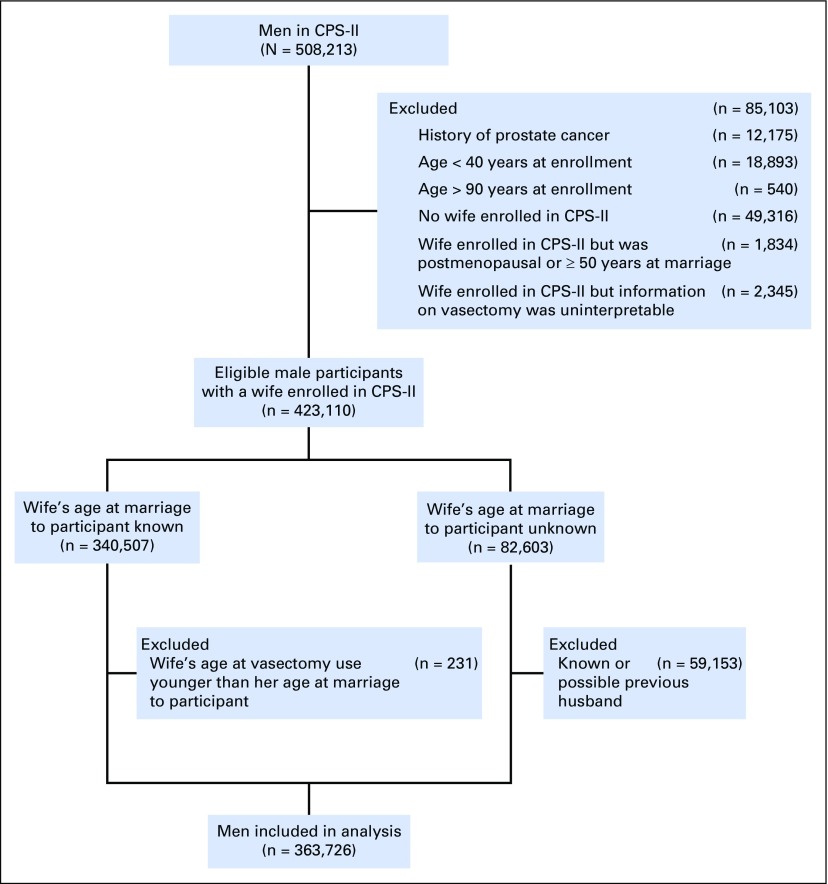
Purpose In a recent large prospective study, vasectomy was associated with modestly higher risk of prostate cancer, especially high-grade and lethal prostate cancer. However, evidence from prospective studies remains limited. Therefore, we assessed the associations of vasectomy with prostate cancer incidence and mortality in a large cohort in the United States. Patients and Methods We examined the association between vasectomy and prostate cancer mortality among 363,726 men in the Cancer Prevention Study II (CPS-II) cohort, of whom 7,451 died as a result of prostate cancer during follow-up from 1982 to 2012. We also examined the association between vasectomy and prostate cancer incidence among 66,542 men in the CPS-II Nutrition Cohort, a subgroup of the CPS-II cohort, of whom 9,133 were diagnosed with prostate cancer during follow-up from 1992 to 2011. Cox proportional hazards regression modeling was used to estimate multivariable-adjusted hazard ratios (HRs) and 95% CIs. Results In the CPS-II cohort, vasectomy was not associated with prostate cancer mortality (HR, 1.01; 95% CI, 0.93 to 1.10). In the CPS-II Nutrition Cohort, vasectomy was not associated with either overall prostate cancer incidence (HR, 1.02; 95% CI, 0.96 to 1.08) or high-grade prostate cancer incidence (HR, 0.91; 95% CI, 0.78 to 1.07 for cancers with Gleason score ≥ 8). Conclusion Results from these large prospective cohorts do not support associations of vasectomy with either prostate cancer incidence or prostate cancer mortality.
Conflict of interest statement
Authors’ disclosures of potential conflicts of interest are found in the article online at
Figures
Comment in
-
Re: Vasectomy and Prostate Cancer Incidence and Mortality in a Large US Cohort.Eur Urol. 2017 Mar;71(3):494-495. doi: 10.1016/j.eururo.2016.11.008. Epub 2016 Nov 16. Eur Urol. 2017. PMID: 27865629 Free PMC article. No abstract available.
-
Re: Vasectomy and Prostate Cancer Incidence and Mortality in a Large US Cohort.J Urol. 2017 Jul;198(1):104-106. doi: 10.1016/j.juro.2017.04.040. Epub 2017 Apr 12. J Urol. 2017. PMID: 28618672 No abstract available.
References
-
- Sharlip ID, Belker AM, Honig S, et al. Vasectomy: AUA guideline. J Urol. 2012;188:2482–2491. - PubMed
-
- Dennis LK, Dawson DV, Resnick MI. Vasectomy and the risk of prostate cancer: A meta-analysis examining vasectomy status, age at vasectomy, and time since vasectomy. Prostate Cancer Prostatic Dis. 2002;5:193–203. - PubMed
-
- Giovannucci E, Ascherio A, Rimm EB, et al. A prospective cohort study of vasectomy and prostate cancer in US men. JAMA. 1993;269:873–877. - PubMed
-
- Giovannucci E, Tosteson TD, Speizer FE, et al. A retrospective cohort study of vasectomy and prostate cancer in US men. JAMA. 1993;269:878–882. - PubMed
-
- Rohrmann S, Paltoo DN, Platz EA, et al. Association of vasectomy and prostate cancer among men in a Maryland cohort. Cancer Causes Control. 2005;16:1189–1194. - PubMed
Publication types
MeSH terms
LinkOut - more resources
Full Text Sources
Other Literature Sources
Medical
