


Warm Handoff Versus Fax Referral for Linking Hospitalized Smokers to Quitlines
- PMID: 27647059
- PMCID: PMC5031370
- DOI: 10.1016/j.amepre.2016.04.006
Warm Handoff Versus Fax Referral for Linking Hospitalized Smokers to Quitlines
Abstract
Introduction: Few hospitals treat patients' tobacco dependence. To be effective, hospital-initiated cessation interventions must provide at least 1 month of supportive contact post-discharge.
Study design: Individually randomized clinical trial. Recruitment commenced July 2011; analyses were conducted October 2014-June 2015.
Setting/participants: The study was conducted in two large Midwestern hospitals. Participants included smokers who were aged ≥18 years, planned to stay quit after discharge, and spoke English or Spanish.
Intervention: Hospital-based cessation counselors delivered the intervention. For patients randomized to warm handoff, staff immediately called the quitline from the bedside and handed the phone to participants for enrollment and counseling. Participants randomized to fax were referred on the day of hospital discharge.
Main outcome measures: Outcomes at 6 months included quitline enrollment/adherence, medication use, biochemically verified cessation, and cost effectiveness.
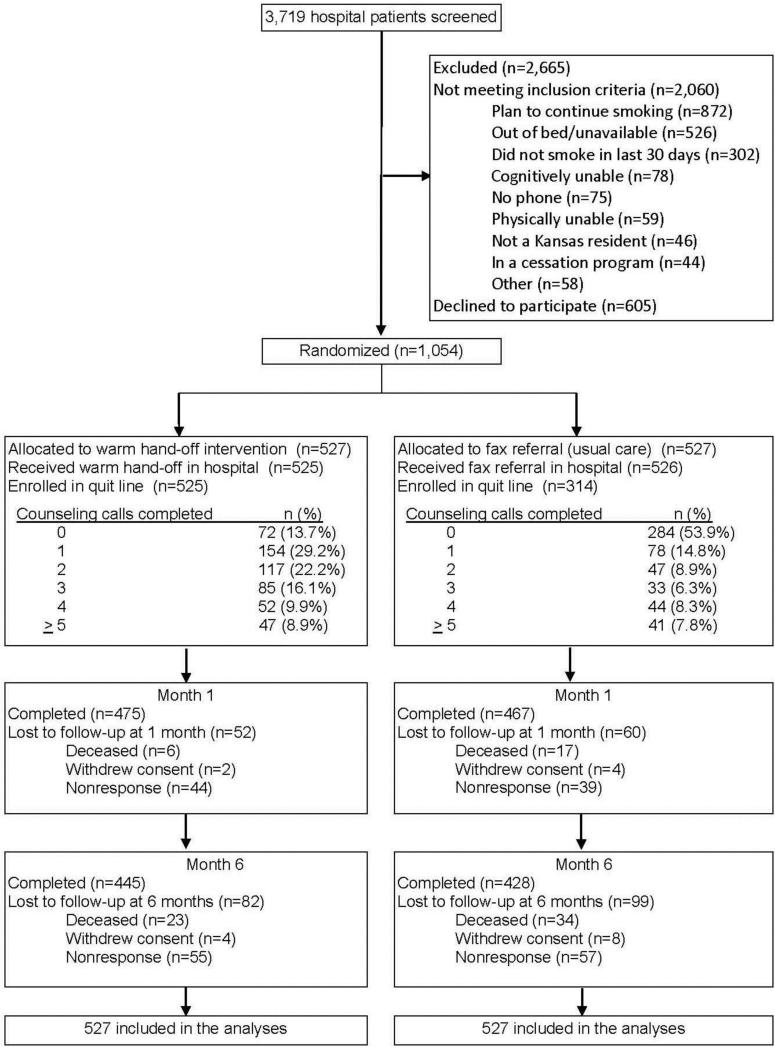
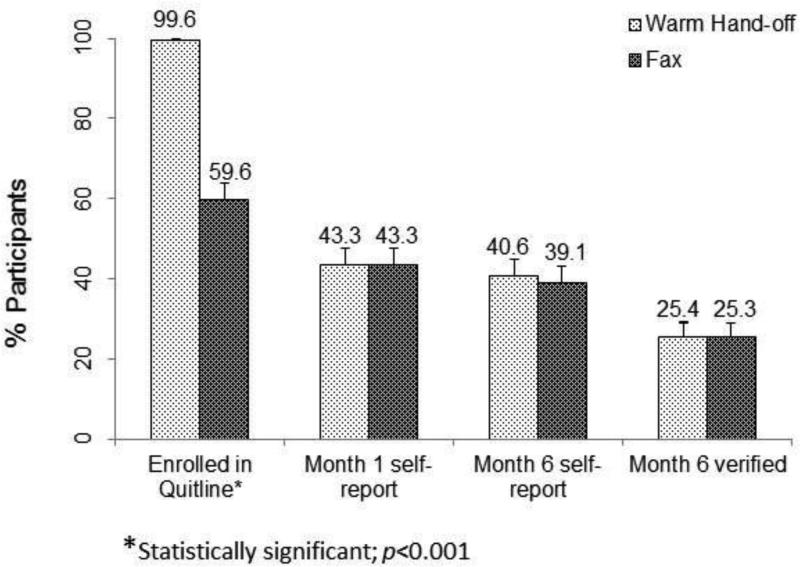
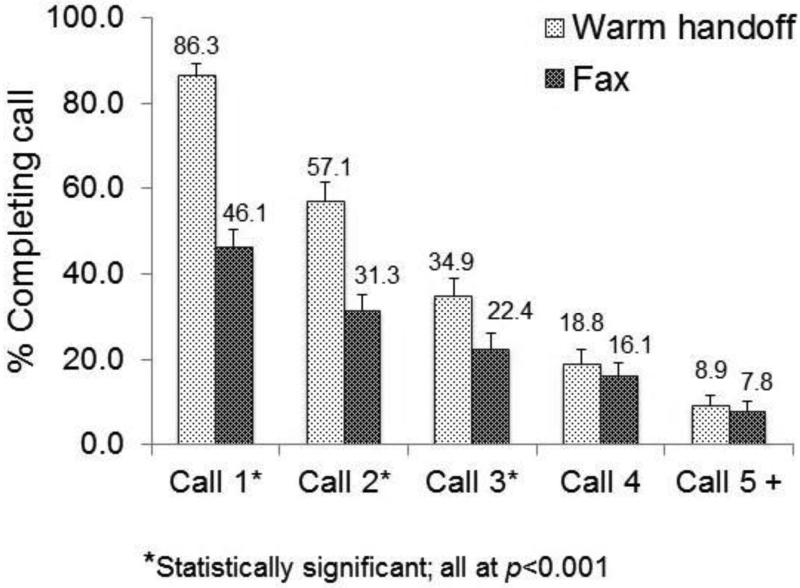
Results: Significantly more warm handoff than fax participants enrolled in quitline (99.6% vs 59.6%; relative risk, 1.67; 95% CI=1.65, 1.68). One in four (25.4% warm handoff, 25.3% fax) were verified to be abstinent at 6-month follow-up; this did not differ significantly between groups (relative risk, 1.02; 95% CI=0.82, 1.24). Cessation medication use in the hospital and receipt of a prescription for medication at discharge did not differ between groups; however, significantly more fax participants reported using cessation medication post-discharge (32% vs 25%, p=0.01). The average incremental cost-effectiveness ratio of enrolling participants into warm handoff was $0.14. Hospital-borne costs were significantly lower in warm handoff than in fax ($5.77 vs $9.41, p<0.001).
Conclusions: One in four inpatient smokers referred to quitline by either method were abstinent at 6 months post-discharge. Among motivated smokers, fax referral and warm handoff are efficient and comparatively effective ways to link smokers with evidence-based care. For hospitals, warm handoff is a less expensive and more effective method for enrolling smokers in quitline services.
Trial registration: ClinicalTrials.gov NCT01305928.
Copyright © 2016 American Journal of Preventive Medicine. Published by Elsevier Inc. All rights reserved.
Figures
References
-
- Szatkowski L, Murray R, Hubbard R, Agrawal S, Huang Y, Britton J. Prevalence of smoking among patients treated in NHS hospitals in England in 2010/2011: a national audit. Thorax. 2015;70(5):498–500. http://dx.doi.org/10.1136/thoraxjnl-2014-206285. - DOI - PubMed
-
- Orleans CT, Kristeller JL, Gritz ER. Helping hospitalized smokers quit: new directions for treatment and research. J Consult Clin Psychol. 1993;61(5):778–789. http://dx.doi.org/10.1037/0022-006X.61.5.778. - DOI - PubMed
-
- Freund M, Campbell E, Paul C, et al. Smoking care provision in hospitals: a review of prevalence. Nicotine Tob Res. 2008;10(5):757–774. http://dx.doi.org/10.1080/14622200802027131. - DOI - PubMed
-
- Rigotti NA, Clair C, Munafo MR, Stead LF. Interventions for smoking cessation in hospitalised patients. Cochrane Database Syst Rev. 2012;5:CD001837. http://dx.doi.org/10.1002/14651858.cd001837.pub3. - DOI - PMC - PubMed
-
- Society of Research on Nicotine and Tobacco. treatobacco.net [April 13, 2014]; Treatobacco.net is a unique source of evidence-based data and practical support for the treatment of tobacco dependence. 2014 www.treatobacco.net/.
Publication types
MeSH terms
Associated data
Grants and funding
LinkOut - more resources
Full Text Sources
Other Literature Sources
Medical
