


Advantages of caudal block over intrarectal local anesthesia plus periprostatic nerve block for transrectal ultrasound guided prostate biopsy
- PMID: 27648052
- PMCID: PMC5017115
- DOI: 10.12669/pjms.324.9823
Advantages of caudal block over intrarectal local anesthesia plus periprostatic nerve block for transrectal ultrasound guided prostate biopsy
Abstract
Objective: To compare caudal block with intrarectal local anesthesia plus periprostatic nerve block for transrectal ultrasound guided prostate biopsy.
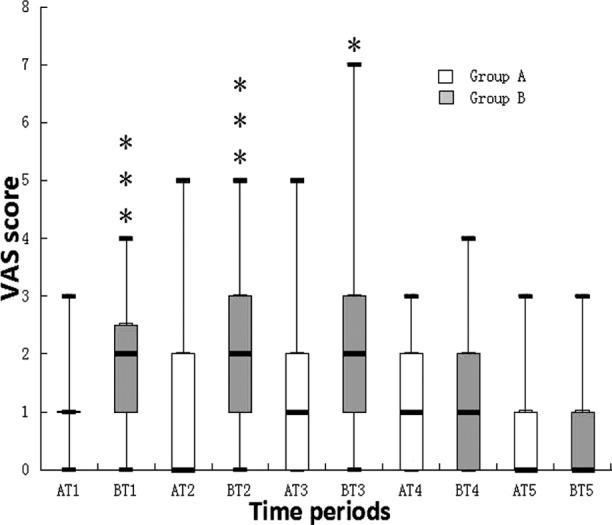
Methods: One hundred and ninety patients scheduled for transrectal ultrasound guided prostate biopsy were randomized equally into Group-A who received caudal block (20 ml 1.2% lidocaine) and Group-B who received intrarectal local anesthesia (0.3% oxybuprocaine cream) plus periprostatic nerve block (10 ml 1% lidocaine plus 0.5% ropivacaine) before biopsy. During and after the procedure, the patients rated the level of pain/discomfort at various time points. Complications during the whole study period and the patient overall satisfaction were also evaluated.
Results: More pain and discomfort was detected during periprostatic nerve block than during caudal block. Pain and discomfort was significantly lower during prostate biopsy and during the manipulation of the probe in the rectum in Group-A than in Group-B. No significant differences were detected in the pain intensity after biopsy and side effects between the two groups.
Conclusions: Caudal block provides better anesthesia than periprostatic nerve block plus intrarectal local anesthesia for TRUS guided prostate biopsy without an increase of side effects.
Keywords: Biopsy; Caudal block; Periprostatic nerve block; Prostate; Transrectal; Ultrasound.
Conflict of interest statement
Declaration of interest: The authors have no financial conflicts of interest
Figures
References
-
- Heidenreich A, Bastian PJ, Bellmunt J, Bolla M, Joniau S, van der Kwast T, et al. EAU guidelines on prostate cancer part 1: Screening, diagnosis, and local treatment with curative intent-update 2013. Eur Urol. 2014;65:124–137. doi:10.1016/j.eururo.2013.09.046. - PubMed
-
- Maccagnano C, Scattoni V, Roscigno M, Raber M, Angiolilli D, Montorsi F, et al. Anaesthesia in transrectal prostate biopsy: Which is the most effective technique? Urol Int. 2011;87:1–13. doi:10.1159/000327827. Epub 2011 16. - PubMed
-
- Raber M, Scattoni V, Roscigno M, Dehò F, Briganti A, Salonia A, et al. Topical prilocaine-lidocaine cream combined with peripheral nerve block improves pain control in prostatic biopsy: results from a prospective randomized trial. Eur Urol. 2008;53:967–973. - PubMed
-
- Giannarini G, Autorino R, Valent F, Mogorovich A, Manassero F, De Maria M, et al. Combination of perianal-intrarectal lidocaine-prilocaine cream & periprostatic nerve block for pain control during transrectal ultrasound guided prostate biopsy: A randomized, controlled trial. J Urol. 2009;181:585–591. doi:10.1016/j.juro.2008.10.002. - PubMed
-
- Cantiello F, Imperatore V, Iannuzzo M, Scibelli G, Di Meo S, Fusco F, et al. Periprostatic nerve block (PNB) alone vs PNB combined with an anaesthetic-myorelaxant agent cream for prostate biopsy: A prospective, randomized double-arm study. BJU Int. 2009;103:1195–1198. doi:10.1111/j.1464-410X.2008.08198.x. - PubMed
LinkOut - more resources
Full Text Sources
Medical