


doi: 10.1164/rccm.201604-0886PP.
Translational Advances in the Field of Pulmonary Hypertension. Translating MicroRNA Biology in Pulmonary Hypertension. It Will Take More Than "miR" Words
Affiliations
- PMID: 27648944
- PMCID: PMC5394787
- DOI: 10.1164/rccm.201604-0886PP
Item in Clipboard
Translational Advances in the Field of Pulmonary Hypertension. Translating MicroRNA Biology in Pulmonary Hypertension. It Will Take More Than "miR" Words
Am J Respir Crit Care Med.
.
No abstract available
Figures

MicroRNA (miRNA) biogenesis and canonical actions of post-transcriptional gene regulation. Left: Canonical protein-coding genes embedded throughout the human chromosomal structure are transcribed, spliced, and transported from the nucleus to the cytoplasm as mature mRNAs. miRNAs are encoded as discrete single genes, as gene families, or embedded in introns of protein-coding genes (mirtrons). After transcription, primary miRNAs (pri-miRNAs) undergo nuclear and cytosolic processing steps to premature miRNAs (pre-miRNAs) before nuclear export and further maturation to a biologically active 19- to 24-nt molecule containing a 6-nt “seed” region. Driven primarily by seed region binding to complementary sites of target mRNAs, miRNAs repress gene expression via translational repression or mRNA degradation (bottom). Right: Technological advances have allowed more efficient and more comprehensive strategies for quantifying miRNA levels in human tissue and fluids. miRNA* duplex = antisense strand of the miRNA duplex; PCR = polymerase chain reaction; RISC = RNA-induced silencing complex; UTR = untranslated region.

Dysregulated microRNAs (miRNAs) implicated in vascular remodeling and extrapulmonary sites in pulmonary arterial hypertension (PAH). (A) Aberrantly expressed miRNAs are organized by their convergent molecular actions and cellular localization during pulmonary artery remodeling in PAH. (B) Down-regulation of miR-208 in right ventricular (RV) cardiomyocytes and miR-126 in RV endothelial cells induces angiogenic and contractile alterations in RV function, promoting the progression of adaptive hypertrophy to overt RV failure. Numerous other miRNAs are dysregulated in the RV during both adaptive hypertrophy and failure, and their precise mechanistic roles are currently being defined. (C) Microcirculation loss and impaired angiogenesis secondary to miR-126 down-regulation contribute to exercise intolerance in patients with PAH. BMPR2 = bone morphogenetic protein receptor 2; BRD4 = bromodomain containing 4; ET-1 = endothelin-1; FGF = fibroblast growth factor; FGFR1 = fibroblast growth factor receptor 1; IGF-1 = insulin-like growth factor 1; ISCU = iron–sulfur cluster assembly protein; KLFs = Krüppel-like factors; miR = microRNA; NFAT = nuclear factor of activated T cells; PAEC = pulmonary arterial endothelial cells; PARP-1 = poly(ADP-ribose) polymerase 1; PASMC = pulmonary arterial smooth muscle cells; PPARγ = peroxisome proliferator-activated receptor γ; PTPB1 = polypyrimidine tract–binding protein 1; SMURF1 = Smad ubiquitination regulatory factor 1; STAT3 = signal transducer and activator of transcription 3.
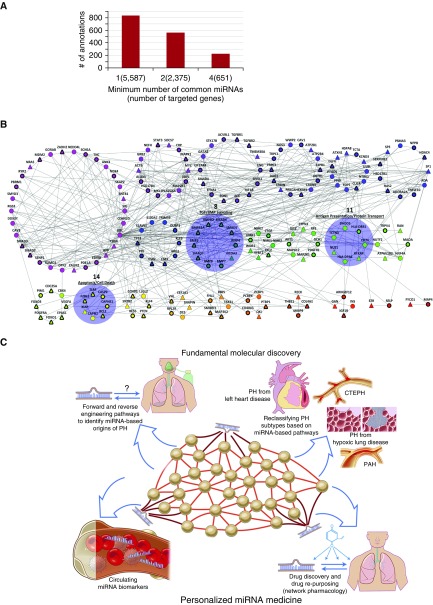
Application of network theory to gain insight into microRNA (miRNA) activity in pulmonary arterial hypertension (PAH). (A) Gene set enrichment analysis (GSEA) demonstrates the vast pleiotropy of miRNA activity. The number of significant pathway annotations was gathered after GSEA enrichment on genes targeted by at least 1, 2, or 4 pulmonary hypertension (PH)-relevant miRNAs (among a group of 25 total miRNAs). A large number of statistically significant annotations was observed in all cases, indicating the need for additional statistical filtering techniques to discern the convergent functions of miRNAs. (B) Network architecture analysis improves the resolution of testable hypotheses regarding convergent miRNA function. From genes targeted by four or more PH-relevant miRNAs and overlaid on an extended network of PH genes and their first-degree interactors, a single connected component of 190 genes was partitioned into clusters based on its topology, using the “MAP” algorithm (58). Each node represents a gene, and each gray line denotes an interaction between genes. Rings of same-colored nodes represent clusters. Triangular nodes are those genes targeted by four or more PH-relevant miRNAs, and circular nodes are first-degree interactors necessary to make a single connected component. Nodes outlined in thick black lines are genes already known to play a role in PH, curated from the scientific literature. Of the 22 clusters, we found 3 to be of particular interest (highlighted in blue). Clusters 8, 11, and 14 are involved in transforming growth factor/bone morphogenetic protein (TGF/BMP) signaling, antigen presentation and protein transport, and apoptosis and cell death, respectively. (C) Leveraging computational gene network analysis for discovery of fundamental miRNA biology in PH and application to personalized medicine initiatives in PH. CTEPH = chronic thromboembolic pulmonary hypertension.

Schematic of strategies to optimize delivery of oligonucleotide therapies to the pulmonary vasculature in humans. Potential delivery routes include intravenous, subcutaneous, and via the airway. The most effective therapeutic strategies will preferentially target the pulmonary vasculature while minimizing targeting of other organs. miRNA = microRNA.
Comment in
-
Transforming Growth Factor β1- and Bone Morphogenetic Protein 2/PPARγ-regulated MicroRNAs in Pulmonary Arterial Hypertension.Am J Respir Crit Care Med. 2017 Nov 1;196(9):1227-1228. doi: 10.1164/rccm.201705-0923LE. Am J Respir Crit Care Med. 2017. PMID: 28653861 No abstract available.
-
Reply: Transforming Growth Factor β1- and Bone Morphogenetic Protein 2/PPARγ-regulated MicroRNAs in Pulmonary Arterial Hypertension.Am J Respir Crit Care Med. 2017 Nov 1;196(9):1228-1229. doi: 10.1164/rccm.201705-1010LE. Am J Respir Crit Care Med. 2017. PMID: 28653904 Free PMC article. No abstract available.
References
-
- Paulin R, Courboulin A, Barrier M, Bonnet S. From oncoproteins/tumor suppressors to microRNAs, the newest therapeutic targets for pulmonary arterial hypertension. J Mol Med. 2011;89:1089–1101. - PubMed
-
- Boucherat O, Potus F, Bonnet S. microRNA and pulmonary hypertension. Adv Exp Med Biol. 2015;888:237–252. - PubMed
-
- Esteller M. Non-coding RNAs in human disease. Nat Rev Genet. 2011;12:861–874. - PubMed
Publication types
MeSH terms
Substances
Grants and funding
LinkOut - more resources
Full Text Sources
Other Literature Sources
Medical
