The Policy Dystopia Model: An Interpretive Analysis of Tobacco Industry Political Activity
- PMID: 27649386
- PMCID: PMC5029800
- DOI: 10.1371/journal.pmed.1002125
The Policy Dystopia Model: An Interpretive Analysis of Tobacco Industry Political Activity
Abstract
Background: Tobacco industry interference has been identified as the greatest obstacle to the implementation of evidence-based measures to reduce tobacco use. Understanding and addressing industry interference in public health policy-making is therefore crucial. Existing conceptualisations of corporate political activity (CPA) are embedded in a business perspective and do not attend to CPA's social and public health costs; most have not drawn on the unique resource represented by internal tobacco industry documents. Building on this literature, including systematic reviews, we develop a critically informed conceptual model of tobacco industry political activity.
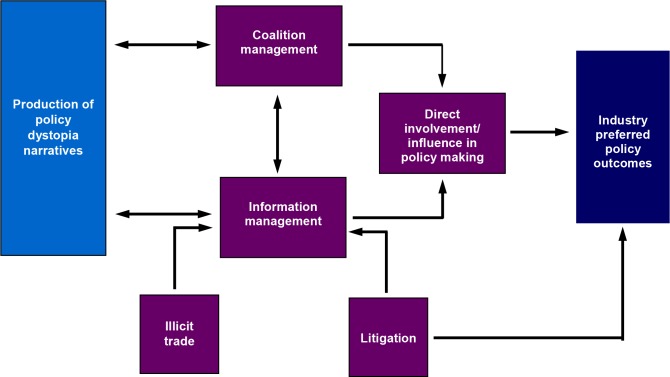
Methods and findings: We thematically analysed published papers included in two systematic reviews examining tobacco industry influence on taxation and marketing of tobacco; we included 45 of 46 papers in the former category and 20 of 48 papers in the latter (n = 65). We used a grounded theory approach to build taxonomies of "discursive" (argument-based) and "instrumental" (action-based) industry strategies and from these devised the Policy Dystopia Model, which shows that the industry, working through different constituencies, constructs a metanarrative to argue that proposed policies will lead to a dysfunctional future of policy failure and widely dispersed adverse social and economic consequences. Simultaneously, it uses diverse, interlocking insider and outsider instrumental strategies to disseminate this narrative and enhance its persuasiveness in order to secure its preferred policy outcomes. Limitations are that many papers were historical (some dating back to the 1970s) and focused on high-income regions.
Conclusions: The model provides an evidence-based, accessible way of understanding diverse corporate political strategies. It should enable public health actors and officials to preempt these strategies and develop realistic assessments of the industry's claims.
Conflict of interest statement
The authors have declared that no competing interests exist.
Figures
Comment in
-
"The Policy Dystopia Model": Implications for Health Advocates and Democratic Governance.PLoS Med. 2016 Sep 20;13(9):e1002126. doi: 10.1371/journal.pmed.1002126. eCollection 2016 Sep. PLoS Med. 2016. PMID: 27649487 Free PMC article.
References
-
- World Health Organization. Tobacco fact sheet no:339, 2014. http://www.who.int/mediacentre/factsheets/fs339/en/
-
- Sanders-Jackson AN, Song AV, Hiilamo H, Glantz SA. Effect of the Framework Convention on Tobacco Control and voluntary industry health warning labels on passage of mandated cigarette warning labels from 1965 to 2012: transition probability and event history analyses. Am J Public Health. 2013;103: 2041–2047. 10.2105/AJPH.2013.301324 - DOI - PMC - PubMed
-
- World Health Organization. Implementation of Article 5.3 of WHO FCTC: Evolving issues related to interference by the tobacco industry. 2014. http://apps.who.int/gb/fctc/PDF/cop6/FCTC_COP6_16-en.pdf
Publication types
MeSH terms
Grants and funding
LinkOut - more resources
Full Text Sources
Other Literature Sources