. 2016 Sep 21:7:12851.
doi: 10.1038/ncomms12851.

Dual regulation of cytoplasmic and mitochondrial acetyl-CoA utilization for improved isoprene production in Saccharomyces cerevisiae

Affiliations

Dual regulation of cytoplasmic and mitochondrial acetyl-CoA utilization for improved isoprene production in Saccharomyces cerevisiae

Xiaomei Lv et al. Nat Commun. .

Abstract

Microbial production of isoprene from renewable feedstock is a promising alternative to traditional petroleum-based processes. Currently, efforts to improve isoprenoid production in Saccharomyces cerevisiae mainly focus on cytoplasmic engineering, whereas comprehensive engineering of multiple subcellular compartments is rarely reported. Here, we propose dual metabolic engineering of cytoplasmic and mitochondrial acetyl-CoA utilization to boost isoprene synthesis in S. cerevisiae. This strategy increases isoprene production by 2.1-fold and 1.6-fold relative to the recombinant strains with solely mitochondrial or cytoplasmic engineering, respectively. By combining a modified reiterative recombination system for rapid pathway assembly, a two-phase culture process for dynamic metabolic regulation, and aerobic fed-batch fermentation for sufficient supply of acetyl-coA and carbon, we achieve 2527, mg l(-1) of isoprene, which is the highest ever reported in engineered eukaryotes. We propose this strategy as an efficient approach to enhancing isoprene production in yeast, which might open new possibilities for bioproduction of other value-added chemicals.


Figures
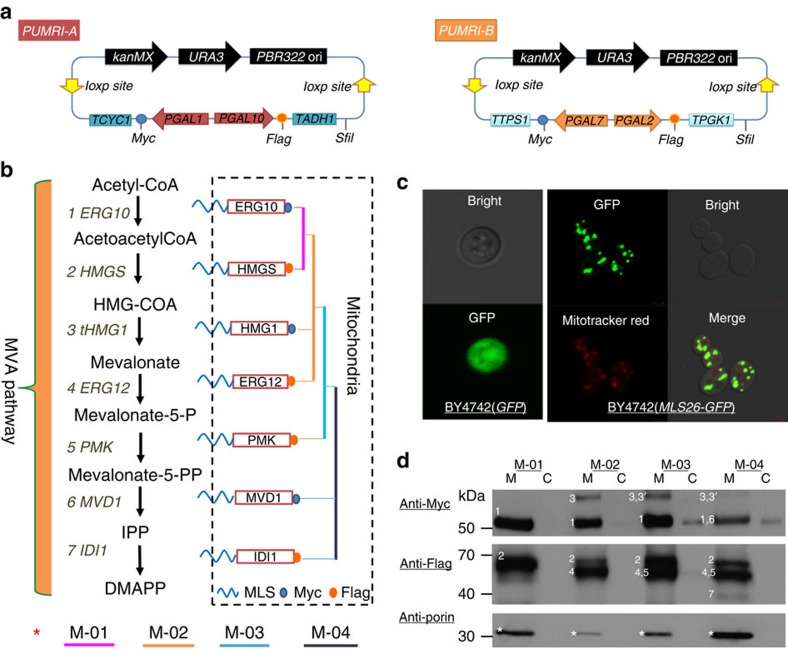
Figure 1
Figure 1. Reconstruction of the MVA biosynthesis pathway in the mitochondria of Saccharomyces cerevisiae.
(a) Plasmids pUMRI-A and pUMRI-B. In each plasmid, two expression cassettes (with different GAL promoters, terminators and C-terminal tags) in reversed orientations were introduced and arranged between the two loxp sites of pUMRI construct. (b) Re-localizing the MVA pathway (including seven genes: 1-ERG10; 2-HMGS; 3-tHMG1; 4-ERG12; 5-PMK; 6-MVD1; and 7-IDI1) in the mitochondria. Each gene was fused with N-terminal MLS and C-terminal Myc or Flag. (c) Fluorescence microscopy of yeast strains expressing GFP (BY4742-PUG35) and MLS-GFP (BY4742-PUG35-MLS26). Scale bar, 2 μm. (d) Western blot analysis of recombinant strains: BY4742-M-01 (BY4742 overexpressing ERG10 and HMGS), BY4742-M-02 (BY4742-M-01 overexpressing tHMG1 and ERG12), BY4742-M-03 (BY4742-M-02 overexpressing PMK and tHMG1), BY4742-M-04 (BY4742-M-03 overexpressing MVD1 and IDI1) (Supplementary Fig. 9, full-scanned images). Bands 1–7 correspond to proteins shown in b. M represents mitochondrial engineering.
Figure 2
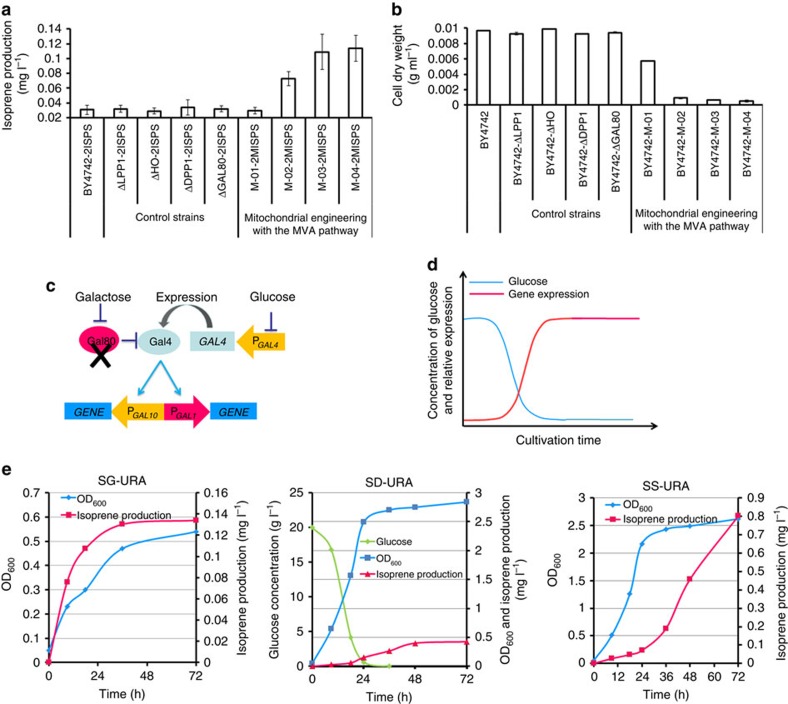
Figure 2. Mitochondrial engineering for isoprene production.
(a) Production of isoprene in recombinant strains. (b) Cell growth of recombinant strains. (c) Schematic diagram of a modified GAL regulation. (d) Two-stage process involved in the growth of GAL80-knockout strains. In the first stage, the genes under control of PGAL were expressed at a low level to sustain cell growth; while in the second stage, these genes were overexpressed at a high level. (e) Isoprene production and biomass of BY4742-M-04 MISPS-MISPS cultured in SG-URA (2% galactose), SD-URA (2% Dextrose) and SS-URA (2% Sucrose). The data in a,b,e are representative of three separate experiments. Bar represents mean±s.d.
Figure 3
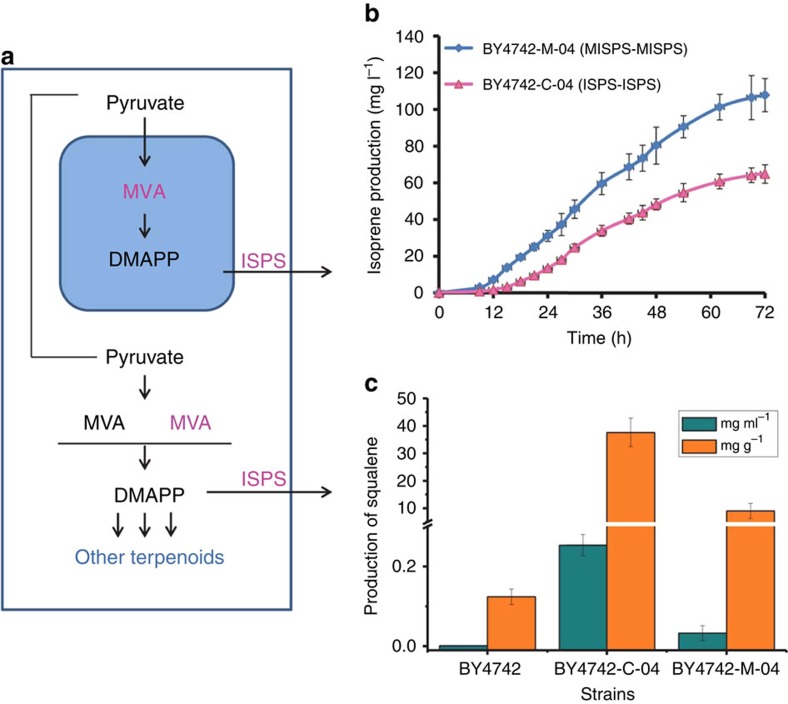
Figure 3. Comparison of cytoplasm-engineered and mitochondria-engineered strains.
(a) Schematic representation for cytoplasmic engineering and mitochondrial engineering of the complete isoprene synthetic pathway. Gene and pathway reconstruction is marked in magenta. Blue box represents mitochondria. (b) Isoprene production of strains constructed by cytoplasmic engineering and mitochondrial engineering of the complete isoprene synthetic pathway in aerobic batch fermentation. (c) Squalene production of strains constructed by cytoplasmic engineering and mitochondrial engineering of the MVA pathway. In b,c, error bars represent s.d. from three independent experiments.
Figure 4
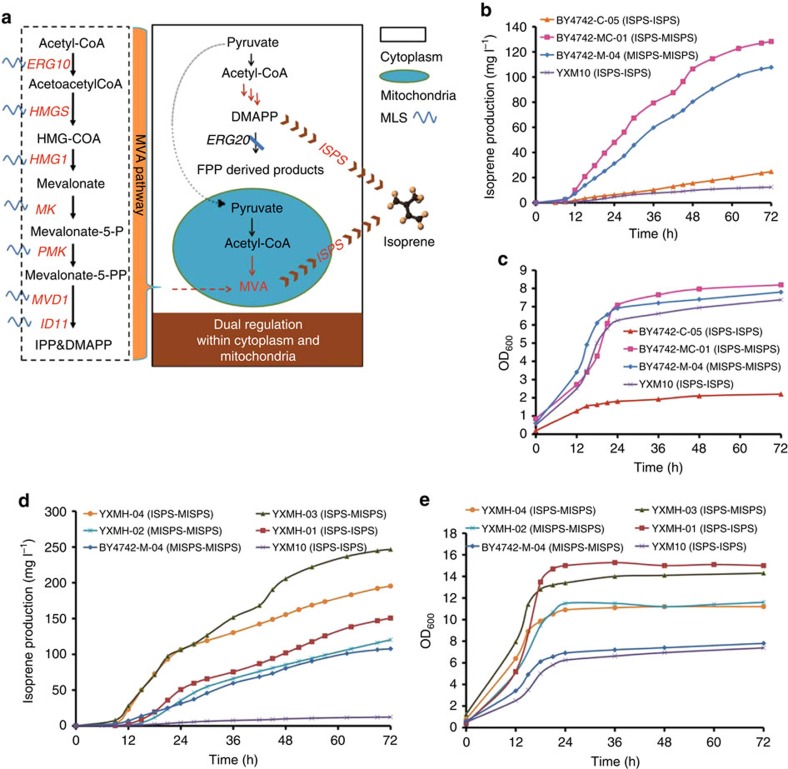
Figure 4. Dual metabolic regulation in the cytoplasm and mitochondria for isoprene production.
(a) Dual regulation strategy. (b) Isoprene production of recombinant strains YXM10 (ISPS-ISPS), BY4742-M-04 (MISPS-MISPS), BY4742-MC-01 (ISPS-MISPS), BY4742-C-05 (ISPS-ISPS) in aerobic batch fermentation. (c) Growth curves of the recombinant strains (in b) in aerobic batch fermentation. (d) Isoprene production of recombinant strains YXM10 (ISPS-ISPS), BY4742-M-04 (MISPS-MISPS), YXMH-01 (ISPS-ISPS), YXMH-02 (MISPS-MISPS), YXMH-03 (ISPS-MISPS), YXMH-04 (ISPS-MISPS) in aerobic batch fermentation. (e) Growth curves of the recombinant strains (in d) in aerobic batch fermentation. YXM10: strain with cytoplasm engineering; BY4742-M-04, strain with mitochondria engineering; BY4742-MC-01, haploid strain with a mixed cytosolic-mitochondrial strategy; BY4742-C-05, haploid strain with comprehensive regulation in the cytoplasm; YXMH-01, the control hybrid strain of YXM10 and BY4742-ΔGal80::HIS; YXMH-02, the control hybrid strain of BY4742-M-04-HIS and BY4741-ΔGal80::LEU; YXMH-03, the hybrid strain of YXM10 and BY4742-M-04-HIS; YXMH-04, the hybrid strain of BY4741-C-04-LEU and BY4742-M-04-HIS.
Figure 5
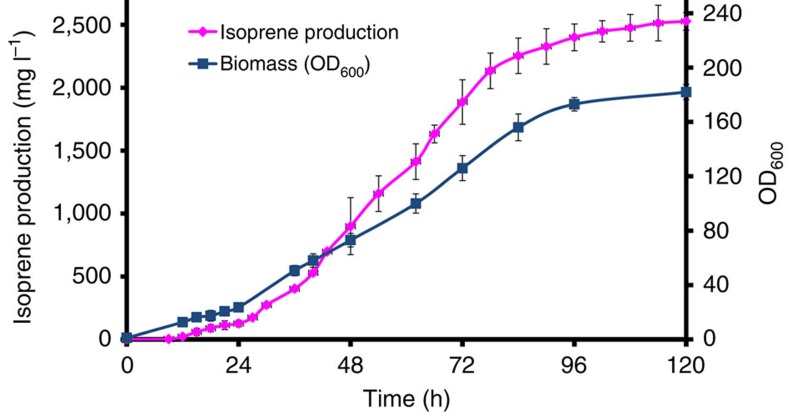
Figure 5. Fed-batch fermentation of YXMH-03 (ISPS-MISPS).
Fermentation was performed in a 5-l fermentor containing 2.5-l fermentation medium at 30 °C with an airflow rate of 1–3 v.v.m. The pH was controlled automatically at 5.0 with the addition of 5 M NH4OH. The isoprene concentration in the off-gas was determined by GC every 3 hours. Error bars represent s.d. from three independent experiments.

References

    1. Rohmer M., Knani M., Simonin P., Sutter B. & Sahm H. Isoprenoid biosynthesis in bacteria: a novel pathway for the early steps leading to isopentenyl diphosphate. Biochem. J. 295, (Pt 2): 517–524 (1993). - PMC - PubMed
    1. Maury J., Asadollahi M. A., Moller K., Clark A. & Nielsen J. Microbial isoprenoid production: an example of green chemistry through metabolic engineering. Adv. Biochem. Eng. Biotechnol. 100, 19–51 (2005). - PubMed
    1. Sasaki K., Ohara K. & Yazaki K. Gene expression and characterization of isoprene synthase from Populus alba. FEBS Lett. 579, 2514–2518 (2005). - PubMed
    1. Miller B., Oschinski C. & Zimmer W. First isolation of an isoprene synthase gene from poplar and successful expression of the gene in Escherichia coli. Planta 213, 483–487 (2001). - PubMed
    1. Sharkey T. D. et al. Evolution of the isoprene biosynthetic pathway in Kudzu. Plant Physiol. 137, 700–712 (2005). - PMC - PubMed

Publication types

MeSH terms