


Natural Variation in Brachypodium Links Vernalization and Flowering Time Loci as Major Flowering Determinants
- PMID: 27650449
- PMCID: PMC5210709
- DOI: 10.1104/pp.16.00813
Natural Variation in Brachypodium Links Vernalization and Flowering Time Loci as Major Flowering Determinants
Abstract
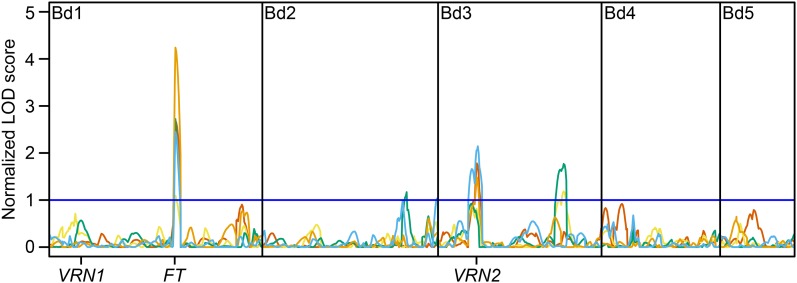
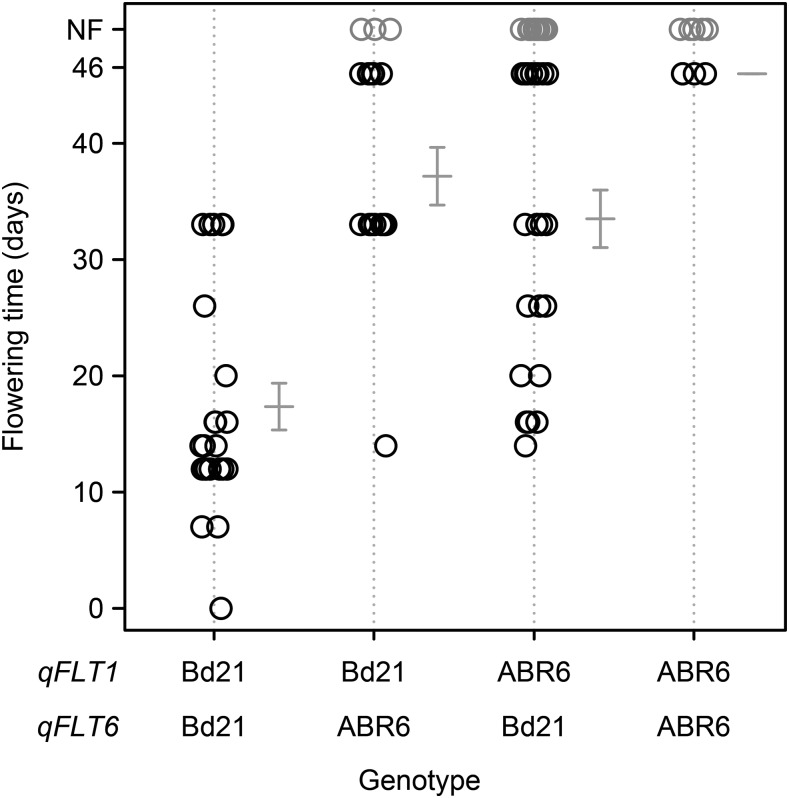
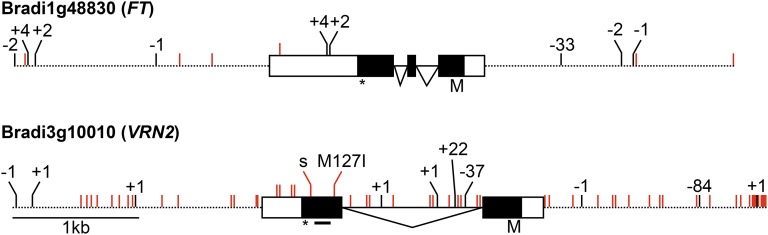
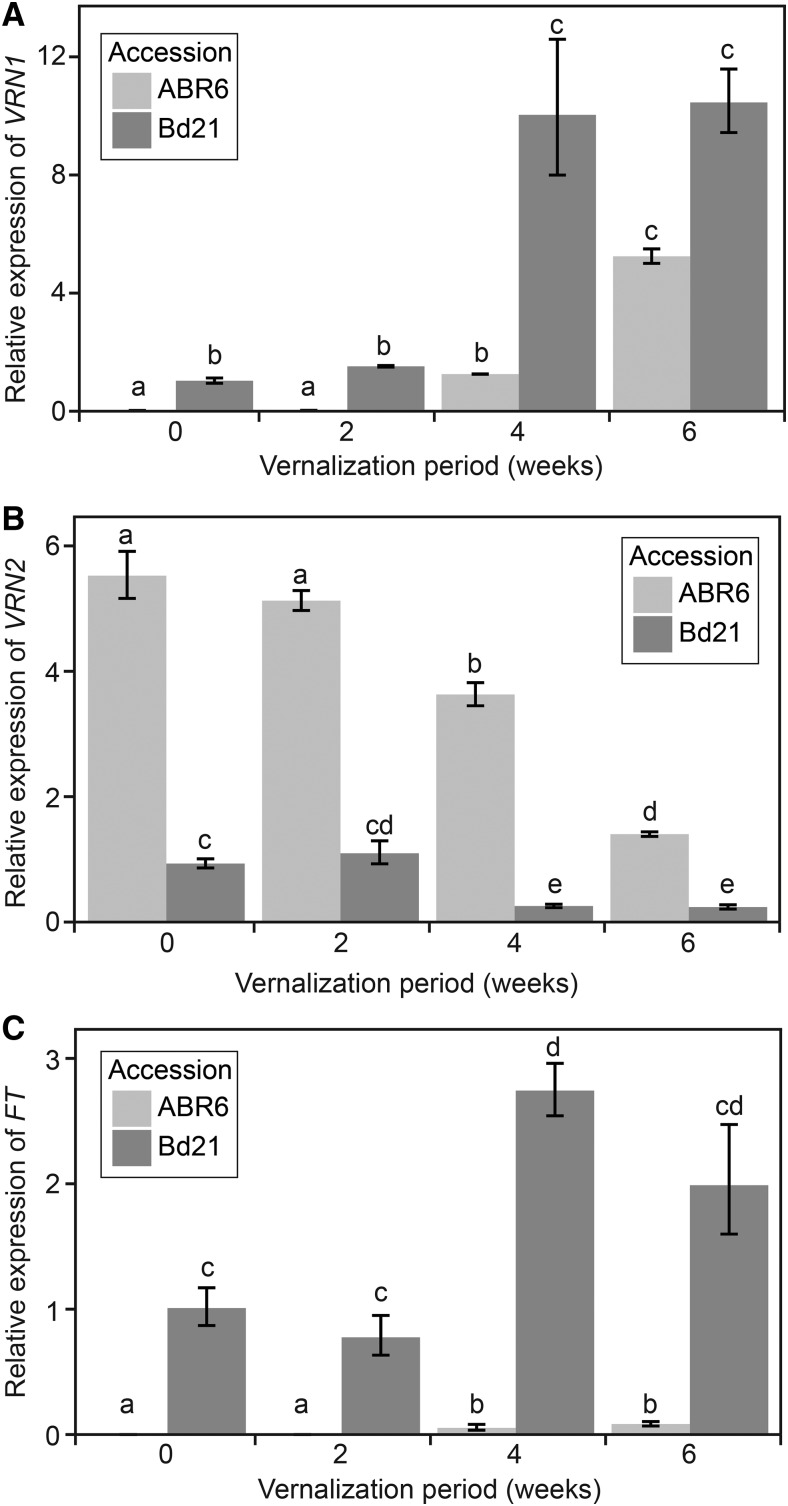
The domestication of plants is underscored by the selection of agriculturally favorable developmental traits, including flowering time, which resulted in the creation of varieties with altered growth habits. Research into the pathways underlying these growth habits in cereals has highlighted the role of three main flowering regulators: VERNALIZATION1 (VRN1), VRN2, and FLOWERING LOCUS T (FT). Previous reverse genetic studies suggested that the roles of VRN1 and FT are conserved in Brachypodium distachyon yet identified considerable ambiguity surrounding the role of VRN2 To investigate the natural diversity governing flowering time pathways in a nondomesticated grass, the reference B. distachyon accession Bd21 was crossed with the vernalization-dependent accession ABR6. Resequencing of ABR6 allowed the creation of a single-nucleotide polymorphism-based genetic map at the F4 stage of the mapping population. Flowering time was evaluated in F4:5 families in five environmental conditions, and three major loci were found to govern flowering time. Interestingly, two of these loci colocalize with the B. distachyon homologs of the major flowering pathway genes VRN2 and FT, whereas no linkage was observed at VRN1 Characterization of these candidates identified sequence and expression variation between the two parental genotypes, which may explain the contrasting growth habits. However, the identification of additional quantitative trait loci suggests that greater complexity underlies flowering time in this nondomesticated system. Studying the interaction of these regulators in B. distachyon provides insights into the evolutionary context of flowering time regulation in the Poaceae as well as elucidates the way humans have utilized the natural variation present in grasses to create modern temperate cereals.
© 2017 American Society of Plant Biologists. All Rights Reserved.
Figures
References
-
- Amasino R. (2010) Seasonal and developmental timing of flowering. Plant J 61: 1001–1013 - PubMed
-
- Andrés F, Coupland G (2012) The genetic basis of flowering responses to seasonal cues. Nat Rev Genet 13: 627–639 - PubMed
-
- Barbieri M, Marcel TC, Niks RE, Francia E, Pasquariello M, Mazzamurro V, Garvin DF, Pecchioni N (2012) QTLs for resistance to the false brome rust Puccinia brachypodii in the model grass Brachypodium distachyon L. Genome 55: 152–163 - PubMed
-
- Basten CJ, Weir BS, Zeng ZB (2004) QTL Cartographer, version 1.17. Department of Statistics, North Carolina State University, Raleigh, NC
-
- Benjamini Y, Hochberg Y (1995) Controlling the false discovery rate: a practical and powerful approach to multiple testing. J R Stat Soc Series B Stat Methodol 57: 289–300
Publication types
MeSH terms
Substances
Grants and funding
- BBS/E/J/000CA348/BB_/Biotechnology and Biological Sciences Research Council/United Kingdom
- BBS/E/J/000CA387/BB_/Biotechnology and Biological Sciences Research Council/United Kingdom
- BB/F017294/1/BB_/Biotechnology and Biological Sciences Research Council/United Kingdom
- BB/J004553/1/BB_/Biotechnology and Biological Sciences Research Council/United Kingdom
LinkOut - more resources
Full Text Sources
Other Literature Sources
Molecular Biology Databases
