


Respiratory Morbidity in Late-Preterm Births: A Prospective Observational Study at a Tertiary Care Hospital
- PMID: 27651621
- PMCID: PMC5016472
- DOI: 10.1007/s13224-016-0893-z
Respiratory Morbidity in Late-Preterm Births: A Prospective Observational Study at a Tertiary Care Hospital
Abstract
Objectives: To study the neonatal respiratory morbidity in late-preterm neonates.
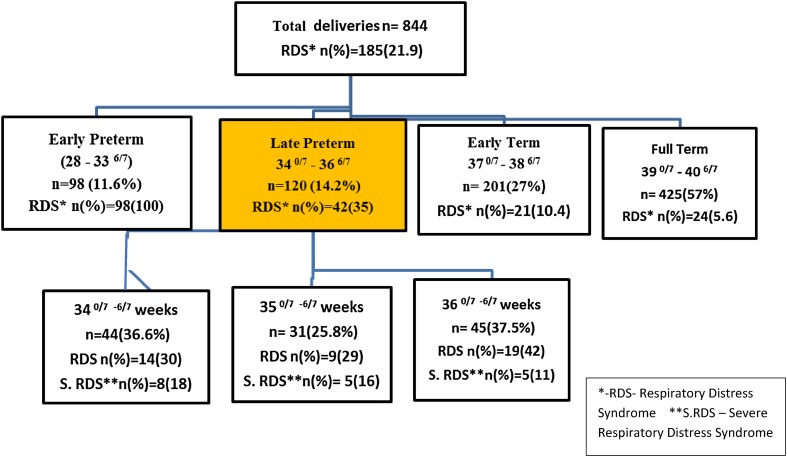
Materials and methods: This study was done over a period of 6 months (November 2014-April 2015) including 120 late-preterm births at a tertiary referral center.
Results: Among the 120 late-preterm babies, 42 (35 %) developed respiratory morbidity. Respiratory distress syndrome (RDS) developed in 43 % of the babies who had not received steroid prophylaxis against 25.8 % receiving the same (p < 0.05). Among the indicated late-preterm deliveries, 45 % of babies developed respiratory morbidity in comparison with 22 % of the babies born following spontaneous onset of labor (p < 0.05). In the neonates with respiratory morbidity, male babies had a higher incidence than their female counterparts (48 vs. 24 % p < 0.05). Severity of RDS declined from 57 % for babies born at 34 weeks of gestation to 26.3 % for those born at 36 weeks (p 0.14). With each advancing week of gestation a significant reduction in the need for ventilator support (78 % at 34 weeks to 15 % at 36 weeks of gestation p < 0.05) was observed. Presence of antenatal risk factors did not significantly contribute to the respiratory morbidity.
Conclusion: The severity of respiratory morbidity and need for ventilator support declines with advancing gestational age; hence, every attempt must be made to prolong pregnancy till 36 weeks of gestation.
Keywords: Late preterm; Respiratory distress syndrome (RDS); Respiratory morbidity; Transient tachypnea of the newborn (TTNB).
Conflict of interest statement
The authors report no conflicts of interest in this work. Ethical Statement All procedures performed in studies involving human participants were in accordance with the ethical standards of the institutional and/or national research committee and with the 1964 Helsinki Declaration and its later amendments or comparable ethical standards. Ethical clearance obtained from the hospital ethical committee (IEC 26/2015). Informed consent Informed consent was obtained from all individual participants included in the study.
Figures
References
LinkOut - more resources
Full Text Sources
Other Literature Sources
Miscellaneous