


Hormonal Changes After Laparoscopic Ovarian Diathermy in Patients with Polycystic Ovarian Syndrome
- PMID: 27651657
- PMCID: PMC5016467
- DOI: 10.1007/s13224-016-0882-2
Hormonal Changes After Laparoscopic Ovarian Diathermy in Patients with Polycystic Ovarian Syndrome
Abstract
Aim of the present study: To assess the changes in hormonal profile (serum FSH, LH, prolactin and total testosterone) following laparoscopic ovarian drilling (LOD) in patients with polycystic ovarian syndrome.
Materials and methods: Fifty patients with PCOS have been included in this study. Serum prolactin, total testosterone, follicular-stimulating hormone (FSH) and luteinizing hormone (LH) levels have been used as biochemical markers, before and after procedures.
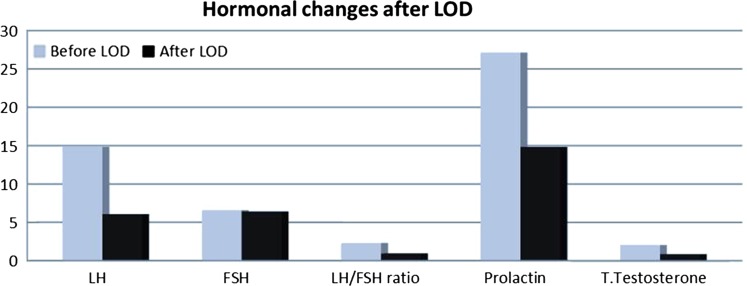
Results: Laparoscopic ovarian drilling was successfully employed without any surgical complications and on an average follow-up time of 24 weeks after the procedure. During the follow-up serum values for prolactin, total testosterone and LH have decreased significantly and FSH levels remained unchanged after the procedure.
Conclusions: The LOD in patients with PCOS may avoid or reduce the risk of OHSS and the multiple pregnancy rate induced by gonadotropin therapy. The high pregnancy rate and the economic aspect of the procedure offer an attractive management for patients with PCOS. However, LOD can be considered as second-line treatment after clomiphene citrate treatment failure and/or resistance.
Keywords: Hormonal changes; Infertility; Laparoscopic ovarian drilling; Laparoscopy; Polycystic ovarian syndrome.
Conflict of interest statement
All of authors report no conflict of interest and no financial benefits related to this article. Ethical approval All procedures performed in our study involving human participants were in accordance with the ethical standards of the institutional review board (IRB), Zagazig University, Egypt. (IRB Approval No.:1427/28-4-2014) Informed consent Informed consent was obtained from all individual participants included in the study.
Figures
References
-
- ESHRE/ASRM, Rotterdam Consensus Workshop Group Revised 2003 consensus on diagnostic criteria and long-term health risks related to polycystic ovary syndrome. Fertil Steril. 2003;81:19–25. - PubMed
LinkOut - more resources
Full Text Sources
Other Literature Sources
Research Materials