Dengue Contingency Planning: From Research to Policy and Practice
- PMID: 27653786
- PMCID: PMC5031449
- DOI: 10.1371/journal.pntd.0004916
Dengue Contingency Planning: From Research to Policy and Practice
Abstract
Background: Dengue is an increasingly incident disease across many parts of the world. In response, an evidence-based handbook to translate research into policy and practice was developed. This handbook facilitates contingency planning as well as the development and use of early warning and response systems for dengue fever epidemics, by identifying decision-making processes that contribute to the success or failure of dengue surveillance, as well as triggers that initiate effective responses to incipient outbreaks.
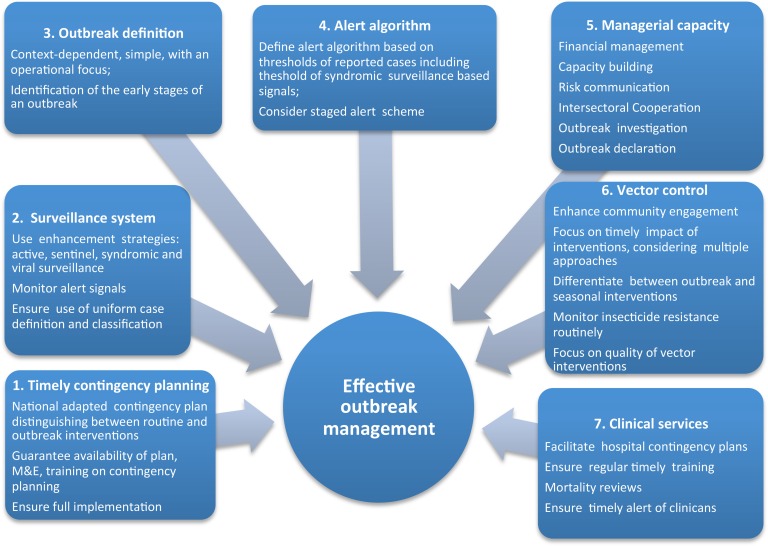
Methodology/principal findings: Available evidence was evaluated using a step-wise process that included systematic literature reviews, policymaker and stakeholder interviews, a study to assess dengue contingency planning and outbreak management in 10 countries, and a retrospective logistic regression analysis to identify alarm signals for an outbreak warning system using datasets from five dengue endemic countries. Best practices for managing a dengue outbreak are provided for key elements of a dengue contingency plan including timely contingency planning, the importance of a detailed, context-specific dengue contingency plan that clearly distinguishes between routine and outbreak interventions, surveillance systems for outbreak preparedness, outbreak definitions, alert algorithms, managerial capacity, vector control capacity, and clinical management of large caseloads. Additionally, a computer-assisted early warning system, which enables countries to identify and respond to context-specific variables that predict forthcoming dengue outbreaks, has been developed.
Conclusions/significance: Most countries do not have comprehensive, detailed contingency plans for dengue outbreaks. Countries tend to rely on intensified vector control as their outbreak response, with minimal focus on integrated management of clinical care, epidemiological, laboratory and vector surveillance, and risk communication. The Technical Handbook for Surveillance, Dengue Outbreak Prediction/ Detection and Outbreak Response seeks to provide countries with evidence-based best practices to justify the declaration of an outbreak and the mobilization of the resources required to implement an effective dengue contingency plan.
Conflict of interest statement
The authors have declared that no competing interests exist.
Figures
References
-
- WHO. Scientific Working Group Report on Dengue: Meeting Report, 1–5 October 2006. Geneva: World Health Organization; 2007. Available: http://www.who.int/tdr/publications/documents/swg_dengue_2.pdf.
-
- WHO. Dengue, Prevention, Treatment and Control, New Edition Geneva: World Health Organization; 2009. Available: http://whqlibdoc.who.int/publications/2009/9789241547871_eng.pdf
-
- WHO. WHO Handbook for Guidelines Development Geneva: World Health Organization; 2012. Available: http://apps.who.int/iris/bitstream/10665/75146/1/9789241548441_eng.pdf?ua=1.
Grants and funding
LinkOut - more resources
Full Text Sources
Other Literature Sources