


Dysregulated JAK2 expression by TrkC promotes metastasis potential, and EMT program of metastatic breast cancer
- PMID: 27654855
- PMCID: PMC5032000
- DOI: 10.1038/srep33899
Dysregulated JAK2 expression by TrkC promotes metastasis potential, and EMT program of metastatic breast cancer
Erratum in
-
Author Correction: Dysregulated JAK2 expression by TrkC promotes metastasis potential, and EMT program of metastatic breast cancer.Sci Rep. 2020 Jul 6;10(1):11103. doi: 10.1038/s41598-020-68128-6. Sci Rep. 2020. PMID: 32632170 Free PMC article.
Retraction in
-
Retraction Note: Dysregulated JAK2 expression by TrkC promotes metastasis potential, and EMT program of metastatic breast cancer.Sci Rep. 2025 Sep 29;15(1):33319. doi: 10.1038/s41598-025-18790-5. Sci Rep. 2025. PMID: 41023028 Free PMC article. No abstract available.
Abstract
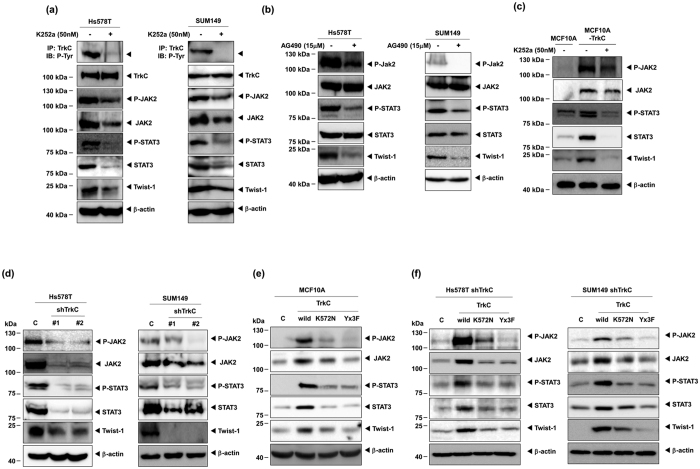
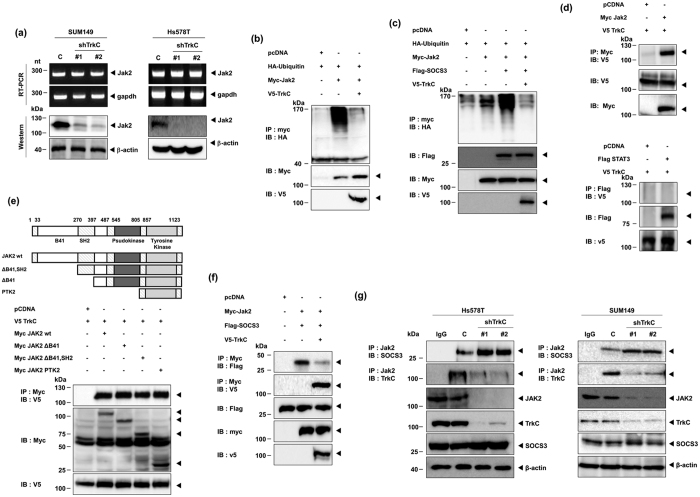
Metastatic breast cancers are aggressive tumors associated with high levels of epithelial-mesenchymal transition (EMT) markers, activation of IL6/JAK2/STAT3 and PI3K/AKT pathways for cell growth, mobility, invasion, metastasis, and CSC status. We identified a new molecular and functional network present in metastasis that regulates and coordinates with TrkC. Inhibition of SOCS3-mediated JAK2 degradation by TrkC increases total JAK2/STAT3 expression, and then leads to upregulation of Twist-1 through activation of JAK2/STAT3 cascade. Also, TrkC increases secretion and expression of IL-6, suggesting that this autocrine loop generated by TrkC maintains the mesenchymal state by continued activation of the JAK2/STAT3 cascade and upregulation of Twist expression. Moreover, TrkC interacts with the c-Src/Jak2 complex, which increases Twist-1 and Twist-2 levels via regulation of JAK2/STAT3 activation and JAK2/STAT3 expression. Furthermore, TrkC enhances metastatic potential of breast cancer via induction of EMT by upregulating Twist-1 and Twist-2. Additionally, TrkC significantly enhances the ability of breast cancer cells to form pulmonary metastases and primary tumor formation. Unexpectedly, we found that TrkC expression and clinical breast tumor pathological phenotypes show significant correlation. These findings suggest that TrkC plays a central role in tumorigenicity, metastasis, and self-renewal traits of metastatic breast cancer.
Figures



References
-
- Hanahan D. & Weinberg R. A. Hallmarks of cancer: the next generation. Cell 144, 646–674 (2011). - PubMed
-
- Batlle E. et al. The transcription factor snail is a repressor of E-cadherin gene expression in epithelial tumour cells. Nat Cell Biol 2, 84–89 (2000). - PubMed
-
- Cano A. et al. The transcription factor snail controls epithelial-mesenchymal transitions by repressing E-cadherin expression. Nat Cell Biol 2, 76–83 (2000). - PubMed
Publication types
LinkOut - more resources
Full Text Sources
Other Literature Sources
Miscellaneous
