Vector Competence of French Polynesian Aedes aegypti and Aedes polynesiensis for Zika Virus
- PMID: 27654962
- PMCID: PMC5031459
- DOI: 10.1371/journal.pntd.0005024
Vector Competence of French Polynesian Aedes aegypti and Aedes polynesiensis for Zika Virus
Abstract
Background: In 2013-2014, French Polynesia experienced for the first time a Zika outbreak. Two Aedes mosquitoes may have contributed to Zika virus (ZIKV) transmission in French Polynesia: the worldwide distributed Ae. aegypti and the Polynesian islands-endemic Ae. polynesiensis mosquito.
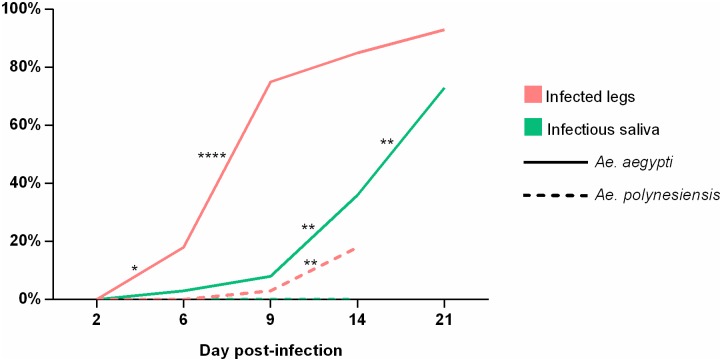
Methodology/principal findings: To evaluate their vector competence for ZIKV, mosquitoes were infected per os at viral titers of 7 logs tissue culture infectious dose 50%. At several days post-infection (dpi), saliva was collected from each mosquito and inoculated onto C6/36 mosquito cells to check for the presence of ZIKV infectious particles. Legs and body of each mosquito were also collected and submitted separately to RNA extraction and ZIKV RT-PCR. In Ae. aegypti the infection rate was high as early as 6 dpi and the dissemination efficiency get substantial from 9 dpi while the both rates remained quite low in Ae. polynesiensis. The transmission efficiency was poor in Ae. aegypti until 14 dpi and no infectious saliva was found in Ae. polynesiensis at the time points studied.
Conclusions/significance: In our experimental conditions, the late ability of the French Polynesian Ae. aegypti to transmit ZIKV added by the poor competence of Ae. polynesiensis for this virus suggest the possible contribution of another vector for the propagation of ZIKV during the outbreak, in particular in remote islands where Ae. polynesiensis is predominating.
Conflict of interest statement
The authors have declared that no competing interests exist.
Figures
References
-
- World Health Organization. Zika virus. Fact sheet, updated 18 March 2016. Available: http://www.who.int/mediacentre/factsheets/zika/en/
-
- Dick GWA, Kitchen SF, Haddow AJ. Zika virus. I. Isolations and serological specificity. Trans R Soc Trop Med Hyg. 1952;46: 509–20. Available: http://www.ncbi.nlm.nih.gov/pubmed/12995440 - PubMed
LinkOut - more resources
Full Text Sources
Other Literature Sources