


Guidelines for identification and treatment of individuals with attention deficit/hyperactivity disorder and associated fetal alcohol spectrum disorders based upon expert consensus
- PMID: 27655132
- PMCID: PMC5032241
- DOI: 10.1186/s12888-016-1027-y
Guidelines for identification and treatment of individuals with attention deficit/hyperactivity disorder and associated fetal alcohol spectrum disorders based upon expert consensus
Abstract
Background: The association of attention deficit/hyperactivity disorder (ADHD) and fetal alcohol spectrum disorders (FASD) results in a complex constellation of symptoms that complicates the successful diagnosis and treatment of the affected individual. Current literature lacks formal guidelines, randomized control trials, and evidence-based treatment plans for individuals with ADHD and associated FASD. Therefore, a meeting of professional experts was organized with the aim of producing a consensus on identification and treatment guidelines that will aid clinicians in caring for this unique patient population.
Methods: Experts from multiple disciplines in the fields of ADHD and FASD convened in London, United Kingdom, for a meeting hosted by the United Kingdom ADHD Partnership (UKAP; www.UKADHD.com ) in June 2015. The meeting provided the opportunity to address the complexities of ADHD and FASD from different perspectives and included presentations, discussions, and group work. The attendees worked towards producing a consensus for a unified approach to ADHD and associated FASD.
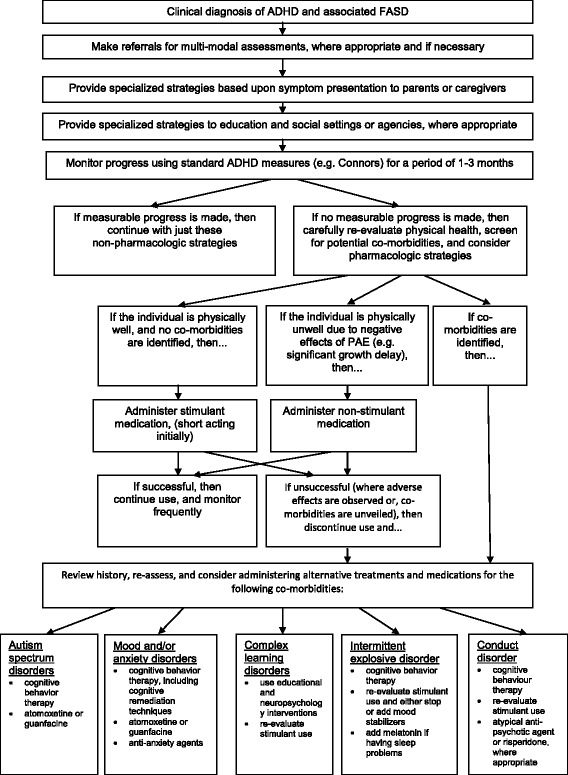
Results: The authors successfully came to consensus and produced recommended guidelines with specific regards to identification and assessment, interventions and treatments, and multiagency liaisons and care management, highlighting that a lifespan approach to treatment needs to be adopted by all involved. Included in the guidelines are: 1) unique 'red flags', which when identified in the ADHD population can lead to an accurate associated FASD diagnosis, 2) a treatment decision tree, and 3) recommendations for multiagency care management.
Conclusions: While clinically useful guidelines were achieved, more research is still needed to contribute to the knowledge base about the diagnosis, treatment, and management of those with ADHD and associated FASD.
Keywords: Attention deficit/hyperactivity disorder (ADHD); Co-morbid or associated FASD; Consensus; Fetal alcohol spectrum disorders (FASD); Interventions; Treatment guidelines.
Figures
References
-
- Thapar, A., Cooper M., Attention deficit hyperactivity disorder. Lancet, Sept. 17, 2015. http://dx.doi.org/10.1016/S0140-6736(15)00238-X. - DOI - PubMed
LinkOut - more resources
Full Text Sources
Other Literature Sources
