Review
. 2016 Sep 5:7:1374.
doi: 10.3389/fmicb.2016.01374. eCollection 2016.

A Review of SHV Extended-Spectrum β-Lactamases: Neglected Yet Ubiquitous

Affiliations
Review

A Review of SHV Extended-Spectrum β-Lactamases: Neglected Yet Ubiquitous

Apostolos Liakopoulos et al. Front Microbiol. .

Abstract

β-lactamases are the primary cause of resistance to β-lactams among members of the family Enterobacteriaceae. SHV enzymes have emerged in Enterobacteriaceae causing infections in health care in the last decades of the Twentieth century, and they are now observed in isolates in different epidemiological settings both in human, animal and the environment. Likely originated from a chromosomal penicillinase of Klebsiella pneumoniae, SHV β-lactamases currently encompass a large number of allelic variants including extended-spectrum β-lactamases (ESBL), non-ESBL and several not classified variants. SHV enzymes have evolved from a narrow- to an extended-spectrum of hydrolyzing activity, including monobactams and carbapenems, as a result of amino acid changes that altered the configuration around the active site of the β -lactamases. SHV-ESBLs are usually encoded by self-transmissible plasmids that frequently carry resistance genes to other drug classes and have become widespread throughout the world in several Enterobacteriaceae, emphasizing their clinical significance.

Keywords: ESBL; Enterobacteriaceae; SHV-12; SHV-2; SHV-5; blaSHV; plasmid; β-lactamase.


Figures
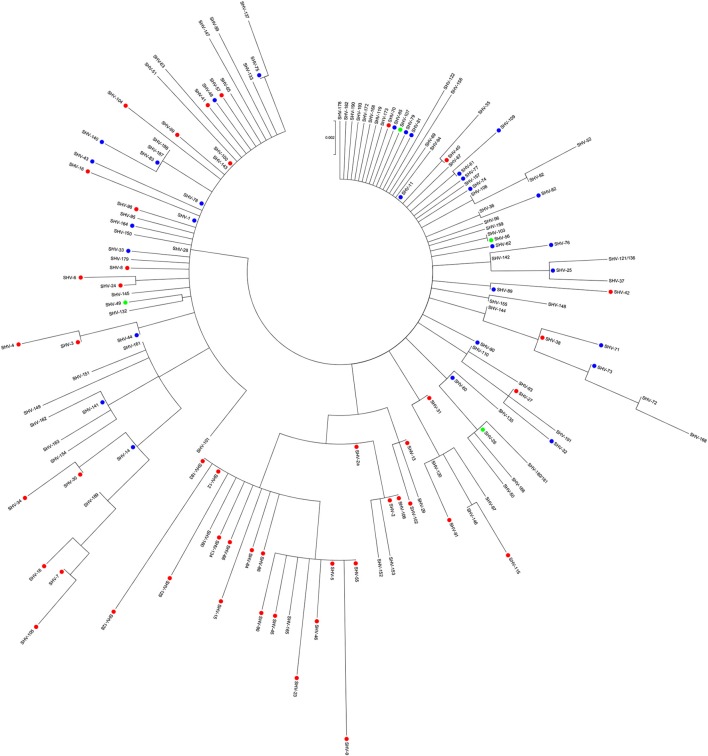
Figure 1
Figure 1
Maximum likelihood amino acid tree of 149 SHV-type β-lactamases. Variants whose sequence has not been released in GenBank as of July 2016, that show partial sequence or are identical to others (http://www.lahey.org/studies/) were not included in the analysis. SHV-180 and SHV-181 share the same sequence as well as SHV-121 and SHV-136. The tree was implemented in Mega version 6.06 (Tamura et al., 2013). Solid circles represent: red, extended-spectrum β-lactamases (2be; n = 46); green, broad-spectrum β-lactamases (2br, n = 5); and blue, penicillinases (2b, n = 30). Unclassified alleles are reported in black (n = 68).
Figure 2
Figure 2
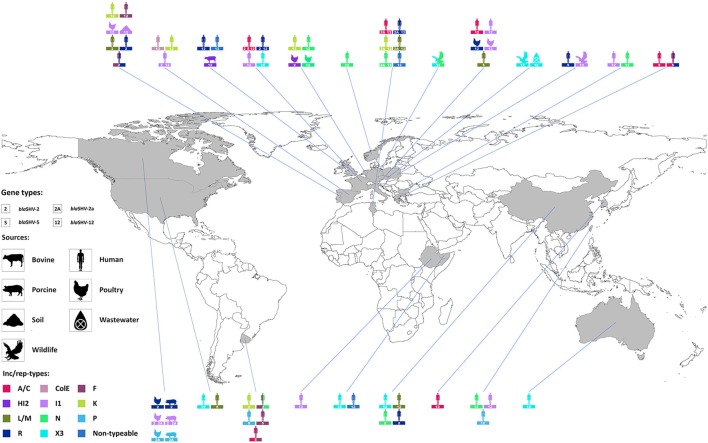
Worldwide distribution of plasmid families encoding blaSHV-2, blaSHV-2a, blaSHV-5, and blaSHV-12. Inc/rep types are represented in different colors; diverse symbols depict human, bovine, porcine, poultry, wildlife, soil, or wastewater sources. For a complete full reference list see Table 4.
Figure 3
Figure 3
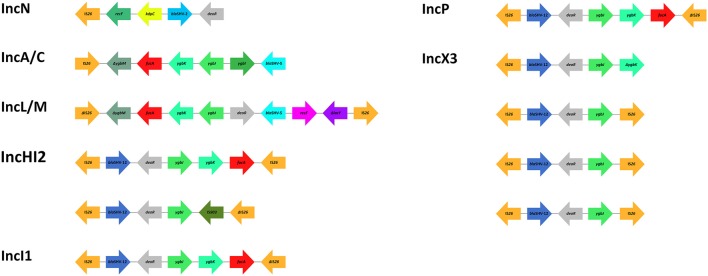
Schematic representation of blaSHV genetic surroundings and IS26 association. Common occurring features are color coded. Map is not to scale. References: IncN (Wang et al., 2012); IncA/C (Giakkoupi et al., 2015); IncL/M (Preston et al., 2014); IncHI2, IncI1, IncP (Chen C. M. et al., 2015); IncX3 (Ho et al., ; Du et al., ; Kassis-Chikhani et al., ; Feng et al., 2015).

References

    1. Abbassi M. S., Torres C., Achour W., Vinué L., Sáenz Y., Costa D., et al. (2008). Genetic characterisation of CTX-M-15-producing Klebsiella pneumoniae and Escherichia coli strains isolated from stem cell transplant patients in Tunisia. Int. J. Antimicrob. Agents 32, 308–314. 10.1016/j.ijantimicag.2008.04.009 - DOI - PubMed
    1. Accogli M., Fortini D., Giufrè M., Graziani C., Dolejska M., Carattoli A., et al. (2013). IncI1 plasmids associated with the spread of CMY-2, CTX-M-1 and SHV-12 in Escherichia coli of animal and human origin. Clin. Microbiol. Infect. 19, E238–E240. 10.1111/1469-0691.12128 - DOI - PubMed
    1. Ahmed A. M., Shimamoto T. (2011). Molecular characterization of antimicrobial resistance in Gram-negative bacteria isolated from bovine mastitis in Egypt. Microbiol. Immunol. 55, 318–327. 10.1111/j.1348-0421.2011.00323.x - DOI - PubMed
    1. Ahmed A. M., Shimamoto T., Shimamoto T. (2013). Molecular characterization of multidrug-resistant avian pathogenic Escherichia coli isolated from septicemic broilers. Int. J. Med. Microbiol. 303, 475–483. 10.1016/j.ijmm.2013.06.009 - DOI - PubMed
    1. Ahmed A. M., Younis E. E., Ishida Y., Shimamoto T. (2009). Genetic basis of multidrug resistance in Salmonella enterica serovars Enteritidis and Typhimurium isolated from diarrheic calves in Egypt. Acta Trop. 111, 144–149. 10.1016/j.actatropica.2009.04.004 - DOI - PubMed