. 2016 Sep 20;8(9):262.
doi: 10.3390/v8090262.

Zebra Alphaherpesviruses (EHV-1 and EHV-9): Genetic Diversity, Latency and Co-Infections

Affiliations

Zebra Alphaherpesviruses (EHV-1 and EHV-9): Genetic Diversity, Latency and Co-Infections

Azza Abdelgawad et al. Viruses. .

Abstract

Alphaherpesviruses are highly prevalent in equine populations and co-infections with more than one of these viruses' strains frequently diagnosed. Lytic replication and latency with subsequent reactivation, along with new episodes of disease, can be influenced by genetic diversity generated by spontaneous mutation and recombination. Latency enhances virus survival by providing an epidemiological strategy for long-term maintenance of divergent strains in animal populations. The alphaherpesviruses equine herpesvirus 1 (EHV-1) and 9 (EHV-9) have recently been shown to cross species barriers, including a recombinant EHV-1 observed in fatal infections of a polar bear and Asian rhinoceros. Little is known about the latency and genetic diversity of EHV-1 and EHV-9, especially among zoo and wild equids. Here, we report evidence of limited genetic diversity in EHV-9 in zebras, whereas there is substantial genetic variability in EHV-1. We demonstrate that zebras can be lytically and latently infected with both viruses concurrently. Such a co-occurrence of infection in zebras suggests that even relatively slow-evolving viruses such as equine herpesviruses have the potential to diversify rapidly by recombination. This has potential consequences for the diagnosis of these viruses and their management in wild and captive equid populations.

Keywords: EHV-1; EHV-9; co-occurrence; diversity; latency; zebra.


Conflict of interest statement

The authors declare no conflict of interest.

Figures
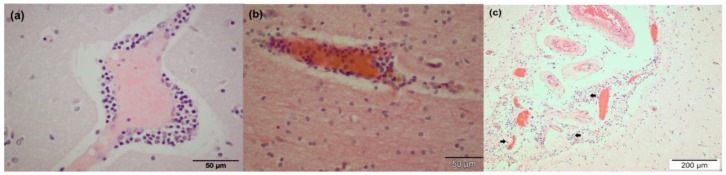
Figure 1
Figure 1
Histopathology (Grevy’s zebra, CG3) showing non-suppurative encephalitis represented by mononuclear perivascular cuffs in the gray matter of the cerebral cortex (a) and forebrain (b); Hematoxilin–eosine (HE) staining. Meningeal perivascular infiltration of inflammatory cells (arrows) (c); HE staining.
Figure 2
Figure 2
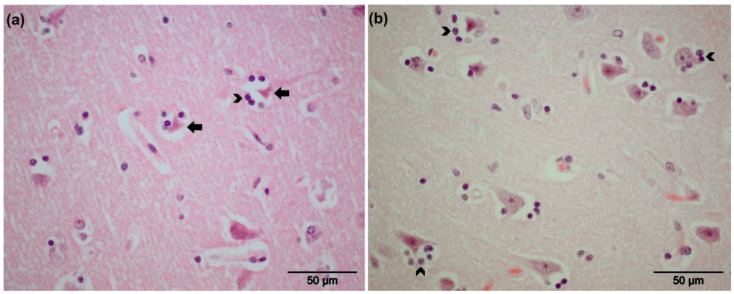
Histopathology of cerebral cortex (Grevy’s zebra, CG3) showing degenerated neurons (arrows) (a) with mild glial reactions (head of arrows) in (a,b); HE staining.
Figure 3
Figure 3
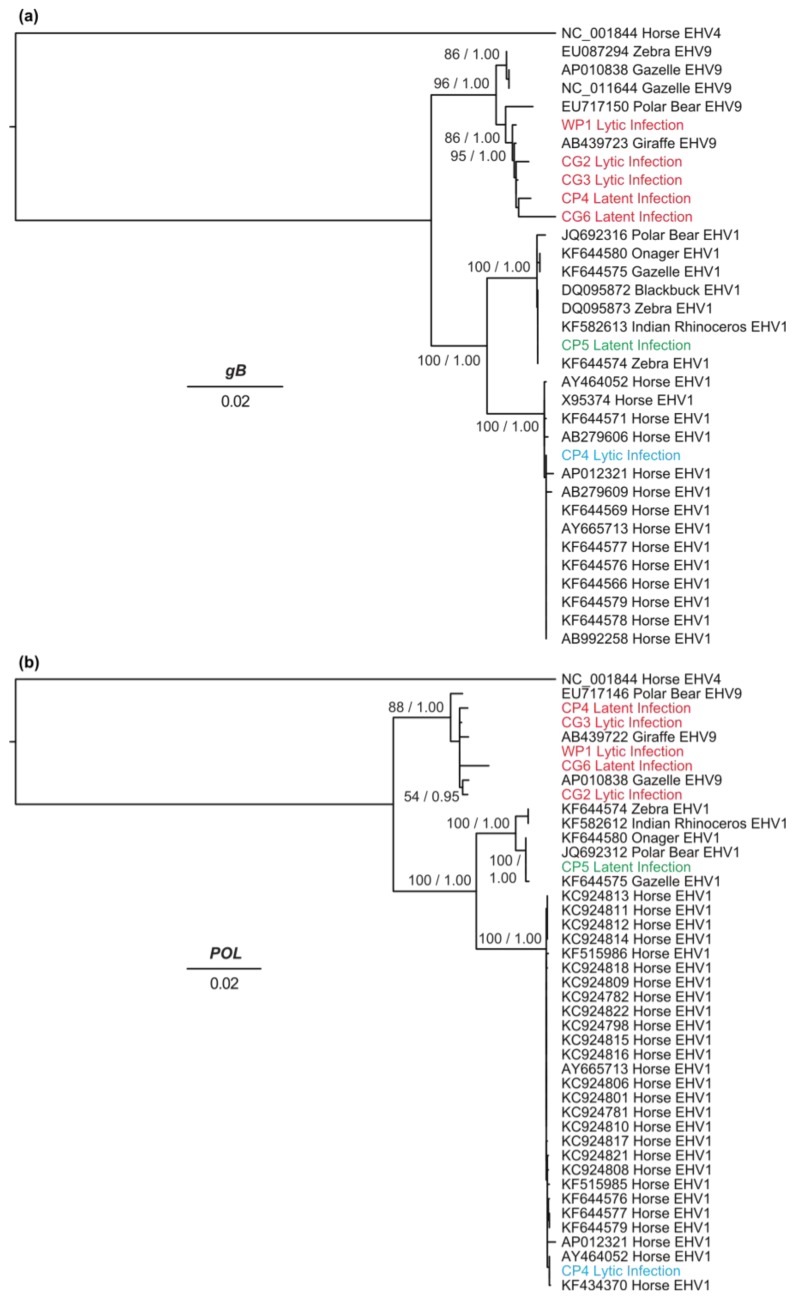
Phylogenetic trees inferred using maximum likelihood from nucleotide sequences of (a) gB and (b) Pol genes for the six zebras WP1, CG2, CG3 (Equine herpesvirus 9 (EHV-9) lytic infection), CP4 (Equine herpesvirus 1 (EHV-1) lytic and EHV-9 latent infection), CP5, and CG6 (EHV-1 and EHV-9 latent infection, respectively) and other equine herpesviruses. Reference sequences are indicated by GenBank accession number, species from which the sequence was isolated, and viral strain. The novel EHV-9 sequences are in red, the novel EHV-1-horse like zebra sequence is in blue, and the novel zebra-EHV-1 sequence is in green. The trees are shown with branches lengths scaled to nucleotide substitutions per site. Selected nodes are labeled with maximum-likelihood bootstrap support values and posterior probabilities, separated by a slash “/”.

References

    1. Thiry E., Meurens F., Muylkens B., McVoy M., Gogev S., Thiry J., Vanderplasschen A., Epstein A., Keil G., Schynts F. Recombination in alphaherpesviruses. Rev. Med. Virol. 2005;15:89–103. doi: 10.1002/rmv.451. - DOI - PubMed
    1. Davison A.J., Eberle R., Ehlers B., Hayward G.S., McGeoch D.J., Minson A.C., Pellett P.E., Roizman B., Studdert M.J., Thiry E. The order Herpesvirales. Arch. Virol. 2009;154:171–177. doi: 10.1007/s00705-008-0278-4. - DOI - PMC - PubMed
    1. Fukushi H., Yamaguchi T., Yamada S. Complete genome sequence of equine herpesvirus type 9. J. Virol. 2012;86:13822. doi: 10.1128/JVI.02607-12. - DOI - PMC - PubMed
    1. Schrenzel M.D., Tucker T.A., Donovan T.A., Busch M.D., Wise A.G., Maes R.K., Kiupel M. New hosts for equine herpesvirus 9. Emerg. Infect. Dis. 2008;14:1616–1619. doi: 10.3201/eid1410.080703. - DOI - PMC - PubMed
    1. Wohlsein P., Lehmbecker A., Spitzbarth I., Algermissen D., Baumgartner W., Boer M., Kummrow M., Haas L., Grummer B. Fatal epizootic equine herpesvirus 1 infections in new and unnatural hosts. Vet. Microbiol. 2011;149:456–460. doi: 10.1016/j.vetmic.2010.11.024. - DOI - PubMed

LinkOut - more resources