Review
. 2016 Oct:20:55-63.
doi: 10.1016/j.coviro.2016.09.004. Epub 2016 Sep 19.

Viral evasion and challenges of hepatitis C virus vaccine development

Affiliations
Review

Viral evasion and challenges of hepatitis C virus vaccine development

Brian G Pierce et al. Curr Opin Virol. 2016 Oct.

Abstract

Hepatitis C virus (HCV) is a major global disease burden, often leading to chronic liver diseases, cirrhosis, cancer, and death in those infected. Despite the recent approval of antiviral therapeutics, a preventative vaccine is recognized as the most effective means to control HCV globally, particularly in at-risk and developing country populations. Here we describe the efforts and challenges related to the development of an HCV vaccine, which after decades of research have not been successful. Viral sequence variability poses a major challenge, yet recent research has provided unprecedented views of the atomic structure of HCV epitopes and immune recognition by antibodies and T cell receptors. This, coupled with insights from deep sequencing, robust neutralization assays, and other technological advances, is spurring research toward rationally HCV designed vaccines that preferentially elicit responses toward conserved epitopes of interest that are associated with viral neutralization and clearance.


Figures

Figure 1
Figure 1
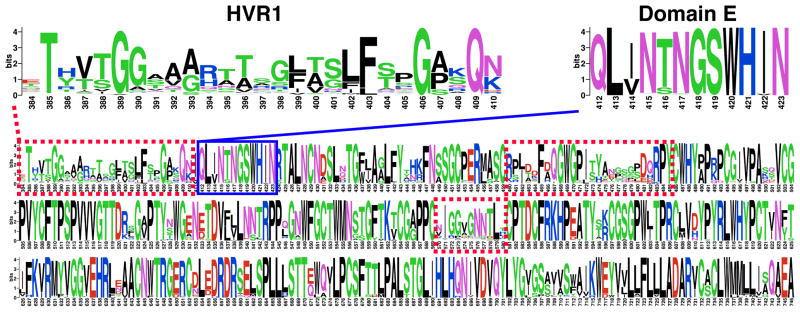
Amino acid sequence variability of HCV envelope glycoprotein E2, the primary target of the antibody response. A sequence logo [94] was generated using a multiple sequence alignment of over 600 E2 sequences downloaded from the Los Alamos HCV database [95]. This gives amino acid propensities at each E2 position (numbering based on the H77 HCV isolate), with total height at each position representing sequence conservation (more variable positions have lower height). Hypervariable regions HVR1, HVR2 and igVR are shown by dotted red boxes, with HVR1 and epitope region 412–423 (antigenic domain E) highlighted.
Figure 2
Figure 2
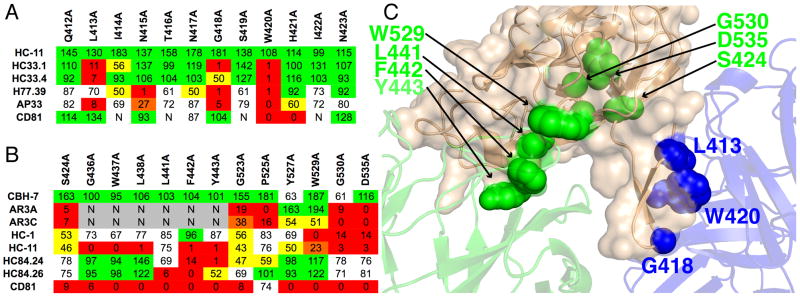
Mapping neutralizing antibody and CD81 receptor binding determinants on the E2 glycoprotein. A) E2 alanine scanning for domain E MAbs (HC33.1, HC33.4, H77.39, AP33), domain B MAb HC-11, and CD81 receptor at E2 positions 412–423 [16,32]. Values represent percent antibody or receptor binding compared to wild-type E2; N = not reported. Cell colors for binding percentiles are: 0–20% red, 21–40% orange, 41–60% yellow, 61–90% white, > 90% green. B) E2 alanine scanning for AR3 MAbs AR3A, AR3C, domain B MAbs HC-1 and HC-11, domain C MAb CBH-7, domain D MAbs HC84.24 and HC84.26, and CD81 receptor at select E2 binding positions in the domain B–D supersite [28,29,32,61]. Cell colors are as in (B). C) Positions of key neutralizing antibody binding residues for domain E (blue spheres) and domain B–D (green spheres) colocalized on the E2 structure. The E2 protein (tan) and bound AR3C MAb (green cartoon) are from the E2 core crystal structure [52] with N-terminal E2 residues 412–423 modeled using Rosetta [96] (residues 412–420 are disordered in the crystal structure), and HCV1 MAb superposed onto residues 412–423 for reference, based on the HCV1-E2 412–423 complex crystal structure [44].
Figure 3
Figure 3
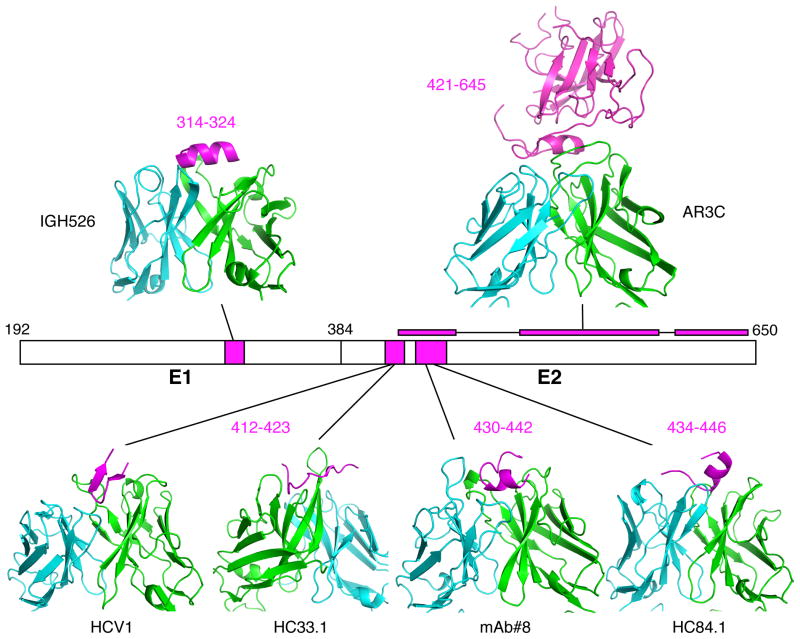
Mapping the structural landscape of neutralizing antibody recognition of E1 and E2 envelope glycoproteins. Antibody-bound peptide epitopes of E1 and E2, as well as the E2 core protein (aa 421–645, with HVR2 removed), are shown in magenta. Antibody heavy and light chains are green and cyan, respectively. Corresponding PDB codes are 4N0Y (IGH526/E1 314–324), 4DGY (HCV1/E2 412–423), 4XVJ (HC33.1/E2 412–423), 4HZL (mAb#8/E2 430–442), 4JZN (HC84.1/E2 434–446), 4MWF (AR3C/E2 core).

References

    1. Mohd Hanafiah K, Groeger J, Flaxman AD, Wiersma ST. Global epidemiology of hepatitis C virus infection: new estimates of age-specific antibody to HCV seroprevalence. Hepatology. 2013;57:1333–1342. - PubMed
    1. Ly KN, Hughes EM, Jiles RB, Holmberg SD. Rising Mortality Associated With Hepatitis C Virus in the United States, 2003–2013. Clin Infect Dis. 2016;62:1287–1288. - PMC - PubMed
    1. Choo QL, Kuo G, Weiner AJ, Overby LR, Bradley DW, Houghton M. Isolation of a cDNA clone derived from a blood-borne non-A, non-B viral hepatitis genome. Science. 1989;244:359–362. - PubMed
    1. Walker CM, Grakoui A. Hepatitis C virus: why do we need a vaccine to prevent a curable persistent infection? Curr Opin Immunol. 2015;35:137–143. - PMC - PubMed
    1. Fauvelle C, Colpitts CC, Keck ZY, Pierce BG, Foung SK, Baumert TF. Hepatitis C virus vaccine candidates inducing protective neutralizing antibodies. Expert Rev Vaccines. 2016:1–10. - PMC - PubMed

Publication types

LinkOut - more resources