


Genetics of gigantism and acromegaly
- PMID: 27657986
- PMCID: PMC5154831
- DOI: 10.1016/j.ghir.2016.08.002
Genetics of gigantism and acromegaly
Abstract
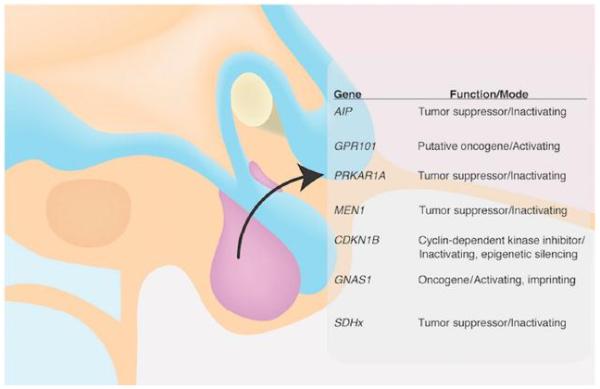
Gigantism and acromegaly are rare disorders that are caused by excessive GH secretion and/or high levels of its mediator, IGF-1. Gigantism occurs when excess GH or IGF-1 lead to increased linear growth, before the end of puberty and epiphyseal closure. The majority of cases arise from a benign GH-secreting pituitary adenoma, with an incidence of pituitary gigantism and acromegaly of approximately 8 and 11 per million person-years, respectively. Over the past two decades, our increasing understanding of the molecular and genetic etiologies of pituitary gigantism and acromegaly yielded several genetic causes, including multiple endocrine neoplasia type 1 and 4, McCune-Albright syndrome, Carney complex, familial isolated pituitary adenoma, pituitary adenoma association due to defects in familial succinate dehydrogenase genes, and the recently identified X-linked acrogigantism. The early diagnosis of these conditions helps guide early intervention, screening, and genetic counseling of patients and their family members. In this review, we provide a concise and up-to-date discussion on the genetics of gigantism and acromegaly.
Keywords: Acromegaly; GH; Genetics; Gigantism; IGF-1; Pituitary adenoma; X-LAG.
Published by Elsevier Ltd.
Figures
References
-
- Sotos JF, Argente J. Overgrowth disorders associated with tall stature. Advances in pediatrics. 2008;55:213–254. - PubMed
-
- Sotos JF. Overgrowth. Hormonal Causes. Clinical pediatrics. 1996 Nov;35(11):579–590. - PubMed
-
- Daly AF, Vanbellinghen JF, Khoo SK, et al. Aryl hydrocarbon receptor-interacting protein gene mutations in familial isolated pituitary adenomas: analysis in 73 families. J Clin Endocrinol Metab. 2007 May;92(5):1891–1896. - PubMed
Publication types
MeSH terms
Substances
Supplementary concepts
Grants and funding
LinkOut - more resources
Full Text Sources
Other Literature Sources
Miscellaneous
