. 2016 Sep 22;11(9):e0163150.
doi: 10.1371/journal.pone.0163150. eCollection 2016.

The Feedback-Related Negativity and the P300 Brain Potential Are Sensitive to Price Expectation Violations in a Virtual Shopping Task

Affiliations

The Feedback-Related Negativity and the P300 Brain Potential Are Sensitive to Price Expectation Violations in a Virtual Shopping Task

Alexandre Schaefer et al. PLoS One. .

Abstract

A large body of evidence shows that buying behaviour is strongly determined by consumers' price expectations and the extent to which real prices violate these expectations. Despite the importance of this phenomenon, little is known regarding its neural mechanisms. Here we show that two patterns of electrical brain activity known to index prediction errors-the Feedback-Related Negativity (FRN) and the feedback-related P300 -were sensitive to price offers that were cheaper than participants' expectations. In addition, we also found that FRN amplitude time-locked to price offers predicted whether a product would be subsequently purchased or not, and further analyses suggest that this result was driven by the sensitivity of the FRN to positive price expectation violations. This finding strongly suggests that ensembles of neurons coding positive prediction errors play a critical role in real-life consumer behaviour. Further, these findings indicate that theoretical models based on the notion of prediction error, such as the Reinforcement Learning Theory, can provide a neurobiologically grounded account of consumer behavior.


Conflict of interest statement

The authors have declared that no competing interests exist.

Figures
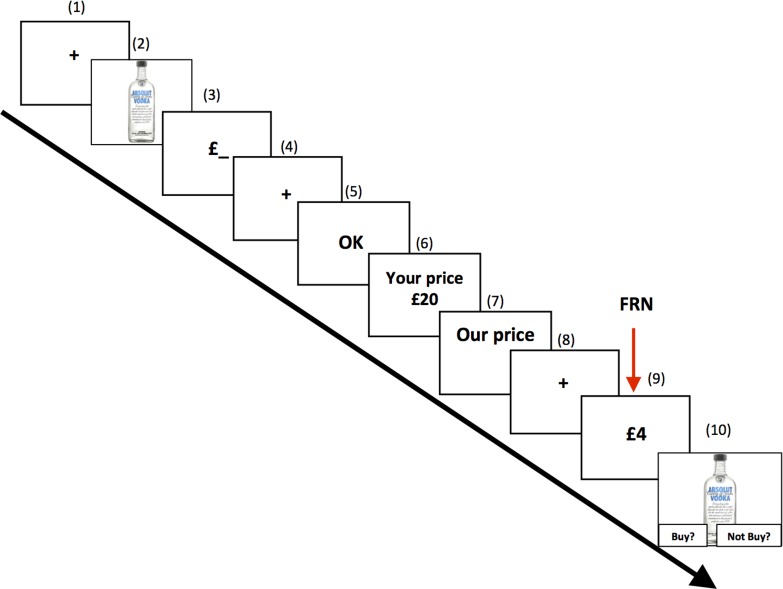
Fig 1
Fig 1. Trial procedure.
(1) A fixation screen was displayed for a random duration (800 to 1,700 ms); (2) A picture of the product was presented for 2 seconds, after which a brief written description of the product was superimposed on the picture for 2 seconds; (3) Participants were prompted to estimate the price of the product and input it via the keyboard; (4) A fixation screen was displayed (800–1,700 ms, random duration); (5) A screen displayed a feedback on whether the participant’s estimation was within an acceptable range around the average market price of the product. If the estimate price was above or below 60% of the actual market price, then a “Too high” or “Too low” feedback was displayed for 1 second. In this case, the current trial was aborted and the next trial would start immediately. Otherwise, an “OK” sign was displayed and the trial could continue until its end. This approach was adopted to minimize strategic underestimations, as skipping stages 6–10 of the current trial removed the participant’s chance of buying the current product. An average of 10% of trials were skipped, and the percentage of skipped trials did not significantly differ between conditions. (6) Participants’ expected price (provided in stage 2) was displayed during 1 second; (7) The message “Our Price” was displayed for 750 ms; (8) A fixation screen was displayed (800–1,700 ms); (9) Participants were shown the actual “offer price” of the product during 1,500 ms; (10) Participants were asked to decide to buy or not the product via a key press.
Fig 2
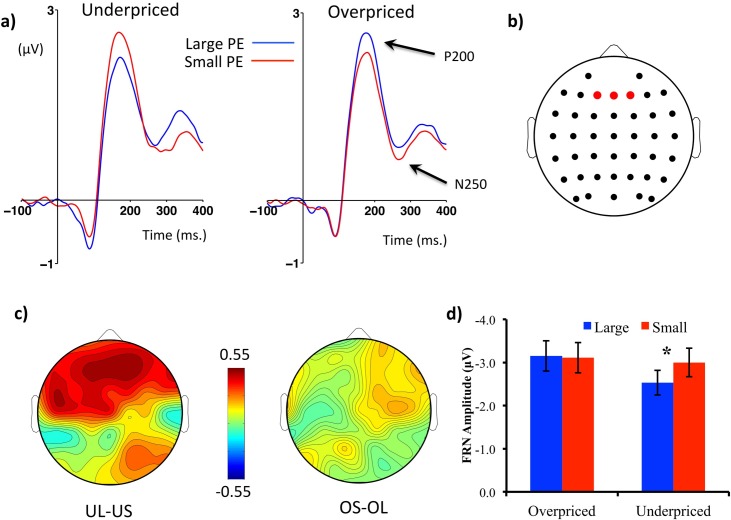
Fig 2. FRN as a function of price expectation violations.
(a) ERP waveforms from a cluster of frontal electrodes time-locked to the offer price (stage #9) separated according to price valence (overpriced vs. underpriced) and price prediction error (large vs. small). Amplitude in microvolts (μV) is on the y axis and time in milliseconds is on the x axis. The arrows indicate the positive and negative peaks used to quantify the FRN (See Methods section) (b) Cluster of frontal electrodes (F1, Fz, F2) used to compute FRN components. (c) Scalp maps plotting contrasts of FRN peak to peak amplitudes between large and small prediction errors separated for underpriced and overpriced conditions, arranged so that more positive values reflect a greater positive valence (UL-US and OS-OL). The colour bar represents maxima and minima (μV). (d) Bar chart plotting peak-to-peak FRN amplitudes (μV) as a function of price valence and price prediction error. * p < .05.
Fig 3
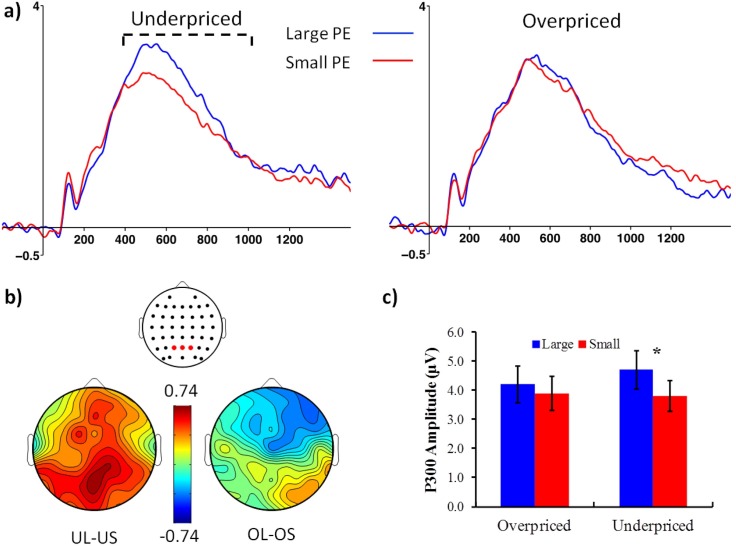
Fig 3. Feedback-Related P300 components.
(a) ERP waveforms from a cluster of parietal electrodes time-locked to the offer price (stage #9) separated according to price valence (overpriced vs. underpriced) and price prediction error (large vs. small). The y axis shows amplitude in microvolts (μV) and x axis shows time in milliseconds. The dashed line indicates the time window used to quantify the P300. (b) Scalp maps showing P300 contrasts between underpriced large and underpriced small trials (UL–US; left) and between overpriced large and overpriced small trials (OL–OS; right), alongside a description of the location of the electrode cluster used in this analysis. Colour bar represents maxima and minima (μV). (c) Bar chart plotting P300 amplitudes (μV) as a function of price valence and price prediction error. * p < .05.
Fig 4
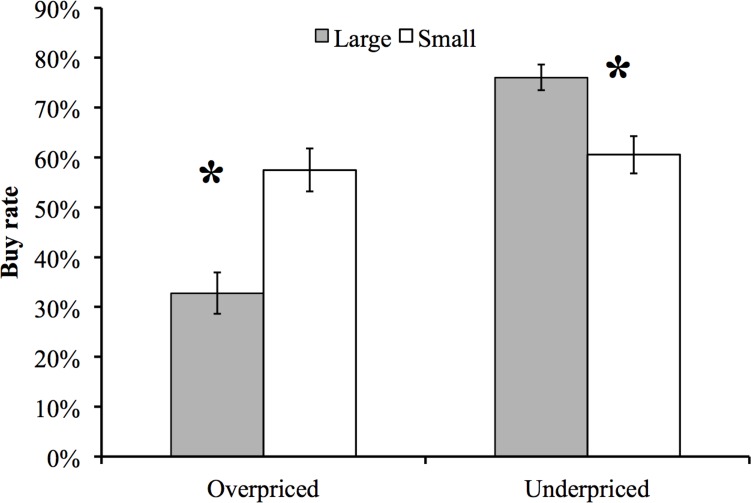
Fig 4. Buying behaviour.
Buying rate (% of total valid trials) as a function of price valence (overpriced vs. underpriced) and price prediction error (large vs. small). * p < .05.
Fig 5
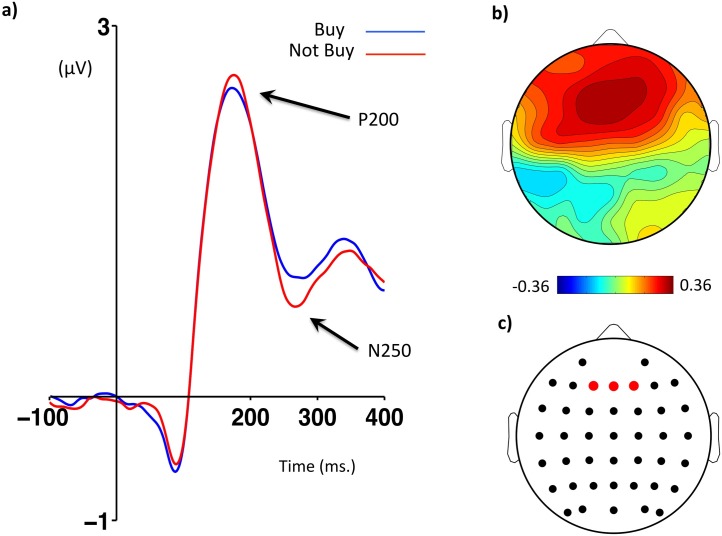
Fig 5. FRNs as a function of buying decisions.
(a) Waveforms from a cluster of frontal electrodes time-locked to the offer price (stage #9) separated by whether the product was subsequently purchased (“Buy”) or not (“Not Buy”) in stage #10. Amplitude in microvolts (μV) is shown on the y axis and time in milliseconds is shown on the x axis. The arrows indicate the positive and negative peaks used to quantify the FRN (See Methods section). (b) Scalp maps showing a contrast between “Buy” and “Not Buy” related FRNs. Color bar represents maxima and minima (μV). (c) Cluster of frontal electrodes (F1, Fz, F2) used to compute FRNs.

References

    1. Kalwani MU, Yim CK, Rinne HJ, Sugita Y. A price expectations model of customer brand choice. J Mark Res. 1990;27: 251–262.
    1. Winer RS. A Reference Price Model of Brand Choice for Frequently Purchased Products. J Consum Res. 1986;13: 250–256.
    1. Knutson B, Rick S, Wimmer GE, Prelec D, Loewenstein G. Neural Predictors of Purchases. Neuron. 2007;53: 147–156. 10.1016/j.neuron.2006.11.010 - DOI - PMC - PubMed
    1. Karmarkar UR, Shiv B, Knutson B. Cost Conscious? The Neural and Behavioral Impact of Price Primacy on Decision-Making. J Mark Res. 2014;02163: 140917092729007. 10.1509/jmr.13.0488 - DOI
    1. Smidts A, Hsu M, Sanfey AG, Boksem MAS, Ebstein RB, Huettel SA, et al. Advancing consumer neuroscience. Mark Lett. 2014;25: 257–267. 10.1007/s11002-014-9306-1 - DOI

LinkOut - more resources