


How consistent are lordosis, range of movement and lumbo-pelvic rhythm in people with and without back pain?
- PMID: 27658946
- PMCID: PMC5034504
- DOI: 10.1186/s12891-016-1250-1
How consistent are lordosis, range of movement and lumbo-pelvic rhythm in people with and without back pain?
Abstract
Background: Comparing movements/postures in people with and without lower back pain (LBP) may assist identifying LBP-specific dysfunction and its relationship to pain or activity limitation. This study compared the consistency in lumbo-pelvic posture and movement (range and pattern) in people with and without chronic LBP (>12 week's duration).
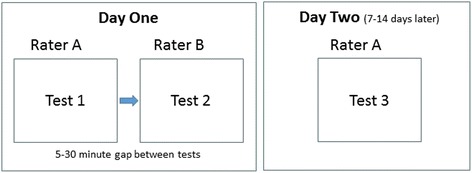
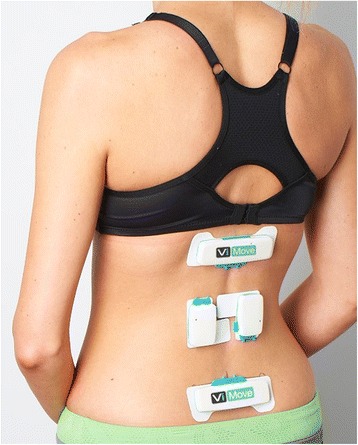
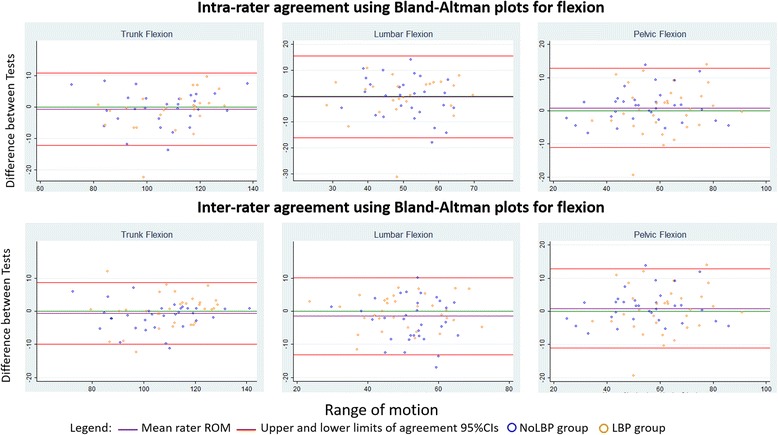
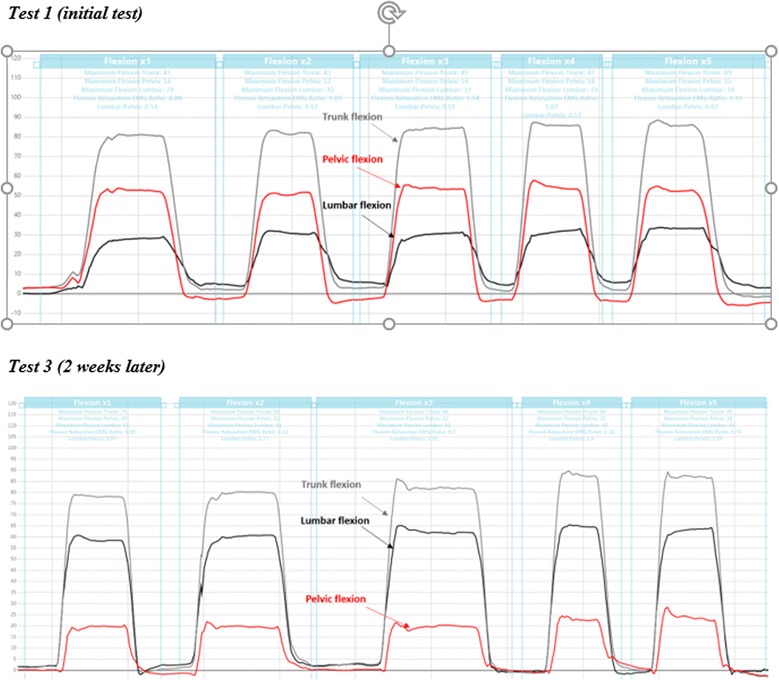
Methods: Wireless, wearable, inertial measurement units measured lumbar lordosis angle, range of movement (ROM) and lumbo-pelvic rhythm in adults (n = 63). Measurements were taken on three separate occasions: two tests on the same day with different raters and a third (intra-rater) test one to two weeks later. Participants performed five repetitions of tested postures or movements. Test data were captured automatically. Minimal detectable change scores (MDC90) provided estimates of between-test consistency.
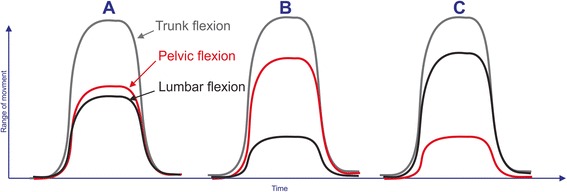
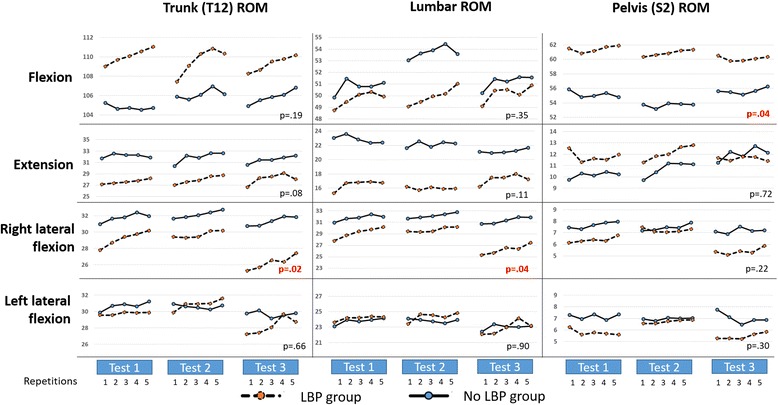
Results: There was no significant difference between participants with and without LBP for lordosis angle. There were significant differences for pelvic flexion ROM (LBP 60.8°, NoLBP 54.8°, F(1,63) = 4.31, p = 0.04), lumbar right lateral flexion ROM (LBP 22.2°, NoLBP 24.6° F(1,63) = 4.48, p = .04), trunk right lateral flexion ROM (LBP 28.4°, NoLBP 31.7°, F(1,63) = 5.9, p = .02) and lumbar contribution to lumbo-pelvic rhythm in the LBP group (LBP 45.8 %, F(1,63) = 4.20, NoLBP 51.3 % p = .044). MDC90 estimates for intra and inter-rater comparisons were 10°-15° for lumbar lordosis, and 5°-15° for most ROM. For lumbo-pelvic rhythm, we found 8-15 % variation in lumbar contribution to flexion and lateral flexion and 36-56 % variation in extension. Good to excellent agreement (reliability) was seen between raters (mean r = .88, ICC (2,2)).
Conclusion: Comparisons of ROM between people with and without LBP showed few differences between groups, with reduced relative lumbar contribution to trunk flexion. There was no difference between groups for lordosis. Wide, within-group differences were seen for both groups for ROM and lordosis. Due to variability between test occasions, changes would need to exceed 10°-15° for lumbar lordosis, 5°-15° for ROM components, and 8-15 % of lumbar contribution to lumbo-pelvic rhythm, to have 90 % confidence that movements had actually changed. Lordosis, range of movement and lumbo-pelvic rhythm typically demonstrate variability between same-day and different-day tests. This variability needs to be considered when interpreting posture and movement changes.
Keywords: Lordosis; Low back pain; Lumbo-pelvic rhythm; Movement disorders; Posture; ROM; Reliability.
Figures
Similar articles
-
Does movement matter in people with back pain? Investigating 'atypical' lumbo-pelvic kinematics in people with and without back pain using wireless movement sensors.BMC Musculoskelet Disord. 2019 Jan 18;20(1):28. doi: 10.1186/s12891-018-2387-x. BMC Musculoskelet Disord. 2019. PMID: 30658610 Free PMC article.
-
Subgroups of lumbo-pelvic flexion kinematics are present in people with and without persistent low back pain.BMC Musculoskelet Disord. 2018 Aug 28;19(1):309. doi: 10.1186/s12891-018-2233-1. BMC Musculoskelet Disord. 2018. PMID: 30153815 Free PMC article.
-
Sex-specific trunk movement coordination in participants with low-back pain and asymptomatic controls.Front Sports Act Living. 2025 Apr 1;7:1524489. doi: 10.3389/fspor.2025.1524489. eCollection 2025. Front Sports Act Living. 2025. PMID: 40235462 Free PMC article.
-
Psychometric Properties of the iHandy Level Smartphone Application for Measuring Lumbar Spine Range of Motion and Lordosis: A Systematic Review of the Literature.J Sport Rehabil. 2020 Mar 1;29(3):352-359. doi: 10.1123/jsr.2018-0354. J Sport Rehabil. 2020. PMID: 30860415
-
Postural asymmetry in low back pain - a systematic review and meta-analysis of observational studies.Disabil Rehabil. 2025 Apr;47(7):1659-1676. doi: 10.1080/09638288.2024.2385070. Epub 2024 Aug 21. Disabil Rehabil. 2025. PMID: 39166267
Cited by
-
Physical Abilities in Low Back Pain Patients: A Cross-Sectional Study with Exploratory Comparison of Patient Subgroups.Life (Basel). 2021 Mar 10;11(3):226. doi: 10.3390/life11030226. Life (Basel). 2021. PMID: 33802214 Free PMC article.
-
Predictors of instanteous relief from spinal manipulation for non-specific low back pain: a delphi study.Chiropr Man Therap. 2020 Jul 2;28(1):39. doi: 10.1186/s12998-020-00324-7. Chiropr Man Therap. 2020. PMID: 32611351 Free PMC article.
-
Finger-Floor Distance Is Not a Valid Parameter for the Assessment of Lumbar Mobility.Diagnostics (Basel). 2023 Feb 8;13(4):638. doi: 10.3390/diagnostics13040638. Diagnostics (Basel). 2023. PMID: 36832125 Free PMC article.
-
Effects of Sensorimotor Training on Transversus Abdominis Activation in Chronic Low Back Pain Patients.J Pers Med. 2023 May 11;13(5):817. doi: 10.3390/jpm13050817. J Pers Med. 2023. PMID: 37240987 Free PMC article.
-
Towards the Real-World Analysis of Lumbar Spine Standing Posture in Individuals with Low Back Pain: A Cross-Sectional Observational Study.Sensors (Basel). 2025 May 9;25(10):2983. doi: 10.3390/s25102983. Sensors (Basel). 2025. PMID: 40431778 Free PMC article.
References
-
- Vos T, Flaxman AD, Naghavi M, Lozano R, Michaud C, Ezzati M, Shibuya K, Salomon JA, Abdalla S, Aboyans V, et al. Years lived with disability (YLDs) for 1160 sequelae of 289 diseases and injuries 1990–2010: a systematic analysis for the Global Burden of Disease Study 2010. Lancet. 2012;380(9859):2163–96. doi: 10.1016/S0140-6736(12)61729-2. - DOI - PMC - PubMed
LinkOut - more resources
Full Text Sources
Other Literature Sources
Miscellaneous
