Carbapenem-resistant Enterobacteriaceae: Prevalence and Risk Factors in a Single Community-Based Hospital in Korea
- PMID: 27659436
- PMCID: PMC5047997
- DOI: 10.3947/ic.2016.48.3.166
Carbapenem-resistant Enterobacteriaceae: Prevalence and Risk Factors in a Single Community-Based Hospital in Korea
Erratum in
-
Erratum: Carbapenem-Resistant Enterobacteriaceae: Prevalence and Risk Factors in a Single Community-Based Hospital in Korea.Infect Chemother. 2019 Dec;51(4):435-438. doi: 10.3947/ic.2019.51.4.435. Infect Chemother. 2019. PMID: 31898429 Free PMC article.
Abstract
Background: Carbapenemase-producing Enterobacteriaceae (CPE) are Gram-negative bacteria with increasing prevalence of infection worldwide. In Korea, 25 cases of CPE isolates were reported by the Korea Centers for Disease Control and Prevention in 2011. Most CPE cases were detected mainly at tertiary referral hospitals. We analyzed the prevalence and risk factors for carbapenem-resistant Enterobacteriaceae (CRE) in a mid-sized community-based hospital in Korea.
Materials and methods: We retrospectively analyzed all consecutive episodes of Enterobacteriaceae in a mid-sized community-based hospital from January 2013 to February 2014. CRE was defined as organisms of Enterobacteriaceae showing decreased susceptibility to carbapenems. Risk factors for CRE were evaluated by a case-double control design. Carbapenemase was confirmed for CRE using a combined disc test.
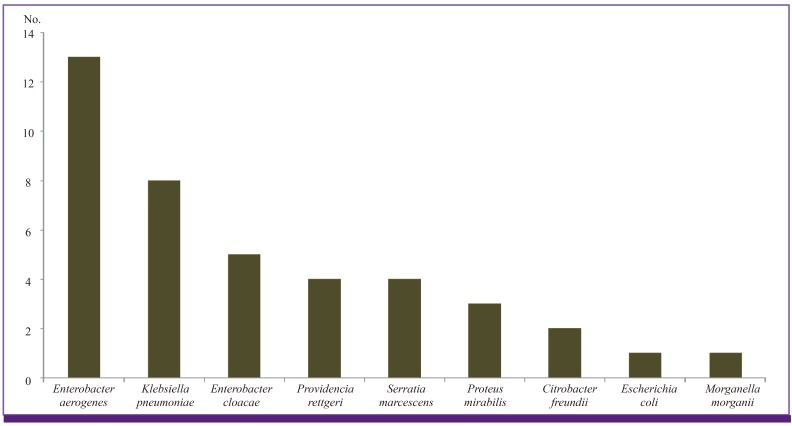
Results: During 229,710 patient-days, 2,510 Enterobacteriaceae isolates were obtained. A total of 41 (1.6%) CRE isolates were enrolled in the study period. Thirteen species (31.7%) were Enterobacter aerogenes, 8 (19.5%) Klebsiella pneumoniae, 5 (12.2%) Enterobacter cloacae, and 15 other species of Enterobacteriaceae, respectively. Among the 41 isolates, only one (2.4%) E. aerogenes isolate belonged to CPE. For evaluation of risk factors, a total of 111 patients were enrolled and this included 37 patients in the CRE group, 37 in control group I (identical species), and 37 in control group II (different species). Based on multivariate analysis, regularly visiting the outpatient clinic was a risk factor for CRE acquisition in the control group I (P = 0.003), while vascular catheter and Charlson comorbidity index score ≥ 3 were risk factors in control group II (P = 0.010 and 0.011, each). Patients with CRE were more likely to experience a reduced level of consciousness, use a vasopressor, be under intensive care, and suffer from acute kidney injury. However, CRE was not an independent predictor of mortality compared with both control groups.
Conclusion: In conclusion, the prevalence of CRE was higher than expected in a mid-sized community-based hospital in Korea. CRE should be considered when patients have a vascular catheter, high comorbidity score, and regular visits to the outpatient clinic. This study suggests the need for appropriate prevention efforts and constant attention to CRE infection control in a mid-sized community-based hospital.
Keywords: Carbapenems; Drug resistance; Enterobacteriaceae; Prevalence; Risk factors.
Conflict of interest statement
No conflicts of interest.
Figures
References
-
- Kaniga K, Flamm R, Tong SY, Lee M, Friedland I, Redman R. Worldwide experience with the use of doripenem against extended-spectrum-β-lactamase-producing and ciprofloxacin-resistant Enterobacteriaceae: analysis of six phase 3 clinical studies. Antimicrob Agents Chemother. 2010;54:2119–2124. - PMC - PubMed
LinkOut - more resources
Full Text Sources
Other Literature Sources
Research Materials
Miscellaneous